08 May 2014

Butterflies Galore! : Pale Grass Blue

Butterflies Galore!
The Pale Grass Blue (Zizeeria maha serica)


This species was first discovered by veteran ButterflyCircle member Steven Neo in 2001. Photographs that were sent to Col Eliot in 2003 were verified by him that this the taxon Zizeeria maha serica which originates from Hong Kong. The Pale Grass Blue may have hitched a ride into Singapore via horticultural material imported from the region. The caterpillar host plant of this species is the Yellow Wood Sorrell (Oxalis corniculata). The full life history is recorded here.

The Pale Grass Blue is often confused with the two local Grass Blue species - the Lesser Grass Blue and the Pygmy Grass Blue. However, when a shot of the three species is available, identification is usually not a problem. The underside markings of the Pale Grass Blue are more pronounced and darker. Males are a light blue on the upperside whilst females are a greyish blue. This shot was taken by young ButterflyCircle member Jonathan Soong in his urban garden.

06 May 2014

Butterflies Galore! : Chocolate Albatross

Butterflies Galore!
The Chocolate Albatross (Appias lyncida vasava)


The Chocolate Albatross is a fast-flying Pierid that has been recorded in Singapore as a rare seasonal migrant.  At this point in time, it has not established a resident colony in Singapore yet, but the species is regularly sighted almost every year during the peak butterfly season in the region. In Malaysia, the species is common and can even be described as abundant during certain times of the year.

This year, in 2014, there have been more sightings of this species in many locations around the island - from urban areas to nature reserves. Many males and females have been sighted over the past weeks in late March and April. Eggs of the Chocolate Albatross have also been observed on its host plant - Crateva religiosa at an urban park. Are we observing the beginnings of the naturalisation of this species in Singapore? We'll have to wait and see. This shot of a male Chocolate Albatross was taken by ButterflyCircle member Koh CH last weekend.

03 May 2014

Life History of the Besta Palm Dart

Life History of the Besta Palm Dart (Telicota besta bina)


Butterfly Biodata:
Genus: Telicota Moore, 1881
Species: besta Evans, 1949
Sub-species: bina Evans, 1949
Wingspan of Adult Butterfly: 39-48mm
Caterpillar Local Host Plants: Ischaemum muticum (Poaceae; common name: Seashore Centipede Grass), Scleria bancana (Cyperaceae; common name: Winged Scleria).


A female Besta Palm Dart.

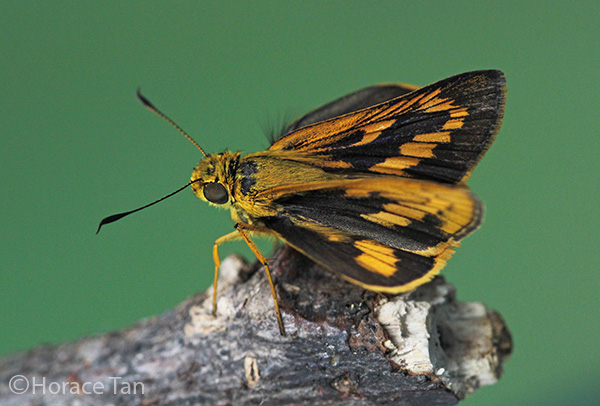
A male Besta Palm Dart.

A view of the upperside of a male Besta Palm Dart, showing the male brand.

Physical Description of Adult Butterfly:
On the upperside, the wings are black with an orange post-discal band on the forewing running from the dorsum and bent over at vein 6 to continue along the costal margin. The orange-yellow post-discal band on the hindwing runs from vein 1b to space 6. The veins crossing the orange-yellow bands on both wings are black-dusted. The male has a grey brand from about the middle of vein 1b to vein 4 on the forewing. The brand is located nearer to the inner edge of the black discal fascia than to tis outer edge. On the underside, the wings are ochreous with post-discal bands outlined with black. The female is greenish ochreous on the hindwing.

A female Besta Palm Dart.

A view of the upperside of a female Besta Palm Dart.


Field Observations of Butterfly Behaviour:
The Besta Palm Dart is moderately common in Singapore. The adults are strong flyers and are typically sighted along the forest edge amongst the grassy undergrowth. The swift flying adults have been observed to visit flowers and sunbath with open-wings in sunny weather.


Early Stages:
Locally in Singapore, Besta Palm Dart has thus far been observed to utilize a common grass species, Ottochloa nodosa, and a moderately common sedge species Scleria bancana as larval food plants. The caterpillars feed on leaves of the host plant in all instars and live in leaf shelters. As the caterpillar grows in size through progressing instars, it migrates to ever larger shelters constructed by joining cut leaf fragments or the opposite edges of a single blade.

Local host plant #1: Ischaemum muticum.

Local host plant #2: Scleria bancana.

A leaf shelter of the Besta Palm Dart observed in the field.

The eggs are laid singly on a leaf blade of the host plant, typically on the underside. Each dome-shaped egg is creamy white and appears to be smooth to the naked eyes. A closer inspection reveals numerous short, discontinuous and irregular tiny ridges running in a longitudinal direction. Each egg has a diameter of about 1.1mm.

An egg of the Besta Palm Dart laid on the underside of a leaf blade.

Two views of an egg of the Besta Palm Dart, diameter: 1.1mm.

It takes about 4 days for the egg to hatch. The young caterpillar eats just enough of the shell to emerge, and then immediately proceeds to finish the remaining egg shell. The newly hatched has a length of about 2.9mm. Its pale yellowish body is cylindrical in shape with a small number of very short and tiny dorso-lateral and lateral setae. There is a tuff of long setae on the posterior segment. It has a black head and a black collar on the prothorax

Two views of a mature egg with a portion of the egg shell already eaten.

Two views of a newly hatched caterpillar eating its egg shell.

Two views of a 1st instar caterpillar, early in this intar, length: 2.9mm.

After consuming the egg shell, the newly hatched caterpillar constructs its first leaf shelter,  typically at the tip of a leaf blade. The body takes on a dark undertone after a few feeding sessions on the leaf. The 1st instar takes a total of 4 days to complete with body length reaching about 6mm.

Two views of a 1st instar caterpillar, length: 4.8mm.

A late 1st instar caterpillar, dormant prior to its moult, length: 5.8mm.

The body of the 2nd instar caterpillar resembles that of the first instar, but with the dark collar on the prothorax now vaguely present. The setae at the posterior end are now proportionately shorter and the anal plate takes on a greyish coloration. The body colour is mainly yellowish green with a dark green undertone. This instar lasts about 4 days with the body length reaching up to 10mm.

Two views of a 2nd instar caterpillar, early in this stage.

Two views of a 2nd instar caterpillar, length: 7.8mm.

The 3nd instar caterpillar resembles the 2nd instar caterpillar except for a more yellowish green body colour and the nearly indistinguishable collar mark on the prothorax. In contrast, the anal plate is now marked prominently in black. This instar lasts a total of 3-4 days with the body length reaching about 15mm.

Two views of a 3rd instar caterpillar, early in this stage, length: 9.8mm.

Two views of a 3rd instar caterpillar, length: 11mm.

Two views of a late 3rd instar caterpillar, dormant prior to its moult, length: 14.5mm.

The 4th instar caterpillar resembles the 3rd instar caterpillar closely. In some specimens, the head capsule has pale grey or brown lateral patches which are rather indistinct. This instar lasts 5-6 days with the body length reaching about 23-24mm.

Two views of a newly moulted 4th instar caterpillar.

Two views of a 4th instar caterpillar, length: 20mm.

Two views of a late 4th instar caterpillar, dormant prior to its moult, length: 23mm.

The 5th instar brings along a prominent change in the head capsule which now has two large pale brown lateral patches separated by dark band lining the epicranial suture. The body is now predominantly yellow with a a green undertone. The black marking on the anal plate has been observed to vary in size and shape among different specimens.

A newly moulted 5th instar caterpillar, length: 21.5mm.

Two views of a male 5th instar caterpillar, length: 26.5mm.

The 5th instar takes about 10-11 days to complete with the body length reaching up to 34-36mm, In the last day of this instar, the body gradually shorten and changes colour to beige purplish brown. The caterpillar ceases feeding and whitish powdery substance begin to appear on its ventrum. Next it proceeds to seal the shelter it is in with silk threads. Soon the caterpillar becomes dormant in this pupation shelter. This prepupatory phase lasts for about 1 day.

Two views of a 5th instar caterpillar, late in this stage, length: 31mm.

A pupation shelter opened to reveal  a pre-pupa of The Besta Palm Dart.

Pupation takes place within the leaf shelter. The pupa does not have a cremastral attachment nor a silk girdle and it is mainly secured with tightly woven silk threads in the shelter. It has a short thorax, a rather long abdomen, and a few tuffs of setae at the anterior segment. The body is dark brown in the thorax and wing pad areas, but orangy brown in the abdomen. Length of pupae: 22-23mm.

Two views of a pupa of the Besta Palm Dart, length:22mm.

Close up views of the anterior end of a pupa of the Besta Palm Dart.

After 9 days, the pupa becomes dark brown with the thorax and wing pads mostly black. The orange markings present on the forewing upperside are now visible through the now translucent pupal skin. Eclosion takes place the next day.

Two views of a mature pupa of the Besta Palm Dart.

A newly eclosed Besta Palm Dart.

References:
  • [C&P4] The Butterflies of The Malay Peninsula, A.S. Corbet and H.M. Pendlebury, 4th Edition, Malayan Nature Society, 1992.
  • Butterflies of Thailand, Pisuth Ek-Amnuay, 2nd Edition, 2012.
  • A Field Guide to the Butterflies of Singapore, Khew S.K., Ink On Paper Communications, 2010.
Text and Photos by Horace Tan.

26 April 2014

New Butterfly Book Launched!

New Butterfly Book Launched
"Butterflies of Peninsular Malaysia, Singapore & Thailand"


ButterflyCircle members with Dr Kirton

Dr Laurence G Kirton's latest book in the Naturalist's Guide series, entitled "Butterflies of Peninsular Malaysia, Singapore and Thailand" was finally launched on 24 Apr 2014. We had earlier had a sneak peek at the book which started some time back in 2011.


After some months of planning for the launch, which included inviting the intrepid Prof Leo Tan to be the Guest of Honour, deciding on the venue and guest list, the book launch finally happened at 5pm at the Education Room at Singapore's latest garden attraction, the Gardens by the Bay.


Dr & Mrs Kirton at the tulip display, Flower Dome

Pansing Distribution Pte Ltd, the Singapore based distributor of John Beaufoy's books, was the organiser and sponsor of the book launch. The day started with a delicious lunch at the Peach Garden Restaurant with Leslie Lim (of Pansing), John Beaufoy, Dr and Mrs Kirton and me. It was a pity that Ken Scriven was unwell and did not manage to make the trip to Singapore from the UK.


An overview of the Flower Dome

It was nice catching up with old friends, especially with Laurence and his wife, who last visited Singapore to give a talk to ButterflyCircle in 2009. After lunch, we took the opportunity to visit the Flower Dome and Cloud Forest conservatories. As with many first-time visitors to GB, our guests were wowed by the botanical display in the airconditioned domes. The current display in the Flower Dome featured 50,000 tulips that were air-flown all the way from their native home in the Netherlands.


All too soon, it was nearly 4pm and Leslie herded the group out of the domes to prepare for the launch and arrival of the guests to the book launch. It was a gathering of "greenies" and old friends as the guests started streaming in. Amongst the prominent conservationists and environmental champions were people like Ria Tan, Subaraj, Joseph Koh, Prof Peter Ng, Geoff Davison, Lena Chan, Grant Pereira, Dr Wee Yeow Chin and many others. We also had many overseas guests like Joseph Goh and his team from the Penang Butterfly Farm and Gary Ruben who made the trip all the way from Langkawi.


Our Minister of State for National Development, Desmond Lee turned up to give his full support for the event. Prof Leo Tan, always energetic and with a warm smile, was mingling amongst old friends in the Education Room. ButterflyCircle members turned up in full force, as a total of 25 members from Malaysia, Singapore and Thailand contributed about 75% of the photographs in Dr Kirton's book. A group from the Tampines-Changkat Butterfly Interest Group also turned up to support the event.


John Beaufoy gives his speech

After a welcome speech by Leslie, who reminded everyone that the launch was meant to be an informal one, and everyone should relax and have a good time, the publisher John Beaufoy, gave an anecdote-filled speech about how the book came into being.


Prof Leo Tan, our Guest of Honour, sharing his anecdotes about butterflies

Our Guest of Honour, Prof Leo Tan, always an accomplished orator at such events, captured the audience with his interesting experiences and peppered his speech with his wit and humour.


Dr Kirton presenting some interesting facts about butterflies of Southeast Asia, and the attentive audience

Dr Kirton then had his moment, as he shared his story of how the book came about. It was an interesting presentation about the butterfly species in the three South East Asian countries. Dr Kirton also shared the rationale for the retention or changes to the taxonomic naming, and more interestingly how he arrived at the common names for the featured butterflies in his book.


Whilst the Latin taxonomic names are generally used by scientists and entomologists and generated less controversy, the English Common Names often varied from country to country, and many species are referred to by more than one common name, or conversely, one common name may be used for two different species. Dr Kirton explained his criteria and rationale for the changing of, or retaining some common names of butterflies.


Dr Kirton autographing his book for his fans, who queued up patiently for their turn

After his presentation, the audience quickly queued up as Dr Kirton obliged by autographing his book. It must have been hard work for him, as he carefully penned personalised messages to his fans. It was a fun time of chatting and catching up with friends and making new ones, and the organisers, Pansing Distribution threw in a mouth-watering buffet to boot.


All in all, it was a very fun and successful book launch, and everyone went home happy, holding on to the latest book on butterflies in the region.

Text by Khew SK : Photography by Huang CJ, Anthony Wong & Khew SK

Special appreciation and thanks to :

  • John Beaufoy Publishing
  • Dr & Mrs Laurence G Kirton
  • Pansing Distribution Pte Ltd - especially to Leslie, Sasha and Samantha for the liaison work and sponsorship of the event
  • Gardens by the Bay - for the complimentary use of the Education Room for the launch - especially to Dr Tan Wee Kiat, Kenneth Er and Ms Peggy Chong
  • Guest of Honour, Prof Leo Tan
  • Minister of State (National Devt) Desmond Lee for joining in the fun
  • ButterflyCircle members who turned up in full force to support the event
  • Friends and guests who shared the wonderful evening with us