13 March 2014

Butterflies Galore! : Suffused Flash

Butterflies Galore!
The Suffused Flash (Rapala suffusa barthema)


This fast-flying "Flash" is one of six species of the genus Rapala that is currently extant in Singapore. The Suffused Flash has a wide distribution, and can be found in urban parks, forested areas and back-mangrove habitats in Singapore. The male is orange-red above with broad black borders, whilst the female is a drab brown and unmarked. The underside is ochreous to pale buff brown, but can be distinctly yellow in some females.

The species is moderately common and in its preferred habitats, several individuals have been observed together e.g. Sg Buloh Wetland Reserve. Amongst the host plants that its caterpillars feed on are Talipariti tiliaceum (Sea Hibiscus) and Falcataria moluccana (Albizia). Its early stages have been recorded here. This female Suffused Flash was shot by ButterflyCircle member Sunny Chir.

12 March 2014

Butterflies Galore! : Studded Sergeant

Butterflies Galore!
The Studded Sergeant (Athyma asura idita)


Amongst the five extant "Sergeants" in Singapore, the Studded Sergeant is the largest member of the genus. A typically forest-dependent species, the Studded Sergeant is usually observed singly. Like its other cousins, it is usually observed gliding around a few favourite perches, stopping with its wings folded upright, or opened flat when sunbathing. Males are sometimes encountered puddling at damp forest paths and sandy streambanks.

It is the only species that has "studs" or black spots within the series of post-discal white band on the hindwings. The early stages of the Studded Sergeant has been recorded on Ilex cymosa and documented in detail here. This individual, showing its ochreous brown undersides, was shot by ButterflyCircle member Nelson Ong.

11 March 2014

Butterflies Galore! : Grand Imperial

Butterflies Galore!
The Grand Imperial (Neocheritra amrita amrita)


This long-tailed Lycaenid is considered a rare butterfly in Singapore and is not regularly encountered. It is one of the largest Lycaenid butterflies in Singapore and sports the longest tails amongst all the "Imperials" found here. Interestingly, this species is quite common on the offshore military island of Pulau Tekong where several individuals can be observed at their favourite locations on the island. It is a forest-dependent species and is usually encountered in the shaded forests within the nature reserves.

The male Grand Imperial is a royal blue on the upperside with black apical borders. The female is dark brown above with a prominent white tornal area on the hindwing. The underside of the forewing and the costal half of the hindwing are brownish-orange and the rest of the hindwing is pure white.

08 March 2014

Life History of the Starry Bob

Life History of the Starry Bob (Iambrix stellifer)


Butterfly Biodata:
Genus: Iambrix Watson, 1893
Species: stellifer Butler, 1879
Wingspan of Adult Butterfly: 18-22mm
Caterpillar Local Host Plants: Centotheca lappacea (Poaceae, common name: Sefa), Lophatherum gracile (Poaceae).


Physical Description of Adult Butterfly:
The adults are small and the 3rd segment of the palpi is long and thin. On the upperside, both sexes are dark brown. The male is unmarked but the female has several white post-discal spots on the forewing. On the underside, the wings are brown to dark brown overlaid with ochreous scales. The apical area of the forewing is yellowish to yellowish brown. There are variable number of silvery spots on both wings. In fully-spotted specimens, the forewing features post-discal spots in spaces 2-5 and one spot near cell-end, and the hindwing features post-discal spots in spaces 1b, 2, 5 and 7, and one spot near cell-end. Noteworthy is that the spot in space 5 on the hindwing lies further out and about half way between cell-end and the wing margin. In the look alike species Iambrix salsala (Starry Bob), this spot lies just beyond the cell.


Field Observations of Butterfly Behaviour:
Starry Bob is moderately rare in Singapore and is typically found in forested ares in the nature reserves and western wastelands. Within the nature reserve, the adults are usually sighted when they are feeding on flowers of Leea indica in the company of other skippers such as the Yellow Vein Lancer. The adults tend to perch in shady foliage and are rarely sighted puddling on wet ground or organic waste matter.

06 March 2014

Butterflies Galore! : Blue Jay

Butterflies Galore! 
The Blue Jay (Graphium evemon eventus)


This fast-flying Papilionidae butterfly is common in Singapore. However, it is a forest-dependent species and rarely found in urban parks and gardens. It often puddles in the company of other species in the family, like the Common Bluebottle, Five Bar Swordtail and Tailed Jay. It is fast flying, skittish but males can often be found puddling at damp streambanks or forest paths. This puddling Blue Jay was shot by ButterflyCircle member Huang CJ in the nature reserves.

The upperside features a blue macular band with broad black borders on both wings. There is a series of blue submarginal spots on both wings. The underside is silvery blue and there is a series of red tornal spots on the hindwing. The black costal bar on the underside of the hindwing, is conjoined with the black basal bar, and this distinguishes the Blue Jay from the several other lookalikes in the genus.

05 March 2014

Butterflies Galore! : Formosan Swift

Butterflies Galore!
The Formosan Swift (Borbo cinnara)


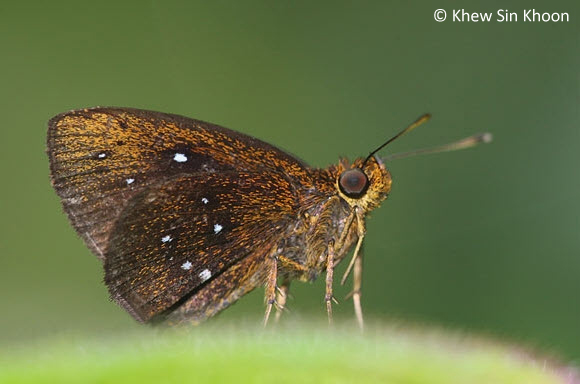
This predominantly brown and rather drab skipper is one of many lookalikes amongst the Hesperiidae family that is frustrating to identify in the field. Skippers are often mistaken to be moths by the general public, and understandably so, due to these butterflies' large eyes, fat bodies and usually unattractive colours. In Singapore, there are likely to be more species that will be added to the checklist as research continues into their early stages and other aspects of distinguishing the many similar-looking butterflies.

This Formosan Swift was shot in the early morning hours whilst it was busy feeding on the flowers of Bidens pilosa, a wild-growing weed in wastelands. The typical colouration of this skipper, light brown with a slight greenish scaling, and the absence of a cell spot on the hindwing below, sets it apart from its close cousins in the Pelopidas and Polytremis genera. The butterfly is relatively common in urban areas, but can also be found in the forested fringes of our nature reserves.

04 March 2014

Butterflies Galore! : Great Helen

Butterflies Galore!
The Great Helen (Papilio iswara iswara)


The Great Helen has a wingspan of 130-140mm that matches and often exceeds that of the Great Mormon and Common Birdwing - two of the other large Papilionidae that occur in Singapore. A forest-dependent butterfly, the Great Helen is often seen flying erratically at tree top level in the nature reserves of Singapore. Its caterpillar host plant, Maclurodendron porteri, is probably a forest plant that is not found outside the nature reserves. The full life history of the Great Helen is recorded here.

After a period of active flying, the Great Helen is often observed to rest with its wings opened flat as is shown in the photo above. This species exhibits an example of "startle display" strategy. At rest with its wings opened flat, the butterfly's forewings conceal the white patches on the hindwings, making it appear totally black. But when startled, it flashes the white patch to 'dazzle' a would-be predator momentarily, giving it a precious moment to make good its escape.