25 February 2014

Butterflies Galore! : Starry Bob

Butterflies Galore!
The Starry Bob (Iambrix stellifer)


The Starry Bob (Iambrix stellifer) is a forest butterfly and is rarely seen in urban areas, unlike its close cousin and lookalike, the Chestnut Bob (Iambrix salsala salsala), which is more common and widely distributed. It can be distinguished from its more common relative by the spot on space 5 of the hindwing, which is placed midway between the cell end and the termen of the hindwing. The underside of the forewing apical area is also distinctly orange tinged in most individuals of the Starry Bob.

This shot of a newly eclosed Starry Bob taking a drink at a pool of water and its reflection makes an interesting composition. The orange background adds to the shot that ButterflyCircle member Nona Ooi managed to take on an outing in the nature reserves of Singapore.

22 February 2014

Life History of the Common Five Ring

Life History of Common Five Ring (Ypthima baldus newboldi)


Butterfly Biodata:
Genus: Ypthima Hübner, 1818
Species: baldus Fabricius, 1775
Subspecies: newboldi Distant, 1882
Wingspan of Adult Butterfly: 30-40mm
Caterpillar Local Host Plant: Axonopus compressus (Poaceae, common names: Wide-leaved Carpet Grass, Cow Grass).


The upperside view of a female Common Five Ring.

The upperside view of a male Common Five Ring.

Physical Description of Adult Butterfly:
On the upperside, the wings are dull brown with the female being paler in the ground colour in the distal halves of both wings. Both sexes have a large yellow-ringed ocellus in space 2 of the forewing, and two smaller and adjoined yellow-ringed ocelli in spaces 2 and 3 of the hindwing (with another ocellus in space 5 in some specimens). The male has a broad strip of greyish black brand in the forewing. On the underside, both wings are pale greyish to bluff brown against a whitish background, and are traversed by numerous fine dark brown striae. The forewing has a large, bi-pupilled, yellow-ringed subapical ocellus. The hindwing has five yellow-ringed ocelli in spaces 1b, 2, 3, 5 and 6. Some specimens might bear another small ocellus in space 4. The pair of ocelli in spaces 2 and 3 are large and adjoined, and the one in space 1b consists of two conjoined spots. The pair of ocelli in spaces 5 and 6 are typically adjoined, with the one in space 5 larger than the one in space 6.


Field Observations of Butterfly Behaviour:
The Common Five Ring is moderately common in Singapore,and are more commonly observed in the Southern Ridges. Adults are typically sighted flying low among vegetation in and around grassy patches. As with other Satyrinae members, the adults fly in an erratic and jerky manner. The adults visits flowers for nectar and sun-bathe with fully opened wings in sunny conditions.


20 February 2014

Butterflies Galore! : Ancyra Blue

Butterflies Galore!
The Ancyra Blue (Catopyrops ancyra)


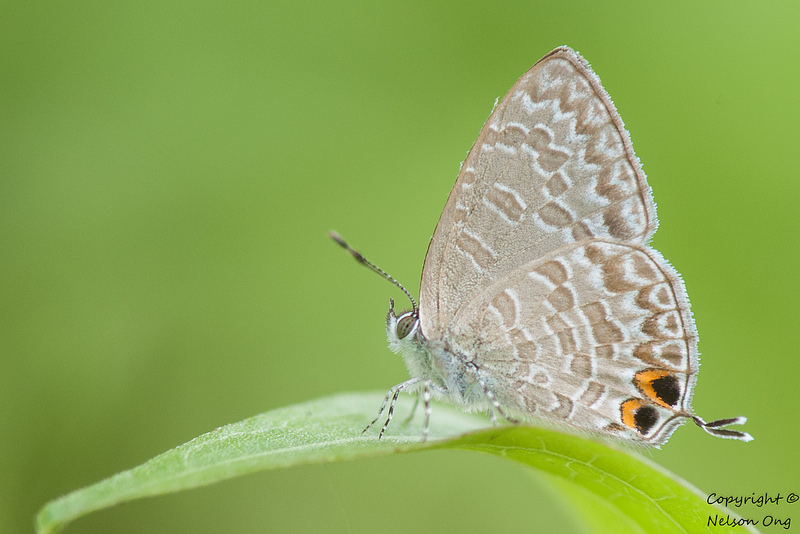
The Ancyra Blue was a new discovery for Singapore when it was first encountered on Pulau Ubin some time ago in June 2005. Since then, this species has been quite widespread in Singapore, from urban parks to the nature reserves. Like many of the Lycaenidae, it is a rapid flyer, often flying erratically amongst shrubbery, and resting with its wings folded upright on the tops of leaves.

The shot was taken by ButterflyCircle member Nelson Ong at a wasteland site in the western part of Singapore. The species has characteristic thick striations on the undersides of the wings and if observed at rest, is quite easily to distinguish from the similar-looking species in the family. Its caterpillars feed on two local host plants and the life history has been recorded here.

19 February 2014

Butterflies Galore! : Yellow Chequered Lancer

Butterflies Galore!
The Yellow Chequered Lancer (Plastingia pellonia)


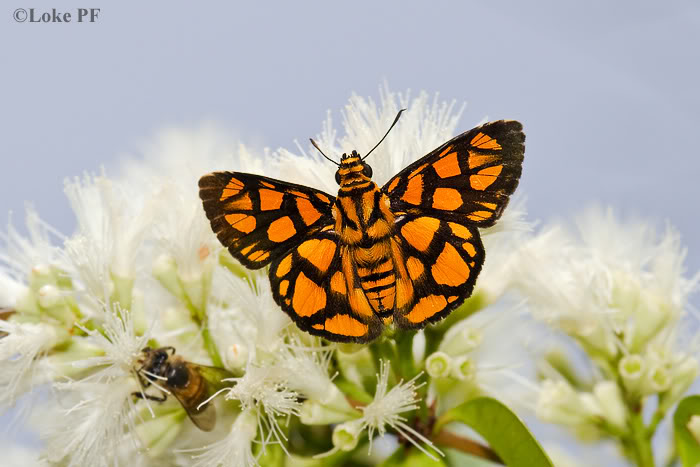
At a glance, this skipper looks very much like its more frequently-encountered cousin, the Chequered Lancer (Plastingia naga). However, a closer look at the colour of the spots will separate it easily. All the markings on the underside of the wings and its body are yellow instead of white.

The Yellow Chequered Lancer prefers shady forested areas in the nature reserves of Singapore. It is usually found perched on the top surface of a leaf, as was photographed here by ButterflyCircle member Loke PF. However, it can be skittish if disturbed and flies off rapidly. It tends to be affected by the camera's flash at times, jumping and flapping its wings whenever the flash goes off.

18 February 2014

Butterflies Galore! : Spotted Judy

Butterflies Galore! 
The Spotted Judy (Abisara geza niya)


The Riodinids, collectively called "Metalmarks" for the metallic spots of some of the species in the family, are quite unique in the way the butterflies fly around and twist and turn with half opened wings. A few of the members of this family have deep red wings with black spots and white streaks. They prefer dark shady habitats under the forest canopy.

The Spotted Judy is only moderately rare, and is quite local in its distribution, often occurring in certain preferred localities with regularity. Where found, several individuals can often be observed together. This Spotted Judy was photographed by ButterflyCircle member Sunny Chir.

15 February 2014

Butterfly of the Month - February 2014

Butterfly of the Month - February 2014
The Hieroglyphic Flat (Odina hieroglyphica ortina)


February 2014 heralded the Year of the Horse in the Chinese zodiac calendar. Unlike last year, when it was uncharacteristically wet for February, this year's weather was quite typical of the dry season, as the North East Monsoon winds waned and the rains that we experienced in the last few months of December 2013 suddenly dried up. Despite the cool north-easterly winds bringing temperatures to a low in early 2014, the exceptionally dry weather began to take its toll on the plants and greenery all around the island. Even in the forests, the leaf litter was particularly brittle and dry whilst the trees and shrubbery appeared limp and listless.


The National Environment Agency warned of imminent haze and poor air quality as the number of hotspots in neighbouring Indonesia increased alarmingly. Typical of the way the Indonesian farmers clear their agriculture land, it has been almost a yearly affair that the wanton burning of forests to clear land for farming will send plumes of choking smoke over to Malaysia and Singapore. The Indonesian authorities appear almost powerless to stop this pollution and environmental abuse as fires burn uncontrollably in their country.


I always wonder how much more of this can Mother Nature take, before she unleashes her wrath at those people who insist on destroying nature around them - solely for monetary gain and little else. We share this planet with the flora and fauna around us, and humans, being the most intelligent of all the creatures that inhabit our Earth, is by far also the greatest destroyers and consumers of our natural resources.


Over here in Singapore, the first two months of the year saw a curious number of unprecedented breakdowns in the MRT system. Some were reported to be due to "human error" and is some cause for concern, as the system has been running for so many years with very few breakdowns in the early years of the system, only to see "human errors" creeping into the operations? There appears to be some systemic issues that the SMRT needs to get a handle on these days before things get any worse.


A number of high profile fatal accidents at construction sites also plagued the industry. Usually, upon investigations, the conclusion is often that the accident could have been avoided, or prevented. Are contractors throwing caution to the wind as far as safety is concerned, for the sake of economic returns? Or is the pressure of ever-tighter deadlines and schedules forcing the workers to take short cuts just to speed up the work? Are developers imposing unrealistic deadlines on their projects, so that they can start getting returns on their investments?  Whatever the reasons are, when a worker dies at the site, someone, somewhere else in the world has lost a son, a father or a husband. Let us remind ourselves that it is not just a statistic on a piece of paper.


This month, we feature a Hesperiidae, commonly called Skippers from the subfamily Pyrginae, which are collectively called "Flats".  This subfamily features species that are robust-bodied, fast-flying butterflies that tend to stop with their wings opened flat, even when feeding or sunbathing. February's Butterfly of the Month is the Hieroglyphic Flat (Odina hieroglyphical ortina).  


Skippers are usually drab, brown coloured butterflies with large eyes and fat bodies. To the uninitiated, they are usually mistaken for moths. However, there are exceptions to these often unappreciated butterflies like the Hieroglyphic Flat, which are relatively more colourful and eye-catching. Over in South America, the Hesperiids are even more spectacular - with iridescent blues and long tails!


The male Hieroglyphic Flat has yellow-orange patches framed by thick black lines on both wings. Females are paler yellow and appear more faded in colour than the male. The underside markings are similar to the upperside, but often paler in colour. The abdomen is striped with black. There are obscure arrow-shaped marginal markings on the upperside of the forewings near the apical area.


This skipper is quite distinctive-looking and cannot be mistaken for any other butterfly species in Malaysia or Singapore. The cryptic patterns are reminiscent of the camouflage paintwork of a German Messerschmitt ME Bf 109 fighter plane in Hitler's desert campaign during World War II. I've often been asked what an ME Bf 109 with desert camouflage looks like, so here it is! Can you see the resemblance? But whether the Hieroglyphic Flat's colours provide it with any form of camouflage in our forests is debatable.


The Hieroglyphic Flat is a fast flyer and in some locations, two or more individuals are sometimes observed dog-fighting at the tree tops, vying for the best perch to sunbathe themselves. A common trait with most of the "Flat" species is that they will fly around rapidly, then perch on the undersides of leaves with their wings opened flat to rest or hide from intruders.


In the forests, the species is often observed puddling on bird droppings. It will repeatedly return to the bird dropping even when disturbed, and then feed greedily, giving a good opportunity to photograph it. It has occasionally been seen puddling at sandy streambanks and footpaths in the forests as well. The Hieroglyphic Flat has a wide distribution and can be seen at urban parks and gardens as well as in the forested nature reserves.


The early stages of this skipper has been recorded and documented here. The caterpillar host plant is Erycibe tomentosa, which is a woody climber and can locally be found on hedges, edges of forests and sides of forest trails, in areas such as the Central Catchment Area and Southern Ridges.


Text by Khew SK : Photos by Sunny Chir, Chng CK, Khew SK, Koh CH, Loke PF, Nelson Ong & Horace Tan


14 February 2014

Butterflies Galore! : Common Birdwing

Butterflies Galore!
The Common Birdwing (Troides helena cerberus)


The Common Birdwing is one of the Troides spp that is a CITES-protected species (the genus Troides is listed in Appendix II of protected species). Although it is not rare in South East Asia, and in locations where its caterpillar host plants are cultivated, the species can actually be common, the CITES protection is probably to protect this large and showy butterfly from being traded to extinction.

The Common Birdwing is a large and beautiful butterfly with its black and yellow wings. It is believed that the aposematic colouration is a display to predators that it is distasteful and should be avoided. Its caterpillar host plant is Aristolochia acuminata which this species shares with the Common Rose (Pachliopta aristolochiae asteris). Here, a male Common Birdwing is feeding on the nectar of the Hibiscus flower.