28 October 2013

Butterflies Galore! : Colonel

Butterflies Galore! 
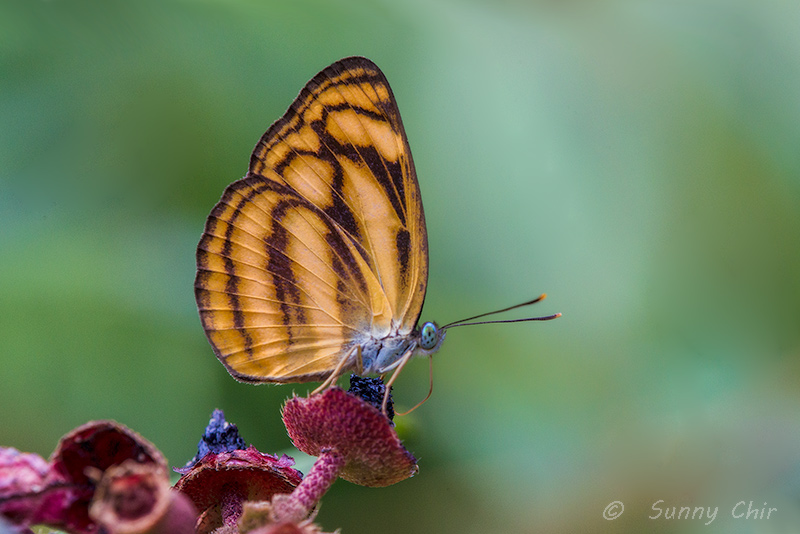
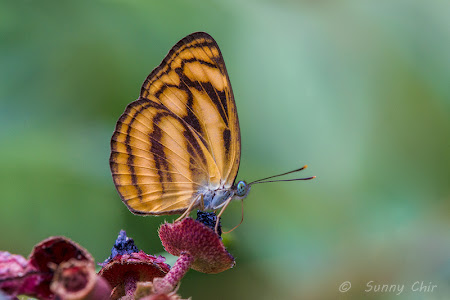
The Colonel (Pandita sinope sinope)


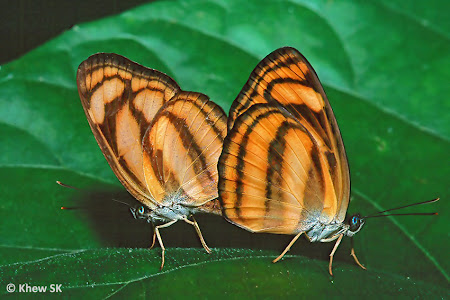
This skittish species is a moderately rare butterfly in Singapore, but can be seen in areas where its caterpillar host plant, Uncaria sp., is found. Usually found in forested areas, it can be approached much easier when it is feeding, particularly on the ripened fruits of the Singapore Rhododendron (Melastoma malabathricum). The wings of the Colonel are orange above with dark brown stripes and markings. The underside is paler orange but the basal area of the wings are a greenish grey.

This individual was shot whilst it was distracted when feeding. It is usually very alert and has a wide circle of fear. When alarmed it takes off to the treetops and perches in a safe location on the top of a leaf. Its life history has been fully recorded in Singapore and can be found here.

26 October 2013

Life History of the Orange Emigrant

Life History of the Orange Emigrant (Catopsilia scylla cornelia)


Butterfly Biodata:
Genus: Catopsilia Hübner, 1819
Species: scylla Linnaeus, 1763
Subspecies: cornelia Fabricius, 1787
Wingspan of Adult Butterfly: 50-60mm
Caterpillar Local Host Plant: Senna surattensis (Fabaceae).


An Orange Emigrant taking nectar from a flower.

A male Orange Emigrant displaying its upperside.

A close-up view of the head of an Orange Emigrant.

Physical Description of Adult Butterfly:
On the upperside, the forewing is white with a black border and the hindwing is deep chrome-yellow. In addition, the female has a black post-discal fascia on the forewing and a series of black marginal spots on the hindwing. On the underside, the wings are yellow with intermittent, faint brown post-discal spots. A brown ring marking can be found at the cell-end on both wings.

25 October 2013

Butterflies Galore! : Colour Sergeant

Butterflies Galore!
The Colour Sergeant (Athyma nefte subrata)


The Colour Sergeant has two female forms - f-neftina with orange and black bands, and f-subrata with brown and black bands. Of the two forms, f-neftina is the one that is more commonly encountered. The species is widely distributed in Singapore, and can be found in urban parks, although its preferred habitat is still the forested areas.

This shot, taken by veteran ButterflyCircle member Sunny Chir, shows a female f-neftina Colour Sergeant's upper wing surfaces. At certain opportune angles, an accomplished photographer can focus on the butterfly itself, and throw the background completely out of focus to enable the subject to stand out prominently, as shown in this shot.

24 October 2013

Butterflies Galore! : Purple Duke

Butterflies Galore!
The Purple Duke (Eulaceura osteria kumana)


Yesterday, we featured a female Purple Duke feeding on the ripened fruit of the Singapore Rhododendron (Melastoma malabathricum). Today's feature butterfly is yet another Purple Duke, but this time, it's a male , also feeding on the ripened fruit of the same plant. The species is common in Singapore, and at times, up to 6 or more individuals can be seen in a small patch of forest. Can you spot and compare the difference between the male and female of the species?

The Purple Duke has a propensity of flying rapidly for short distances and then settling on the underside of a leaf with its wings folded upright when it is disturbed. This behaviour is quite consistent with the regular sightings of this species. This shot was taken by ButterflyCircle member Huang CJ at the nature reserves last weekend.

23 October 2013

Butterflies Galore! : Purple Duke

Butterflies Galore!
The Purple Duke (Eulaceura osteria kumana)


The relative abundance of its caterpillar host plant, Gironniera nervosa in the forested areas of Singapore, coupled with the habitats that it prefers, could be the reasons why the Purple Duke is a common butterfly in Singapore. This forest-dependent species is seldom found outside the nature reserves. The species exhibits sexual dimorphism where the male and female appear quite different from each other.

Here is a shot of the female Purple Duke feeding on the ripened fruit of the Singapore Rhododendron (Melastoma malabathricum).  Note the long bright green proboscis probing into the fruit to get the much-needed nutrients. This shot was taken by ButterflyCircle member Loke PF.

22 October 2013

Butterflies Galore! : Grey Sailor

Butterflies Galore!
The Grey Sailor (Neptis leucoporos cresina)


The Grey Sailor is very much a forest-dependent species. Although seldom seen in urban parks and gardens, this species is fairly common in the forested nature reserves of Singapore. The caterpillar host plant, Gironniera nervosa, is not uncommon in forested areas, and is a plant which another species, the Purple Duke (Eulaceura osteria kumana)'s caterpillar also share as its host plant. The Grey Sailor features the typical black and white horizontal bands across both wings, typical of the genus Neptis. There are two lookalikes in Singapore - Short Banded Sailor and Common Sailor.

This shot of a sunbathing Grey Sailor was taken by ButterflyCircle member Anthony Wong at the nature reserves. The underside of the species is grey, and distinguishes it easily from the other two lookalikes mentioned above, which has orange-brown undersides.

20 October 2013

Butterfly of the Month - October 2013

Butterfly of the Month - October 2013
The Malayan Lascar (Lasippa tiga siaka)


It's the tenth month of the year 2013 already! Have you fulfilled that resolution that you promised to do at the beginning of this year? Did you plan to save up to complete your studies? Get that Masters thesis done? Or resolved to start that exercise regime that you have been putting aside for so long? It's still not too late. You have two more months to go!


2013 is also a significant year for the company that I work for.  This year, on 31 Oct, we will be celebrating the company's 180th anniversary!  Yup, you read that right, it's 180 years old this year. Our company's history can be traced back to the colonial times, right up to 1833 when the first Superintendent of Public Works/Convicts was appointed by the British colonial government in Singapore.  From then on, commenced the foundations of the infrastructural development upon which modern Singapore was built.  


In a Sunday Times article today, the headlines read "More than 100 butterfly species extinct". Yes, it's quite true. Reference material and checklists from two main books - Butterflies of the Malay Peninsula 3rd Edition (1978) and 4th Edition (1992) by Corbet & Pendlebury (and updated by Col John Eliot) and Butterflies of West Malaysia and Singapore by WA Fleming, 1st Edition, 1975 and 2nd Edition, 1983, indicated that there were 386 butterfly species found in Singapore.


Today, we have on record, 306 species, of which 37 were new records for Singapore.  Hence of the original 386 species, only 269 have been traced today, suggesting that at least 117 may have gone extinct from Singapore.  There are a few more species that are pending final identification that may bring the total Singapore checklist up to 310 or more, but these will be updated in a comprehensive revision at the end of this year.  Even so, the notion that "more than 100 species may have gone extinct" in Singapore is certainly not far-fetched.


Whilst strategies have been proposed for the regeneration and the recovery of urban butterfly biodiversity, it is also at the same time, important to conserve the central core of flora in Singapore. It is predicted that at least 60% of our butterfly species in Singapore is forest-dependent, and once the nature reserves are affected, the further loss of the forest species may be irreversible. On the urban front, species that are found in parks and gardens may be given a leg up with appropriate planting and creating urban habitats that are conducive for the these species to recover their numbers.
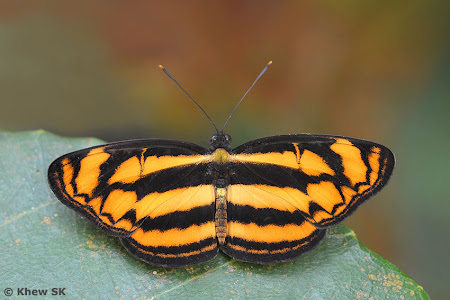


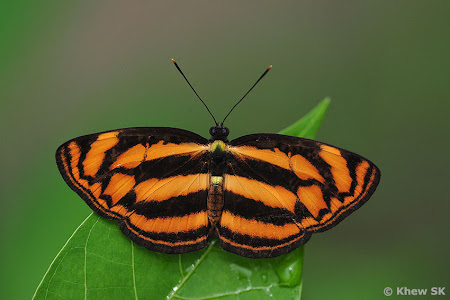
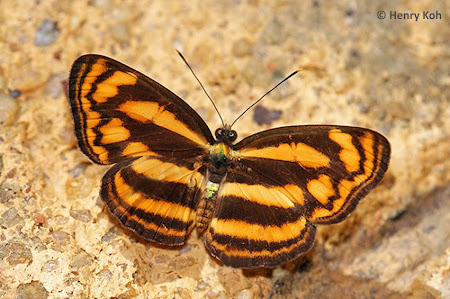
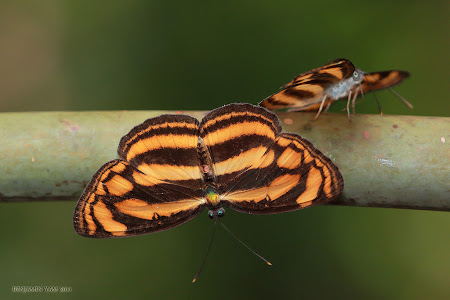
Our Butterfly for the month of October is the Malayan Lascar (Lasippa tiga siaka). This species one of four lookalike species found in Singapore that feature small. gliding butterflies with black and orange stripes across their wings. It is curious that its scientific name contains a Malay word "tiga", or "three" in it. Could it be because the author was making reference to the sub-marginal triangular spot in "space 3" of the forewing? This size of this spot is an important diagnostic feature that distinguishes it from the very similar looking Burmese Lascar.


The Malayan Lascar is widely distributed in Singapore and can be found in forested areas of the nature reserves, as well as in urban parks and gardens. Although the species has a weak gliding flight, it is skittish and alert, often frustrating many butterfly photographers who are tracking it. When alarmed, the butterfly often heads for the tree tops and perch on an inaccessible leaf, looking down at the unfortunate photographer whose effort to shoot it has been in vain!
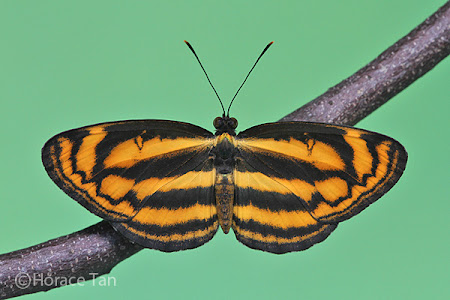


However, the Malayan Lascar is often encountered feeding on flowering trees like Syzygium or the ripened fruits of the Singapore Rhododendron (Melastoma malabathricum) where the butterfly will be quite distracted whilst feeding, giving the photographer a much better chance at taking a good shot of the butterfly.
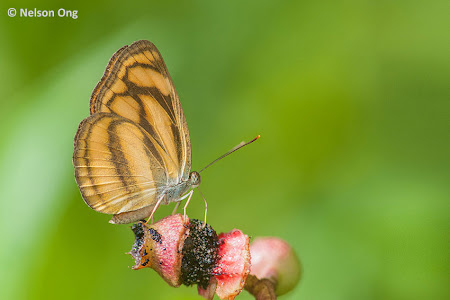


The upperside of the butterfly features the typical orange/black horizontal bands across both wings, whilst the undersides are a paler copy of the upperside wing patterns. The characteristic triangular orange spot in space 3 of the forewing above, which is wider (often twice as wide) as the adjacent spots in spaces 2 and 4, sets it apart from it close cousin, the Burmese Lascar (Lasippa heliodore dorelia).
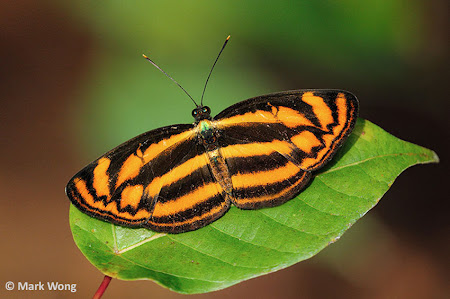


The Malayan Lascar is common, and sometimes several individuals can be observed at the same location, especially when they are feeding on flowers or ripened fruits. The species has also been observed puddling on damp sandy streambanks.


The early stages of the Malayan Lascar has been fully documented here. The caterpillars have been successfully bred on two species of host plants - Erycibe tomentosa (Convolvuaceae), Bauhinia semibifida (Leguminosae, Caesalpinodeae).


Text by Khew SK : Photos by Sunny Chir, Khew SK, Koh CH, Henry Koh, Horace Tan, Mark Wong, Billy Oh, Nelson Ong & Benjamin Yam.