12 October 2013

Life History of the Burmese Bush Brown

Life History of the Burmese Bush Brown (Mycalesis perseoides perseoides)


Butterfly Biodata:
Genus: Mycalesis Hübner, 1818
Species: perseoides Moore, 1892
Subspecies: perseoides Moore, 1892
Wingspan of Adult Butterfly: 40-50mm
Caterpillar Local Host Plants: Ottochloa nodosa (Poaceae), Ischaemum ciliare (Poaceae).

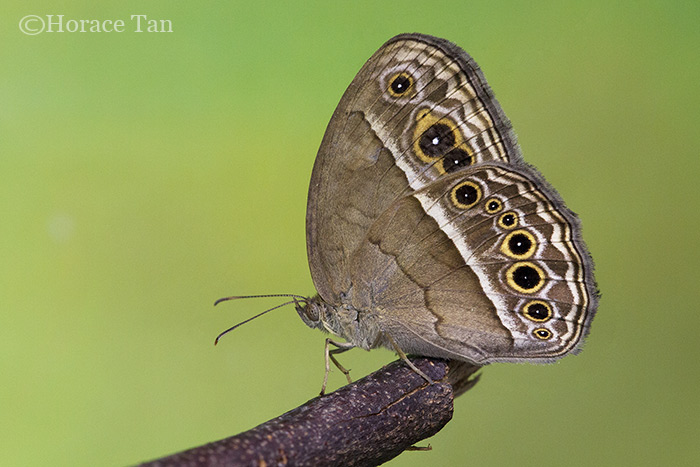


Physical Description of Adult Butterfly:
On the upperside, the wings are dull brown with a prominent yellow-ringed ocellus in space 2 of the forewing, and two obscure ocelli in spaces 2 and 3 of the hindwing. The male has a dark brown sex brand above vein 7 in the hindwing covered with a hair pencil. On the underside, both wings are pale brown in ground colour and have a whitish post-discal band. There is a series of ringed ocelli in the submarginal area on both wings. In the forewing, there are four faint lines (obscure in the wet season form but more readily seen in the dry season form) crossing the basal half of the cell. In the hindwing, the post-discal line is slightly curved in spaces 4 and 5, and there is a prominent dark brown indentation line stretching down to and beyond vein 1b with a "tooth" at vein 1b.


Field Observations of Butterfly Behaviour:
Once thought to be rare, this species is now a common member of the Mycalesis genus in Singapore. Adults are typically sighted flying low among vegetation in and around grassy patches found at multiple locations across the island nation. As with other Satyrinae members, the adults fly in an erratic and jerky manner as their wings are closed for a relatively long period during flights.


Early Stages:
Two local common grass species, Ottochloa nodosa and Ischaemum ciliare, have been recorded as larval hosts so far. The caterpillars feed on leaves of the host plant, and have been observed to forcefully ejecting their frass pellets, a larval habit rarely seen outside the skipper/flat families. They tend to rest lengthwise on the underside of a leaf during pauses between feeds.

Local host plant: Ottochloa nodosa.

A mating pair of Burmese Bush Brown.

The eggs are laid singly on the underside of a grass blade. Each egg is more or less spherical (about 1mm in diameter) and pale translucent with a light greenish tinge. It appears to be smooth to the naked eyes, but faintly sculptured with a hexagonal reticulum when viewed with a macro lens.

A mother Burmese Bush Brown laying an egg on its host plant.

Two views of an egg of Burmese Bush Brown.

Two views of a mature egg with the head clearly visible through the egg shell.

The egg takes about 3 days to mature. The young caterpillar nibbles away a portion of the egg shell to exit and then proceeds to devour the rest of the egg shell almost entirely. It has a cylindrical body in whitish colour, and an initial body length of about 2.8mm. The body is covered with dorso-lateral and lateral rows of moderately long setae. At the posterior end, there is a pair of backward-pointing processes. Its dark colored head features a number of setae and has a pair of short and rounded horns, a few lateral protuberances.

Two views of a newly hatched caterpillar, length: 3.1.mm

As a result of its leaf diet, the 1st instar caterpillar soon takes on a strong greenish undertone. As growth proceeds, the dorsum of the last two to three segments turns reddish. The first instar lasts about 4 days with the body length increases to about 5.5-6mm.

Two views of a 1st instar caterpillar, length: 4.9mm.

Two views of a late 1st instar caterpillar, dormant prior to its moult, length: 4.5mm.

In the 2nd instar, the cephalic horns become pointed and the two anal processes longer and thus pronounced. The few lateral conical protuberances on the head capsule are now much smaller and whitish in colour. The body color is pale yellowish with a green undertone. The head and body is also adorned with numerous minute tubercles, each with a single seta emanating from it. The 2nd instar lasts about 3 days with the body length reaches about 9mm.

Two views of a 2nd instar caterpillar, early in this stage, 4.5mm.

Two views of a 2nd instar caterpillar, length: 5.4mm.

Two views of a late 2nd instar caterpillar, dormant prior to its moult, length: 8mm.

The 3rd instar caterpillar mostly resembles the previous instar. The head capsule is dark brown in the cephalic horns and the basal areas around the mouth parts but pale brown elsewhere. This stage also takes 3 days to complete with body length reaching about 13-14mm.

Two views of a newly moulted 3nd instar caterpillar, length: 9mm.

Two views of a 3nd instar caterpillar, length: 12mm.

Two views of a late 3nd instar caterpillar, dormant prior to its moult, length: 13mm.

The 4th instar caterpillar bears a close resemblance to the 3rd instar caterpillar with no obvious change of any features or markings. The 4th instar lasts about 4 days with body length reaching 20.5-21.5mm.

Two views of a newly moulted 4th instar caterpillar, length: 13.5mm.

Two views of a 4th instar caterpillar, length: 17mm.

Two views of a late 4th instar caterpillar, dormant prior to its moult, length: 21.5mm.

Burmese Bush Brown caterpillars in the act of catapulting frass pellets. The next moult brings the caterpillar to its 5th and final instar. Now the caterpillar could appear in two colour forms: a brown form which is mostly pale to dark beige brown and a green form which is pale yellowish green. Feature wise, there is now a narrow band on the dorsum of the thorax. In addition, small black dorso-lateral spots appear at the joints between segments 2 to 7. Furthermore, faint oblique stripes adorns the body surface. In a period of 8 days, the body grows to a maximum length of about 32-35mm. Two views of a newly moulted 5th instar caterpillar, length: 20mm.
Two views of a 5th instar caterpillar, green form, length: 29mm.
Two views of a 5th instar caterpillar, brown form, length: 35mm.
Two views of a 5th instar caterpillar, late in this stage, body shortened and body colour changed to mostly green, length: 22mm. Toward the end of the 5th instar, the body gradually shrinks in length and the body of both colour forms turn mostly green. Finally the caterpillar finds a spot on the underside of a leaf blade to spin a silk pad. It then secures itself there via its anal end, and assumes its upside-down pre-pupatory pose.
A prep-pupa of Burmese Bush Brown. After one day as a pre-pupa, pupation takes place. The smooth pupa is mostly green throughout. It is somewhat angular in appearance, with a dorsal keel on the thorax and ridges defining the dorsal wing margins. There are a few small black spots dotting the wing pad margin. Dorso-lateral pairs of small yellowish spots can be observed on abdominal segments 2-6. Length of pupae: 15-16mm.
A Burmese Bush Brown caterpillar moults to its pupal stage.
Three views of a pupa of Burmese Bush Brown. After 5 days of development, the pupa becomes darkened in color, and the ringed-spot on the forewings can now be seen through the pupal skin in the wing pads. The next day the eclosion event takes place with the adult butterfly emerges to start the next phase of its life cycle.
Three views of a mature pupa of Burmese Bush Brown.
A Burmese Bush Brown caterpillar emerges from its pupal case.
A newly eclosed Burmese Bush Brown. References:
  • [C&P4] The Butterflies of The Malay Peninsula, A.S. Corbet and H.M. Pendlebury, 4th Edition, Malayan Nature Society.
  • Butterflies of Thailand, Pisuth Ek-Amnuay, 2nd Edition, 2012.
  • A Field Guide to the Butterflies of Singapore, Khew S.K., Ink On Paper Communications, 2010.
Text by Horace Tan, Photos by Bobby Mun, Federick Ho, Khew SK and Horace Tan

10 October 2013

Butterflies Galore! : Malay Baron

Butterflies Galore!
The Malay Baron (Euthalia monina monina)


The Malay Baron is one butterfly species that displays sexual polymorphism*. It is particularly noteworthy that, in the Malay Baron, the polymorphism occurs in the males. In butterflies, polymorphism occurs more frequently in females than in males. In the Malay Baron, there are three known forms of the males - form-decorata, form-monina and form-gardineri. The species is represented by only one female 'form'.

The Malay Baron is a forest-dependent butterfly, and is seldom seen in urban parks and gardens, except perhaps for those which are in close proximity to the nature reserves in Singapore. All three forms of the males are seen with regularity, and in some instances, two or more forms are seen in the same vicinity.  This male form-decorata was photographed in the nature reserves feeding on the ripened fruit of the Singapore Rhododendron (Melastoma malabathricum)

*Polymorphism in biology occurs when two or more clearly different phenotypes exist in the same population of a species — in other words, the occurrence of more than one form or morph.

09 October 2013

Butterflies Galore! : Great Orange Awlet

Butterflies Galore!
The Great Orange Awlet (Burara etelka)


This fast-flying skipper exhibits crepuscular* behaviour and is more often seen in the early hours of the day or late in the evening. With a wingspan of 50-60mm, it is a large species, by Hesperiidae standards, with only the Gangara and Erionota spp surpassing it in size. Males are predominantly brown on the upperside and unmarked, whilst the females are deep iridescent blue above. The undersides are orange-brown with pale orange cellular streaks.

This individual was photographed by ButterflyCircle member Huang CJ at around 7:30am when the butterfly was attracted to a flowering Syzygium tree in a nature park.  Besides being encountered feeding at flowers, the Great Orange Awlet has also been observed puddling at damp streambanks at times.

*Crepuscular animals are those that are active primarily during twilight, that is, during dawn and dusk.

08 October 2013

Butterflies Galore! : Grass Demon

Butterflies Galore!
The Grass Demon (Udaspes folus)


This skipper's caterpillars feed on a range of "ginger" plants and is a widely-distributed butterfly in Singapore. Its host plants include Cheilocostus speciosus (White Costus), Costus lucanusianus (African Spiral Flag), Hedychium coronarium (White Ginger Lily, Butterfly Ginger), Zingiber officinale (Ginger), Curcuma longa (Tumeric), of this the last two are used as spices in Asian food and also for their medicinal qualities. The Grass Demon is a predominantly dark brown with white markings on its fore- and hind wings and is unlikely to be mistaken for any other Hesperiidae species.

This pristine individual was photographed by ButterflyCircle member Anthony Wong last weekend at a park connector. The Grass Demon is shown here, perched on the red buds of one of its caterpillar host plants, the White Costus.

07 October 2013

Butterflies Galore! : Short Banded Sailor

Butterflies Galore!
The Short Banded Sailor (Phaedyma columella singa)


The Short Banded Sailor is one of several black-and-white striped (upperside of the wings) butterfly species in Singapore. Amongst the species that have a weaker gliding flight, the Short Banded Sailor can sometimes be confused with the two Neptis spp., the Common Sailor and the Grey Sailor. The Grey Sailor has grey undersides whereas the Common and Short Banded Sailors have orange-brown undersides. The postdiscal triangular patch in the Short Banded Sailor is rounded and not as angular and long as the triangular patch in the Common Sailor.

The Short Banded Sailor is common and is quite widespread in its distribution. It occurs from urban areas to nature reserves. One of its caterpillar host plants is the roadside tree, Angsana (Pterocarpus indicus), whilst in mangrove areas, its preferred host plant is the Sea Hibiscus (Hibiscus tiliaceus. This individual, photographed yesterday, was feeding on the ripened fruit of the Singapore Rhododendron (Melastoma malabathricum) in the nature reserves.

05 October 2013

Greening of Eco-Link @ BKE

Greening of Eco-Link @ BKE
A Safe Passage for Wildlife


The completed Eco Link spanning across the BKE

Way back in 1986, when the roads engineers of the then Public Works Department designed the Bukit Timah Expressway (or BKE as we acronym-mad Singaporeans know it by), their emphasis was to create an efficient transport link from the Causeway to downtown Singapore. Back then, probably the most efficient route took the expressway right through the Central Catchment, splitting the Bukit Timah Nature Reserve from the rest of the Central Catchment Nature Reserve.


Elbowed Pierrot (Caleta elna elvira) one of the species observed 

Over the decades that passed, nature observers lamented the fragmentation of the two major high biodiversity nature areas by the BKE. Animals separated by the BKE remained on the two sides and were unable to cross the expressway without the risk of being killed by vehicles. The expressway became an insurmountable barrier.


Lesser Harlequin (Laxita thuisto thuisto)

In 2005, the nature community and the government authorities mooted the idea of a nature or green corridor to re-connect BTNR to the CCNR. After some debate and feasibility studies, the location selected for this biodiversity-bridge was confirmed. It took some time for the realisation of this Eco-Link as there were issues like design, budget, effectiveness and environmental impact of the link to be dealt with.


After further delays, the contract was finally awarded to local contractor Eng Lee Engineering for a contract sum of $11.8M. The Ground Breaking Ceremony for the Eco Link was held on 30 Jul 2011. Today, slightly over two years after work commenced on the Eco Link, I attended the Greening of the completed Eco Link.


Group Photo at the Tree Planting site (via Twitter by ©Debby Ng)

This was basically an event to celebrate the completion of the biodiversity link with a tree-planting ceremony involving the nature community. The event was graced by the Minister of State for National Development, Mr Desmond Lee.


The morning started with an imminent threat of another thunderstorm. The NEA weather radar showed a massive front coming in from Sumatra, and it had begun raining cats and dogs in parts of Singapore. However, the nature community, being a determined bunch, braved the prospects of planting trees in the heavy rain!


When I arrived at the meeting point, I was pleasantly surprised to see that a decent crowd had already made their way to the Dairy Farm area. The dark rain clouds were also beginning to clear up, and it looked like the event was a go!


MOS Desmond Lee hard at work digging the tree hole

The guests were ferried to the Eco Link by coaches, and before long, the group made its way to the top of the Eco Link, led by MOS Desmond Lee. After the traditional group photo, everyone got busy with the tree planting. MOS was even game enough to plant more than one!


As everyone took in the sights around the Eco Link and the speeding vehicles on the BKE below, I could imagine that this "narrow" 50m wide link could indeed be a bridge across which animals can use to move safely between BTNR and CCNR.


I was also told that the Eco Link will not be opened to the general public and will be kept inaccessible so that the animals that may use it will not be disturbed by human presence. There was also concerns that poachers may also use it as a convenient means to capture their prey.


MOS Desmond Lee entertaining the crowd with his handling of the Oriental Whip Snake

Very soon, all the trees were planted, and the group made its way down to the exhibition area and our much-needed refreshments. As if on demand, a couple of snakes showed up and got the attention of the group, including our Guest of Honour. As it was still cool and cloudy, I didn't manage to spot any butterflies in the area.


As for ButterflyCircle's involvement, members had earlier conducted a pre-construction survey in April 2011 in the area. On that single day alone, a total of 54 species of butterflies were recorded. A few rarities like the Lesser Harlequin, Malay Tailed Judy, Indigo Flash were spotted. After the contractors vacate the site and the vegetation recovers on the Eco Link and the surrounding forests, another survey will be conducted to ascertain the butterfly count.


So there you have it, a biodiversity bridge over an expressway, just for nature. There were concerns that the Eco Link would not be effective or is too narrow for animals to want to use it. Will all this effort will be in vain? To me, it is a little effort that may go a long way in trying to bridge the fragmented nature reserves. These reserves are important in the sense that the forest-dependent butterfly species are dependent on the preservation of this habitat. Although the Eco Link itself may not be directly beneficial to butterflies, since they can easily fly across the BKE, the selection of plants and regeneration of habitats across the bridge may help butterfly populations to spread between the two nature reserves.


An exhibition showing the flora and fauna of the Nature Reserves

The Central Catchment and Bukit Timah Nature Reserves are the last remaining remnants of a once awesome primary forest that covered Singapore. These are certainly worth preserving as our natural heritage, and as a home to an amazing diverse spectrum of flora and fauna. The controversy that surrounds the construction of an underground MRT line cutting across the southern part of the Central Catchment Nature Reserve in the MacRitchie Reservoir area stems primarily from the critical need to protect this precious 'green heart' that is home to an awesome biodiversity. That debate is still ongoing, and it will be another story for another time on this blog.

Text & Photos by Khew SK : Group Photo courtesy of Debby Ng

References and Past Articles about the Eco Link


  • From WildSingapore : http://wildsingaporenews.blogspot.sg/2010/12/singapore-bukit-timah-eco-bridge-to.html
  • From the Biology Refugia : http://biologyrefugia.blogspot.sg/2009/09/ecological-corridor-for-bukit-timah-and.html
  • From SGLinks : http://sglinks.com/pages/1202944-eco-link-bke-links-nature-reserves
  • From IYB 2010 : http://iyb2010singapore.blogspot.sg/2010/05/bridge-for-biodiversity-eco-link-to.html


List of Butterflies observed during the pre-construction survey on 9 Apr 2011 :

1) Papilio polytes romulus (Common Mormon)
2) Graphium sarpedon luctatius (Common Bluebottle)
3) Chilasa clytia clytia (Common Mime) (caterpillar)
4) Euploea mulciber mulciber (Striped Blue Crow)
5) Leptosia nina malayana (Psyche)
6) Catopsilia pomona pomona (Lemon Emigrant)
7) Eulaceura osteria kumana (Purple Duke)
8) Eurema blanda snelleni (Three-Spot Grass Yellow)
9) Elymnias hypermnestra agina (Common Palmfly)
10) Elymnias panthera panthera (Tawny Palmfly)
11) Mycalesis mineus macromalayana (Dark Brand Bush Brown)
12) Mycalesis perseus cepheus (Dingy Bush Brown)
13) Mycalesis visala phamis (Long Brand Bush Brown)
14) Mycalesis fusca fusca (Malayan Bush Brown)
15) Orsotriaena medus cinerea (Nigger)
16) Ypthima baldus newboldi (Common Five Ring)
17) Ypthima pandocus corticaria (Common Three Ring)
18) Tanaecia iapis puseda (Horsfield's Baron)
19) Tanaecia pelea pelea (Malay Viscount)
20) Lebadea martha parkeri ( The Knight )
21) Moduza procris milonia (Commander)
22) Hypolimnas anomala anomala (Malayan Eggfly)
23) Athyma nefte subrata (Colour Sergeant)
24) Junonia hedonia ida (Chocolate Pansy)
25) Junonia almana javana (Peacock Pansy)
26) Lasippa tiga siaka (Malayan Lascar)
27) Phaedyma columella singa (Short Banded Sailor)
28) Abisara saturata kausambiodes (Malayan Plum Judy)
29) Abisara savitri savitri(Malay Tailed Judy)
30) Laxita thuisto thuisto ( Lesser Harlequin )
31) Logania marmorata damis (Pale Mottle)
32) Acytolepis puspa lambi (Common Hedge Blue)
33) Caleta elna elvira (Elbowed Pierrot)
34) Eooxylides tharis distanti (Branded Imperial)
35) Iraota rochana boswelliana (Scarce Silverstreak)
36) Surendra vivarna amisena (Acacia Blue)
37) Zizina otis lampa (Lesser Grass Blue)
38) Jamides celeno aelianus (Common Caerulean)
39) Prosotas dubiosa lumpura (Tailless Line Blue)
40) Arhopala centaurus nakula (Centaur Oakblue)
41) Arhopala major major
42) Anthene emolus goberus (Ciliate Blue)
43) Zeltus amasa maximinianus (Fluffy Tit)
44) Rapala varuna orseis (Indigo Flash)
45) Rapala pheretima sequeira (Copper Flash)
46) Hypolycaena erylus teatus (Common Tit)
47) Neopithecops zalmora zalmora ( The Quaker)
48) Pelopidas mathias mathias (Small Branded Swift)
49) Tagiades japetus atticus (Common Snow Flat)
50) Tagiades calligana (Malayan Snow Flat)
51) Hasora badra badra (Common Awl)
52) Iambrix salsala salsala (Chestnut Bob)
53) Potanthus omaha Omaha (Lesser Dart)
54) Taractrocera archias quinta (Yellow Grass Dart)