25 September 2013

Butterflies Galore! : Archduke

Butterflies Galore!
The Archduke (Lexias pardalis dirteana)


The large, robust-bodied butterflies of the genus Lexias are forest-dependent species that seldom stray from the sanctuary of the forested nature reserves of Singapore. They are largely ground feeders, preferring to forage amongst leaf litter and fallen fruits on forest floor. Two of the three extant species of the genus display distinct sexual dimorphism in that the male and female look very different from each other.

This shot, taken by ButterflyCircle member Nelson Ong, shows a male of the Archduke feeding on some liquid nutrients on a tree trunk. The males are velvety black above with a prominent blue marginal border on the hindwing, which continues to the termen of the forewing. The Archduke is a powerful flyer and is usually skittish.

21 September 2013

Butterfly of the Month - September 2013

Butterfly of the Month - September 2013
The King Crow (Euploea phaenareta castelnaui)


The first week of September saw another unprecedented flood in Singapore - this time on the western side of the island near the National University of Singapore. For the first time, an entire major expressway was completely shut down to all classes of vehicles for about 40 minutes. The Ayer Rajah Expressway, or the AYE was inundated by the sudden downpour in the early morning hours, and coupled with the high tide, caused the flooding of all four lanes.


This 'rainy season' that is known as the South-West monsoon has seen several wet days in September, including weekends, that caused ButterflyCircle members to be cooped indoors (rather unhappily) instead of going out on their regular outings. The 'Sumatras' as these seasonal monsoon winds are called, are forecasted to taper off in October as the inter-monsoon lull will hopefully bring better weather.


For the nature groups, the concerns over the 50km Cross Island MRT line that will start in Changi and end in Jurong will be given a short reprieve as the Land Transport Authority announced that a two-year Environmental Impact Assessment will be conducted to ascertain the impact on biodiversity and the habitats where the line cuts through MacRitchie Nature Reserve. Some initial thought-provoking questions can be found on this site. The NSS also published a position paper on the concerns regarding the initial soil investigation works, as well as the potential ecological damage that the underground tunnelling work may cause during the construction stage.


Dr Wee YC, the author behind the Bird Ecology Study Group, has also penned a series of articles showcasing the biodiversity that may be lost with the Cross Island Line, if it goes ahead as planned. His latest article is posted here. A site to showcase the biodiversity of MacRitchie forest, and to lobby concerned nature enthusiasts and anyone who shares the common cause has been set up. It's called the Love Our MacRitchie Forest site.


Our feature butterfly for the month is the largest species in the genus Euploea often referred to as the 'Crows'. The genus features large distasteful butterflies, usually black or blue, with white spots or stripes on their wings. The King Crow (Euploea phaenareta castelnaui) is the largest member of the genus, with a wingspan between 90-105mm.


The King Crow is a moderately rare species, although it can be regularly observed in local areas, particularly where its caterpillar host plant grows. It is often spotted in the back-mangrove areas of Pasir Ris Park, Pulau Ubin and even in urban areas in the vicinity of its host plant, the Pong Pong Tree (Cerbera odollam).


On the upperside the predominantly dark brownish-black butterfly features a series of violet-tinged apical spots on the forewings. There is a series of white marginal and submarginal spots on both wings. The spots on the underside are smaller although there are some individuals where some of these spots appear violet in colour.


On the upperside of the hindwings, male King Crows feature a raised scent patch in the cell, and there is a certain obvious discolouration at the tornal area of the hindwing. The forewing dorsum of the female is straight, whilst in the males, the forewing dorsum is strongly bowed. Females are typically larger, with a wider wingspan.


The King Crow flies slowly but can be alert and skittish. It tends to fly at higher levels amongst the treetops, stopping occasionally to rest with its wings folded shut. At times, the butterfly is observed to rest with its wings opened flat, as if to sunbathe. It can also be observed feeding on a variety of nectaring plants, and is particularly attracted to the flowers of the Syzygium trees.


The caterpillar host plants were previously planted as a roadside tree and in some housing estates. But in recent years, the tree has fallen out of favour, as the large apple-like fruits have been known to drop and damage parked cars, prompting the authorities to remove the Pong Pong as a roadside tree. It is now more often seen in backmangrove areas and parks, away from carparks.


The complete life history of the King Crow has been recorded in this blog here.  The photo below shows the eclosion sequence of the King Crow.


Text by Khew SK : Photos by Sunny Chir, Khew SK, Loke PF, Bobby Mun, Horace Tan, Tan Ben Jin & Benedict Tay

19 September 2013

ButterflyCircle : Embroidered Patch

ButterflyCircle
Embroidered Patch


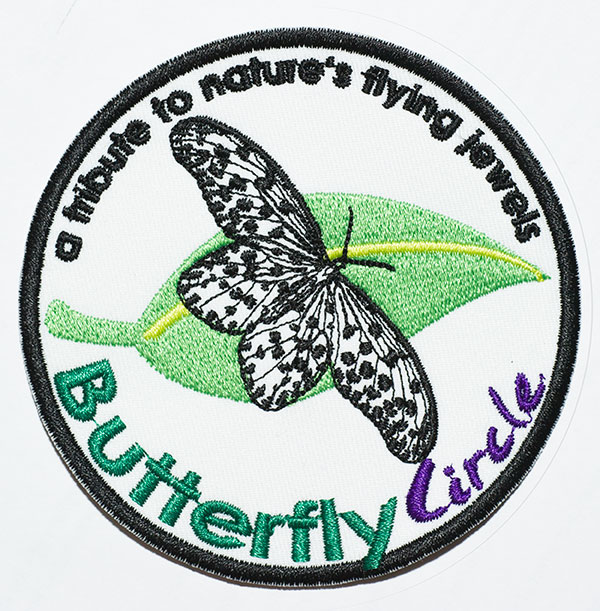
ButterflyCircle members now have a new embroidered patch or 'badge' that they can wear proudly to display their membership of the group. The patch features the Common Tree Nymph, which is the 'mascot' on the logo of ButterflyCircle, resting on a green leaf. The group's tagline "A Tribute to Nature's Flying Jewels" frames the top of the circular patch above the butterfly. The group's name, ButterflyCircle, sits at the base of the circle, completing the design of the patch. The patch is made possible through the effort of ButterflyCircle member Simon Sng who designed and saw through the production of the patch.

18 September 2013

Butterflies Galore! : Branded Imperial

Butterflies Galore!
The Branded Imperial (Eooxylides tharis distanti)


This pretty long-tailed Lycaenid that typically stays within the safe confines of forested areas never fails to impress butterfly watchers. Its bright orange-red undersides, contrasted with the black and white tornal area and long tails make it a very attractive butterfly. The upperside of the Branded Imperial is a jet black, except for the tornal area, which is similar to the underside. At certain times of the day, the butterfly can be observed to sunbathe in sunlit spots with its wings opened flat. However, at most times of the day, it flies around and stops with its wings folded upright, as is shown in this photo.

This pristine Branded Imperial was shot last week in the nature reserves by ButterflyCircle member Anthony Wong. As the caterpillars of this species feeds on the young shoots of the invasive creeper, Smilax bracteata, it is common and is quite widespread in the forested areas of Singapore, particularly in the vicinity of where its caterpillar host plant can be found.

15 September 2013

Life History of the Great Imperial v2.0

Life History of the Great Imperial (Jacoona anasuja anasuja)
An earlier version of the life history of the Great Imperial can be viewed by clicking this link.


Butterfly Biodata:
Genus: Jacoona Distant, 1884
Species: anasuja
C & R Felder, 1865
Sub-species: anasuja
C & R Felder, 1865
Wingspan of Adult Butterfly: 34-38mm
Caterpillar Local Host Plants:
Dendropthoe pentandra (Loranthaceae), Scurrula ferruginea (Loranthaceae).

A sunbathing  Great Imperial  displaying its upperside.

A male Great Imperial.

Physical Description of Adult Butterfly:
Above, the male is dark brown with lower halves of both wings in shining blue. In the forewing, there is a short and oblique blue band in the apical area, and a black oval band in the outer part of the cell. The female is mainly brown. In its hindwing, the tornal area is white with embedded black spots in space 1b, space 2 and in the tornal lobe. Underneath, both sexes are mainly yellowish orange with the lower half of the hindwing white. Black post-discal striae are present in the tornal half of the hindwing. In the forewing, the basal part of vein 12 is black (this is a key characteristic for distinguishing the Great Imperial from the Grand Imperial). There are tails at the end of veins 1b and 2 in the hindwing. For the tail at end of vein 2, the one for the male is little more than a tooth, while that of the female is moderately long. As for the tail at end of vein 1b, the one for the male is long and sword-like, while that for the female is even longer and fluffy in appearance.


A newly eclosed male Great Imperial resting on its pupal case.

A male Great Imperial taking nectar from Syzygium flowers.

Field Observations of Butterfly Behaviour:
This species is rare in Singapore. The handful of sightings take place mainly in the Central Catchment Reserve, as well as small pockets of wooded area to its west and north. The Great Imperial appears to be a tree-top dweller. The fast flying adults typically perch with its wings closed upright between flights. In sunny weather, however, they have been observed to sun-bathe with wings fully open.

13 September 2013

Down Memory Lane - Burmese Caerulean

Down Memory Lane
The Burmese Caerulean (Jamides philatus subditus)


This species, referred to as the Burmese Caerulean, was recorded in Singapore by the early authors. Both the reference books, Butterflies of the Malay Peninsula by Corbet & Pendlebury and Butterflies of West Malaysia and Singapore by WA Fleming listed this species as extant in Singapore in the checklists found in the books. It is described as uncommon.


The Burmese Caerulean has distinctive black wedge-shaped submarginal spots on the underside of the hindwing and sets it apart from the other lookalike species of the Jamides genus. The upperside is a pretty light sky blue. It has a filamentous white-tipped tail at vein 2 of the hindwing.


These shots, taken this year in Malaysia, show the Burmese Caerulean puddling at a sandy streambank. It would be awesome to see this species again in Singapore. Will it be back here again one day? Or will it remain only in our memories and is gone forever from Singapore?

09 September 2013

Butterflies Galore! : Tree Yellow

Butterflies Galore!
The Tree Yellow (Gandaca harina distanti)


The Tree Yellow resembles the "Grass Yellows" from the genus Eurema. Although there are at least six species from the Eurema, the Tree Yellow, the sole representative of its genus, is slightly larger and lighter yellow in appearance. The absence of any markings on the underside of this species will easily distinguish the Tree Yellow from its commoner relatives. The Tree Yellow is mainly a forest denizen and rarely seen in urban parks and gardens. The butterfly is unmarked except for a narrow black border on the upperside of the wings.

In Singapore, the Tree Yellow is often seen puddling at moist footpaths and sandy streambanks. However, it is very skittish and not easily approached. There are occasions, however, when the butterfly is more cooperative and allows a photographer to sneak up close to it for a good shot. This individual was photographed in the nature reserves by ButterflyCircle member Nelson Ong.