24 July 2013

Butterflies Galore! : Spotted Black Crow

Butterflies Galore!
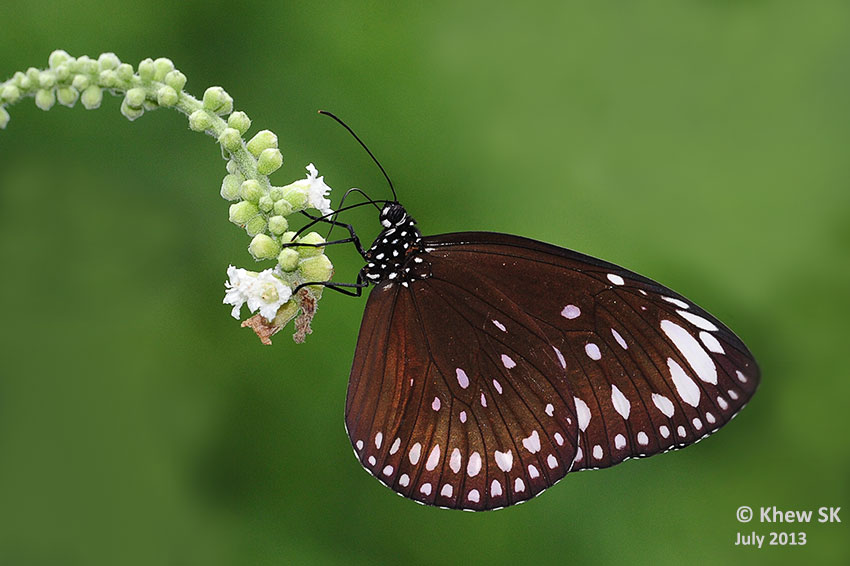
The Spotted Black Crow (Euploea crameri bremeri)


The subfamily Danainae, often referred to by their collective English Common name of "Tigers and Crows" display aposematic colouration as a warning to predators that they are distasteful and should be avoided. One such species, the Spotted Black Crow is predominantly black in colour, with typical white spots on its wings which is characteristic of several species of the Euploea genus.

This Spotted Black Crow, shot last weekend, kept returning again and again to the flowers of the Stringbush to feed, even when disturbed. A moderately rare species, the Spotted Black Crow is often observed on the landward side of mangrove areas in Singapore. Its caterpillars feed on Apocynaceae plants which are lactiferous. It is the chemical compound in the host plant that gives the adult butterfly its distasteful properties.


23 July 2013

Butterflies Galore! : Peacock Pansy

Butterflies Galore!
The Peacock Pansy (Junonia almana javana)


The Peacock Pansy is one of four Pansies found in Singapore. Sun-loving butterflies, all the four belong to the genus Junonia, of which there are six species in the Southeast Asian region. Two of them, the Lemon Pansy and the Yellow Pansy are not found this far south. In flight, the Pansies are fast on the wing and adopt a rapid gliding flight.

The Peacock Pansy is predominantly orange with large eyespots adorning both wings. The underside is paler with the same markings and ocelli as the upperside. The caterpillars of this species feed on the Creeping Ruellia (Ruellia repens). The species is fairly common and usually found in open grassy areas. This perching Peacock Pansy was shot by ButterflyCircle member Nona Ooi last weekend.

20 July 2013

Butterfly of the Month - July 2013

Butterfly of the Month - July 2013
The Blue Helen (Papilio prexaspes prexaspes)


Last month's haze is but a memory now, blown away as quickly as the prevailing winds changed. Our northern neighbour, Malaysia received a good dose of the polluted air before the rains came and it was over as suddenly as it started, despite reaching hazardous levels in terms of air quality. The forest fires in Sumatra were blamed on the slash-and-burn method that was used to clear large tracts of land - mainly for the cultivation of oil palm. As we picked up our lives and continued with our daily routines again, after the record-breaking PSI of 401, one wonders when the next wave of the polluted smog will return again.


Whilst regulations are in place to prohibit the open burning of forests and plantations, enforcement and other punitive measures to ensure that such burning does not recur is another matter altogether. It is interesting to see how the Indonesian government gets its act together to prevent such irresponsible burning in future. Fortunately, political pressures at the diplomatic level, together with the favourable change in weather ended the July 2013 haze quickly.


Over in Singapore, after the disruptive conditions caused by the haze, Singapore experienced another abnormal weather phenomenon in the form of a hail storm in the afternoon of 25 June. Hail is a form of solid precipitation and consists of irregular lumps of ice dropping with the rain. Hail is supposedly caused by supercooled water droplets freezing on contact with particles in the air, such as dust, during a thunderstorm. Whilst the authorities declined to conclude that the hailstorm was caused by the haze, we are left to form our own opinions, considering that haze is certainly contributing to "particles in the air" as the rains fell.


July was of course an exciting month for biodiversity in Singapore, with the 2nd Festival of Biodiversity held at VivoCity. ButterflyCircle contributed a video, which basically summarises the group's work in butterfly conservation and research, as well as featured the members' high quality photographs. NParks mentioned that the visitorship over the weekend when the Festival was held was estimated at about 13,000 visitors to the exhibition area, a far higher number than the first festival held at the Singapore Botanic Gardens.


This month we feature the forest-dependent Swallowtail, the Blue Helen (Papilio prexaspes prexaspes). A rather rare species in Singapore, the Blue Helen is usually observed singly in the forest reserves. It is rarely, if ever, seen in urban parks and gardens. It was not listed in the checklists of the early authors, and was first discovered in the Chestnut Drive area some time back in late 90's. It makes an erratic appearance in various areas of the nature reserves over the years and is believed to be now a resident species in Singapore.


The Blue Helen is only one of two "Helen" species of the swallowtails that occur in Singapore. The other one is the Great Helen (Papilio iswara iswara) which also shares the same localities with the Blue Helen. However, the Blue Helen is the smaller of the two species, and is observed feeding on the flowers of the Common Asystasia, Lantana, Saraca and various Syzygium spp.


Males of the Blue Helen are often observed puddling at sandy stream banks and damp footpaths in the forests that have been tainted with decomposing organic material. Usually flying amongst the treetops restlessly, this species can be approached more easily when it is distracted whilst puddling.


The Blue Helen is a predominantly black butterfly, with four prominent white patches on the upperside of the hindwings extending into space 4. On the underside, there are narrow pale beige submarginal spots but some may be obscure. Near the tornal area of the hindwing there are blue lunules. There is a spatulate tail at vein 4 of the hindwing.


Thus far, the caterpillar host plant of the Blue Helen remains elusive. Although it is likely to share similar host plants from the Rutaceae family like the related Great Helen, the early stages of this species remain unrecorded in Singapore.

Text by Khew SK : Photos by Sunny Chir, Khew SK, Henry Koh, Huang CJ, Simon Sng, Jonathan Soong & Mark Wong
19 July 2013

Down Memory Lane - Common Sergeant

Down Memory Lane
The Common Sergeant (Athyma perius perius)


The Common Sergeant, one of the species of the genus Athyma, was recorded as extant in Singapore by the early authors. However, there have been no reliable sightings of this species for the past four decades and is believed to be no longer found in Singapore. Featuring the typical black-and-white markings of the genus, the Common Sergeant is distinguished by the forewing cell streak being divided into four portions. The orange underside has a characteristic series of prominent black post discal spots.


The caterpillars of the Common Sergeant feeds on host plants like Glochidion and Phyllanthus, both of which can still be found in Singapore. It is not known why the species has disappeared from Singapore. There are currently five other species of the genus Athyma extant in Singapore. Was the Common Sergeant's preferred habitat wiped out? Will it be seen back here again one day? Or will it remain only in our memories and is gone forever from Singapore?

17 July 2013

Butterflies Galore! : Yamfly

Butterflies Galore!
The Yamfly (Loxura atymnus fuconius)


This brightly coloured Lycaenid is one of two species of butterflies currently known from Singapore, whose caterpillars feed on the young shoots of the forest "weed" Smilax bracteata (although there is still some debate as to whether this plant should be called Smilax setosa.) Whilst it has been recorded on some species of Dioscoreacea (Yam) in other countries in the region, the caterpillars in Singapore appear to prefer the invasive, non-native Smilax vine.

The Yamfly is not uncommon, and is quite widespread in distribution across Singapore, but mainly in areas where the caterpillar host plants are found nearby. This shot of a pristine Yamfly perched on a leaf, was taken by ButterflyCircle member Nelson Ong recently at the Dairy Farm Nature Park.


16 July 2013

Butterflies Galore! : Bigg's Brownie

Butterflies Galore!
The Bigg's Brownie (Miletus biggsii biggsii)


The Bigg's Brownie is a species of butterfly that belong to the subfamily Miletinae. The caterpillars are considered "carnivorous" as they feed on other insects - primarily coccids, mealy bugs, aphids or ant larvae. The early stages of this butterfly also have a symbiotic relationship with ants. The caterpillars get protection from the ants in return for sweet secretions often referred to as "honeydew" from their bodies.

The Bigg's Brownie is often seen in the vicinity of ants like shown in this shot. As the ants are known to "farm" the aphids, mealy bugs and coccids for their secretions, the butterfly seeks out these locations to lay her eggs so that the caterpillars can feed on the aphids. This shot was taken by ButterflyCircle member Mark Wong in the forested nature reserves recently.

Also see related article : Mergers, Partnerships & Betrayals


15 July 2013

Butterflies Galore! : Fluffy Tit

Butterflies Galore!
The Fluffy Tit (Zeltus amasa maximinianus)


This long-tailed Lycaenid, or Hairstreak, is moderately common and widespread in distribution. It can be found in urban parks and gardens as well as in the sanctuary of Singapore's forested nature reserves. It can fly quite rapidly amongst the treetops but comes down to the forest floor to puddle occasionally. In the nature reserves it likes to feed on the flowers of the Bandicoot Cherry (Leea indica).

Males are regularly observed to puddle at moist sandbanks in the nature reserves. This individual was shot puddling by ButterflyCircle member Chng CK at the Dairy Farm Nature Park recently. Note the long white twirling tails and the shorter pair along the vein beside it. There is a characteristic prominent rounded black spot at the base of space 7 on the hindwing.