07 July 2013

Life History of the Chequered Lancer

Life History of the Chequered Lancer (Plastingia naga)


Butterfly Biodata:
Genus: Plastingia Butler, 1870
Species: naga de Nicèville, 1884

Wingspan of Adult Butterfly: 38-45mm
Caterpillar Local Host Plant: Caryota mitis (
Arecaceae; common name: Fishtail Palm).


Physical Description of Adult Butterfly:
Above, the wings are brown with the forewing adorned with pale yellow hyaline spots in the cell-end and spaces 2, 3, 6 and 7, and a narrow yellow streak in space 1b. A series of interneural yellowish streaks is present in the hindwing. Beneath, the wings bear a striking pattern of black veins and whitish rectangular spots on a black background. The abdomen is black and white banded.

A Chequered Lancer sunbathing with partially open wings.

Another sunbathing Chequered Lancer giving a glimpse of its upperside.

Field Observations of Butterfly Behaviour:
The Chequered Lancer is moderately common in Singapore. Sightings are rather frequent in nature reserves and in parks where its host plant, the FishTail Palm, is commonly found. The adults are fast flyers and are skittish when disturbed. They have been observed to visit flowers and sunbath in sunny weather, and to puddle on bird dropping.

04 July 2013

Down Memory Lane - Smaller Wood Nymph

Down Memory Lane : Gone Forever?
The Smaller Wood Nymph (Ideopsis gaura perakana)


A long time ago, this black-and-white butterfly was recorded in Singapore. Both the reference books by the early authors listed the Smaller Wood Nymph as extant in Singapore. It resembles the much bigger Tree Nymph (Idea stolli logani) which still flies in Singapore today, but is only about half the size and has more rounded hindwings. The wings are a pale translucent grey with large black spots. It is more often found in the hill stations, but has also been observed as far south in the peninsula, in the nearby lowland forests in Johor, Malaysia.


The typical black and white colour is a display of aposematic colouration where it mimics and is mimicked by the Idea species and also the female of the moth Cyclosia pieridoides consistent with Mullerian mimicry. Its host plant is a species of the forest vine, Hoya, and is likely to have alternative host plants even in Singapore. Will it ever return to fly gently, at the mercy of the breeze, in our forests again ? Or will it remain only in our memories and is gone forever from Singapore?


03 July 2013

Butterflies Galore! : Malay Viscount

Butterflies Galore!
The Malay Viscount (Tanaecia pelea pelea)


Of the two species of the genus Tanaecia found in Singapore, the Malay Viscount is by far the commoner. It is a forest dependent species and is usually found in the safety of the forested areas in Singapore's nature reserves. It prefers to forage on the forest floor for overripe fruits and can frequently be observed at the ripened fruits of the Singapore Rhododendron, on which it feeds greedily.

Did you know that Viscount is pronounced as (vaɪkaʊnt), where the "s" is silent? There are still some people whom I've heard pronouncing the name incorrectly. The Malay Viscount may sometimes be confused with the female Malay Baron or the female Horsfield's Baron when in flight. Only a closer look and checking on the diagnostic features of the markings can one ID it correctly. This individual was photographed last weekend by ButterflyCircle member Mark Wong at the Dairy Farm Nature Park.


02 July 2013

Butterflies Galore! : Malayan Sunbeam

Butterflies Galore!
The Malayan Sunbeam (Curetis santana malayica)


The majority of the Sunbeam butterflies of the genus Curetis feature orange and black uppersides and silvery grey undersides. When in flight, one can see flashes of bright orange as the little butterfly zips past at its typical high speed flight. The Sunbeams are quick in flight and usually skittish. It tends to return repeatedly to a few preferred perches when it is sunbathing, and at certain hours of the day, it will sunbathe with its wings opened to show the attractive orange and black uppersides.

It has also been observed to puddle where it stays still and is more cooperative for butterfly photography. This shot, taken at Dairy Farm Nature Park last Saturday by ButterflyCircle padawan Nona Ooi, shows the Malayan Sunbeam puddling on the concrete pavement at the Wallace Education Centre.


01 July 2013

Butterflies Galore! : Chocolate Pansy

Butterflies Galore!
The Chocolate Pansy (Junonia hedonia ida)


On this first day of July, our weekday mini articles will take on a new series called Butterflies Galore! We will feature the awesome works of ButterflyCircle members who spend their time and effort shooting these winged jewels in Singapore on a regular basis.

Today's feature butterfly is the Chocolate Pansy. A common and widely distributed species, it is often ignored by photographers who prefer to chase after rarer subjects to add to their personal collection. However, although it is a common species that can be found in urban parks and gardens, as well as in nature areas, it is a very skittish butterfly and usually uncooperative. ButterflyCircle member Horace Tan chanced upon this tame individual recently and was able to bring out the beauty of this predominantly brown butterfly (hence its common name), with its reddish brown ocelli and cryptic patterns on the underside of the wings.


29 June 2013

Butterfly of the Month - June 2013

Butterfly of the Month - June 2013
The Rustic (Cupha erymanthis lotis)


Tomorrow will be the last day of June, and we will cross the halfway mark for 2013. It seems like only yesterday that we were wishing each other a Happy New Year in 2013, and now, half the year is almost over. It has indeed been an eventful month for Singapore in June - at least for those residents who were not away from our little red dot during this school holiday month. As with any blog that has anything to do with nature, the environment and current affairs, it would be unthinkable to avoid talking about the dreaded HAZE.


It is almost an annual environmental scourge that, during the dry season of the year, crop farmers and plantation owners in neighbouring Indonesia clear large tracts of land using their archaic (but cheap) method of slash-and-burn. In the past, where farmlands were more compact and the farmers used this method, the burning was more contained and manageable. In recent years, as large areas of land are cleared using the same method for oil palm plantations, the fires that are started take weeks to extinguish - but not before massive areas of greenery are razed to the ground.


This June, the haze, as we call it, started some time in the middle of the month. As more fires were started on Sumatra, the large volumes of smoke generated was carried by the south-westerly winds over to Singapore. What started as a minor haze around the 15th and 16th of the month grew into something that was to set an all-time record for the Pollutants Standard Index (PSI) level that Singapore uses to monitor the island city's air quality.


The last recorded high was in 1997 when the PSI level topped 226 when most of Singapore choked on the smog and kept cross-border diplomats busy with 'protests'. On 17 Jun 2013, at 12 noon, the PSI breached the 400 level and reached a historical record of 401 (and was way into the "hazardous" air quality level). Numbers notwithstanding, just being outdoors on that day made me feel like a trapped and helpless rodent in a burning and smoking building with nowhere to run. The air smelt of burnt wood and the smoke was absolutely smothering.


It was time again, for Singaporeans of all walks of life to don all manner of masks to try to go about their daily routine of commuting to and from work, and to carry out their daily activities in as normal a manner as possible. The recommended 3M N95 face masks, touted to be more effective than the surgical masks, flew off the shelves of the retailers that stocked them.


And so came the annual haze, courtesy of the old ways of the farmers in Indonesia, and the exploitative large-scale commercial companies whose primary aim is to maximise their profits with the wanton destruction of large tracts of land for their money-spinning oil palm plantations. I wonder how long more this will continue to happen, before Mother Nature strikes back again.


As for our beloved butterflies, the haze will affect them like any other living and breathing organism on planet Earth. Whilst the haze particles and pollutive elements in the air are miniscule, compared to us humans, these very same particles are like large pieces of trash, relative to the sizes of butterflies and their caterpillars. The particles are likely to interfere with the respiratory function of butterflies and their early stages. The impact of the haze on butterflies is yet to be ascertained, but as long as the haze is not prolonged, it is likely that the population of butterflies will spring back, as it did back in 1997. So let's hope that our butterflies continue to be as resilient as they had been in the past.


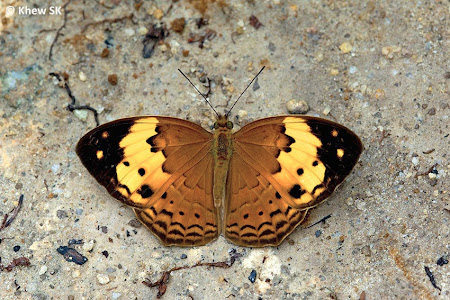
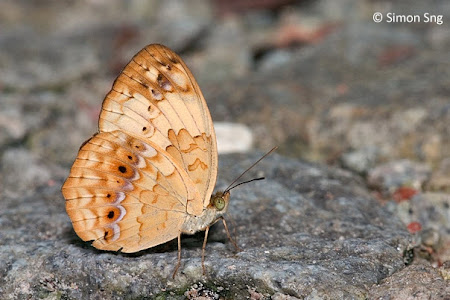
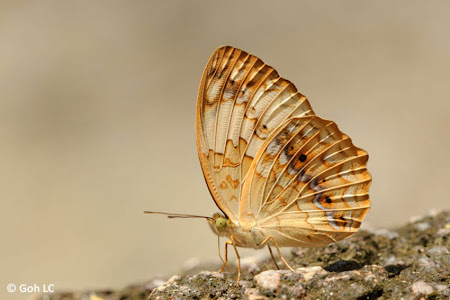
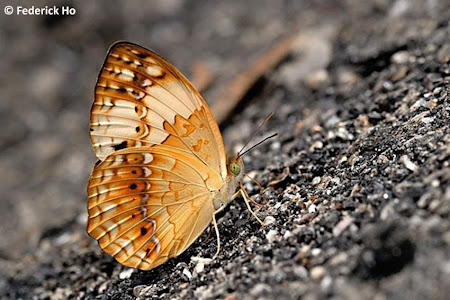
This month, we feature a medium sized Nymphalid, the Rustic (Cupha erymanthis lotis). An active and skittish butterfly, the Rustic often leaves many a photographer seething with frustration as it has a wide circle of fear and it takes off quickly before a photographer has a good chance of taking a shot of it at close range. Occasionally, however, when it is attracted to sweat and other food sources that it likes, the Rustic becomes more cooperative and allows a photographer to approach it.
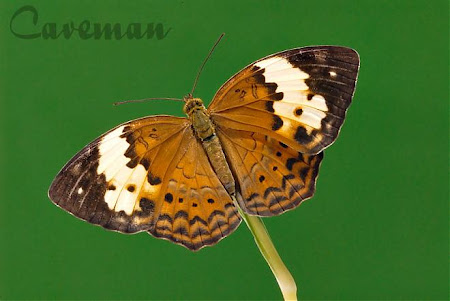


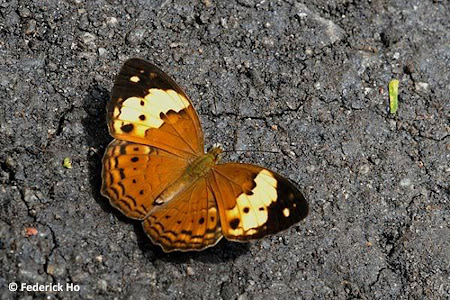
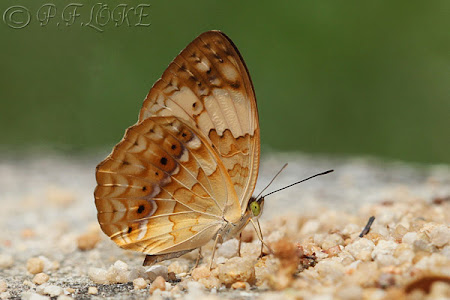
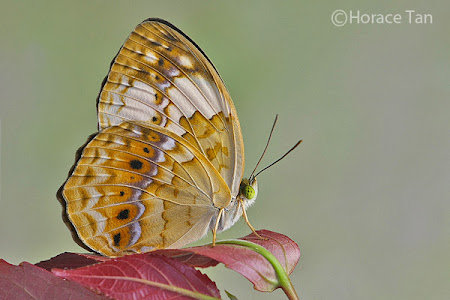
The Rustic is a restless flyer and constantly on the move in its habitats in the forested areas of Singapore. The upperside is orange-brown with a yellow discal patch and a black apical area on the forewing. The wings are ornamented with black spots and streaks. The underside is pale yellow orange, but with essentially the same black markings and spots as above.
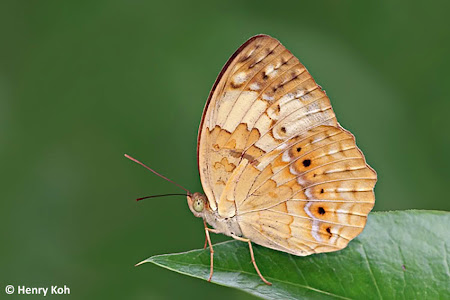


The butterfly is usually observed singly and is quite widespread in Singapore.  Although it prefers the safety of the forested nature reserves, individuals have been observed in urban parks and gardens where its caterpillar host plants - Flacourtia rukam and Flacourtia inermis, which it shares with other closely related species like the Leopard and Vagrant.

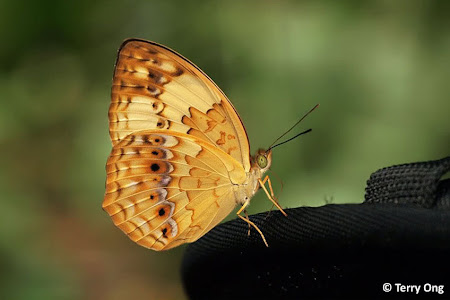


The complete life history of the Rustic has been recorded on this blog here. The caterpillar host plants, particularly Flacourtia inermis has been cultivated in many parks and gardens as a feature plant, e.g. Fort Canning Park, Ang Mo Kio West Town Park and Gardens by the Bay, and will probably attract the species to these parks from time to time.
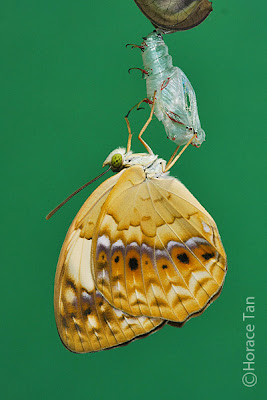


Let us hope that the urban greening of Singapore continues to favour butterfly biodiversity, as we move towards more biodiversity-friendly strategies to promote and enhance nature. In our city planning there are ample opportunities to allow development and nature to co-exist in harmony, and it is up to everyone who cares about nature to work towards this vision.

Text by Khew SK : Photos by Sunny Chir, Goh LC, Antonio Giudici, Federick Ho, Khew SK, Henry Koh, Loke PF, Simon Sng, Terry Ong & Horace Tan

This article is dedicated to ButterflyCircle member Tan Chung Pheng (who uses the online nick Rustic), a long-time butterfly photographer who has taken a leave of absence from active butterfly photography to enjoy a blissful married life, and raising a bundle of joy.


27 June 2013

Down Memory Lane - Orange Albatross

Down Memory Lane : Gone Forever?
The Orange Albatross (Appias nero figulina)


This new weekday short article series features some butterfly species that were previously recorded in checklists of the early authors who collected in Singapore from the 50's through to the 70's. Two main references of the species found in Singapore during that era were "Butterflies of the Malay Peninsula by Corbet & Pendlebury 4th Edition, revised by Col John Eliot" and "Butterflies of West Malaysia and Singapore by W.A. Fleming".

The latter author's collection of nearly 9,000 specimens is now nestled in the good hands of Raffles Museum of Biodiversity Research. See the story of the collection arriving in Singapore here.


The first species in this series is the Orange Albatross (Appias nero figulina). Recorded in Singapore in the 70's, the Orange Albatross has not been seen since. Veteran butterfly expert Steven Neo recalls this species flying around in the "kampung areas" during his younger butterfly-chasing days.


The butterfly is dark orange above with prominent black veins on both wings, whilst the underside is a light yellowish orange. Males of the Orange Albatross can sometimes be common in Malaysia during the months of March to June and found puddling on sandy streambanks in the company of other Papilionidae and Pieridae. Will we ever see this orange beauty in Singapore again? Or will it remain only in our memories and is gone forever from Singapore?