08 February 2013

Happy Lunar New Year 2013!

Happy Lunar New Year 2013!
Welcoming the Year of the Snake


ButterflyCircle wishes all its Chinese readers all around the world a Happy and Prosperous Lunar New Year 2013! The photo featured here shows two recently-eclosed individuals of the Yellow Flat (Mooreana trichoneura trichoneura) placed together on a backdrop of a orange-red leaf. This shot was courtesy of ButterflyCircle member Sunny Chir.

Gong Xi Fa Cai! Xin Nian Kuai Le!

07 February 2013

Random Gallery - The Courtesan

Random Butterfly Gallery
The Courtesan (Euripus nyctelius euploeioides)


The Courtesan is a rare species in Singapore. There are certain periods in a year when an individual or two makes an appearance, after which the species completely disappears and not been seen for months, only to reappear again unexpectedly! It is not known to be a migratory species. There have been cases where its early stages - caterpillars and pupae, have been observed on its host plant, Trema tomentosa, which is a relatively common plant.

This male Courtesan was recently observed at a Park Connector and photographed by ButterflyCircle member Loke PF. The males have distinctive bright yellow eyes. Its forewings are deep bluish-black with a series of white spots and streaks. The underside is a pale brown with the white spots and streaks as on the upperside. There are two female forms of the Courtesan in Singapore, both of which are even rarer than the males. Both mimic the Magpie Crow a Danainae that is known to be distasteful to predators.


03 February 2013

Life History of the Yellow Flat

Life History of the Yellow Flat (Mooreana trichoneura trichoneura)


Butterfly Biodata:
Genus: Mooreana Evans, 1926
Species: trichoneura C & R Felder, 1860
Sub-Species: trichoneura C & R Felder, 1860
Wingspan of Adult Butterfly: 32-36mm
Caterpillar Local Host Plant: Mallotus paniculatus (Euphorbiaceae, common name: Turn-in-the-wind).


A newly eclosed female Yellow Flat showing its underside.

Physical Description of Adult Butterfly:
Both sexes are alike in coloration and markings. Above, the wings are dark brown with veins strongly dusted in white or pale yellowish brown. The forewing bears a number of round and stroke-shaped hyaline spots in the outer half of the wing. The hindwing has a large yellow tornal area and has yellow coloured cilia extending up to vein 6. Underneath, the forewing is dark brown with the same set of spots as above. The veins are not marked in white or pale brown. The hindwing is predominately white from the dorsum to vein 6, with the white coloration diffusing into spaces 7 and 8. The male has a hair tuft on its mid- and hind tibiae.

Close-up views of the legs of both sexes of Yellow Flat, the hair tuffs on the mid- and hind tibae of the male are visible.


Close-up view of the front part of a Yellow Flat taking nectar from Lantana flowers.

Field Observations of Butterfly Behaviour:
C&P4 describes Yellow Flat as being rare in the forested plain in Malaya. This holds true for this newly discovered species in Singapore (see this blog article for a report of the discovery in November 2012) as there has only been a handful of field sightings in the few months since the first sighting. The adult has a strong preference for dark and shady area, and rarely does it venture to sunny spots for sunbathing. The adults are fast and strong flyers and have the habit of perching with their wings opened flat.

26 January 2013

Butterfly of the Month - January 2013

Butterfly of the Month - January 2013
The Blue Jay (Graphium evemon eventus)


The month of January 2013 seems to have whizzed by again. It felt that it was only yesterday that Singaporeans were celebrating the countdown at Marina Bay to welcome the new year, and some of us were making our New Year resolutions! Well, more than three weeks have passed, as the year 2013 kicks into gear. The wet weather appears to be hanging on longer than usual, as the past few weeks have been an abnormally rainy. But it looks like the weather will be changing soon, and it will be butterfly season again!


The initial weeks of January have been rather quiet on our little red dot, except perhaps with the excitement of a by-election in the Punggol East single-member constituency. Election fever has gripped us again, although essentially, only 31,649 registered Singaporean voters are eligible to decide on who their Member of Parliament should be, come 26 Jan 2013. The ruling party's candidate will be pitted against three opposition candidates for a showdown that many predict to be a watershed by-election for Singapore. Will the PAP retain its parliamentary seat? Or will the Opposition wrest it away? Stay tuned to your favourite news channels on Saturday night!


Over a quick two-day trip up north to Kuala Lumpur in Malaysia over the early part of the week to attend a conference, I observed that in many ways, the plight of rising costs, labour shortage and the competition for talent is very similar to our building industry in Singapore. The Malaysian economy appears to be chugging along quite fine, and some say that it has an even stronger endurance than that of Singapore.


I also met up with some newfound friends amongst the Facebook gardening community and had a pleasant taste of Malaysian hospitality. The Internet is a great platform for bringing together like-minded people from different walks of life, across borders and irrespective of race or religion. The camaraderie enjoyed online is often carried into the real world as friends meet to discuss common interests and share experiences.


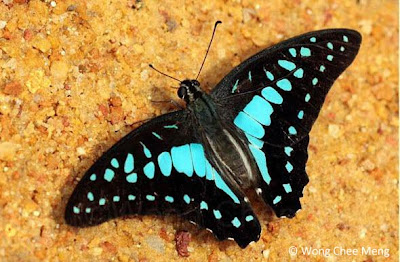
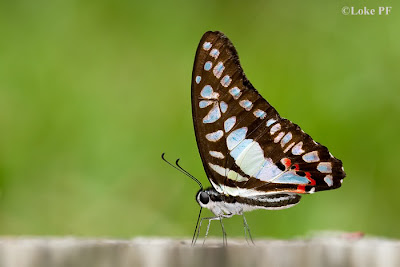
This month we feature a speedy butterfly, the Blue Jay (Graphium evemon eventus).  With a powerful and erratic flight, this butterfly is challenging to photograph, as it zips past observers at breakneck speed in the forested nature reserves of Singapore. However, when it stops to puddle at sandy streambanks, the odds of getting a closeup shot of the Blue Jay would be much better.


The Blue Jay is a forest-dependent butterfly, and is predominantly found in the nature reserves. It is seldom seen in urban parks and gardens. It is difficult to identify with certainty when in flight, and is often confused with the Common Bluebottle (Graphium sarpedon luctatius) and the Common Jay (Graphium doson evemonides), two other species of the same genus found in Singapore. Over in Malaysia, there are at least four more lookalike species that would add further to the confusion when trying to identify these butterflies in the field!
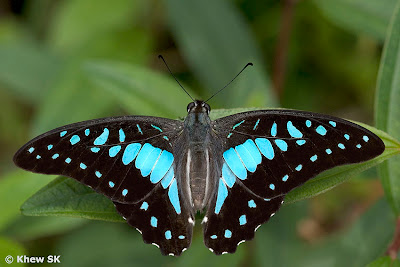

A Blue Jay opens its wings to sunbathe on a Melastoma bush after a long bout of puddling

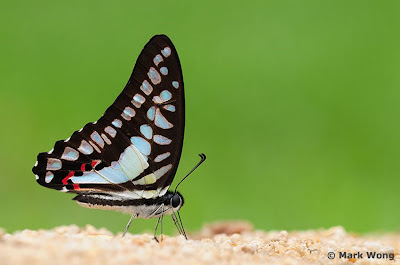
The Blue Jay wing's are black above with a blue macular band. Both the fore and hind wings have a series of blue submarginal spots. On the undersides, the spots are larger but takes on a slivery-blue hue. There is a series of bright red spots on the underside of the hindwings. The distinguishing black costal bar which is united with the basal bar on the underside of the hindwing distinguishes the Blue Jay from its other lookalike cousins.

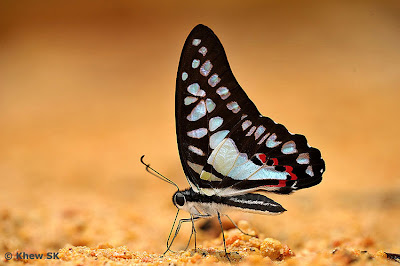


Blue Jays puddling at moist sandy streambanks (top and middle) and stopping to rest amongst the bushes (bottom)

Caterpillars of the Blue Jay are believed to feed on a type of Cinnamon that can be found quite commonly in the forested areas of Singapore. The head of the pupa features a horned process. The males of the species are often observed puddling at sandy streambanks in the company of other Papiliondae like the Common Bluebottle and the FiveBar Swordtail. It can be considered common and can almost be found throughout the year.
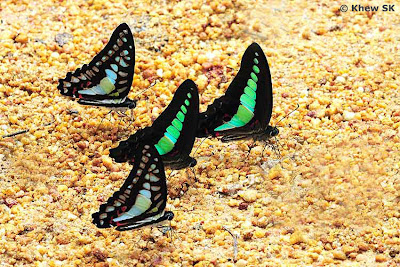

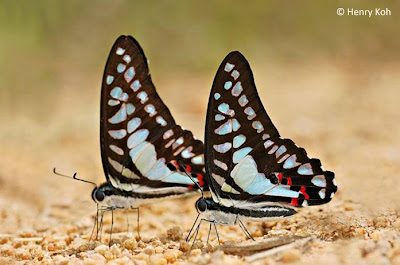
Two pairs of Blue Jays and Common Bluebottle puddling together

During puddling, it can be observed that the butterfly often ejects a stream of fluids out of its abdomen. This is probably due to the large amounts of water intake as it sucks up nutrients via its proboscis. Often, after a long period of puddling and having satiated itself, an individual flies to a nearby bush, and perches to rest with its wings opened fully to display its nice blue uppersides that contrast beautifully with the black borders.
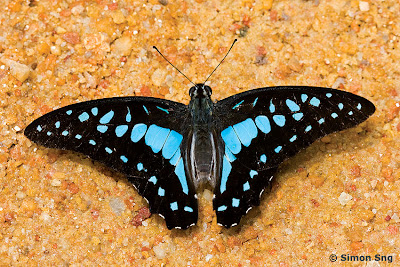


Text by Khew SK : Photos by Sunny Chir, Khew SK, Henry Koh, Loke PF, Simon Sng, Jonathan Soong, Anthony Wong, Mark Wong and Wong CM.

This blog post is dedicated to ButterflyCircle's youngest member, Brian Goh, who uses the nick "Blue Jay" on our forums. Brian represents the future generation of butterfly conservationists in Singapore.

23 January 2013

Random Gallery - Striped Blue Crow

Random Butterfly Gallery
The Striped Blue Crow (Euploea mulciber mulciber)


This Danainae belongs to a genus of butterflies that are called "Crows" presumably due to their generally drab brown or black wings. Many of the species are indeed black, dark blue or dark brown with white patches or spots on their wings. In Singapore, there are eight species of the genus Euploea that generally fall into these characteristics. At first glance, the Striped Blue Crow is no exception. The undersides of the butterfly are dark reddish brown with the usual white spotting.

However, when the male of the butterfly opens and shows off its forewings, the beautiful iridescent blue forewings makes this species probably the most attractive of the "Crow" butterflies. The species is moderately common, as its caterpillar is able to feed on a number of species of lactiferous plants that gives the caterpillar (and butterfly) some distasteful qualities that predators would avoid eating them. This male Striped Blue Crow displaying its shining blue wings was photographed by ButterflyCircle member Lemon Tea Yi Kai.

19 January 2013

Life History of the Banded Lineblue

Life History of the Banded Lineblue (Prosotas lutea sivoka)


Butterfly Biodata:
Genus: Prosotas H.H.Druce, 1891
Species: lutea Martin, 1895

Sub-species: sivoka Evans, 1910
Wingspan of Adult Butterfly: 18-22 mm
Caterpillar Local Host Plant:
Acacia concinna (Fabaceae, Leguminosae, common name: soap pod).


Physical Description of Adult Butterfly:
Upperside, both sexes are brown. Underside, both sexes are pale yellowish orange and  similarly marked in both wings with darker yellowish orange spots arranged the form of post-discal band, cell-end bar and subbasal markings. The forewing has a series of small black marginal spots and a series of faint dark yellowish orange submarginal spots. The hindwing has dark marginal spots in spaces 3-6, of which the one in space 6 is the largest. There are two tiny black tornal spots at the end of vein 1b, and a larger black  subtornal spot in space 2. The hindwing of this species is tailless.

A Banded Lineblue visiting a flower of Mile-a-minute.


Field Observations of Butterfly Behaviour:
This tiny species was recently discovered in Singapore (see this BC blog article for details). Sightings of  adults have typically been in the vicinity of its local host plant, either visiting flowers on nearby flowering shrubs/herbs or puddling on wet ground. In flight, they can easily be mistaken as other similarly-sized Lineblues. A definite identification can only be made when the butterfly perches briefly and allows its trademark hindwing marginal spot in space 6 to be observed.

16 January 2013

Random Gallery - Scarce Silverstreak

Random Butterfly Gallery
The Scarce Silverstreak (Iraota rochana boswelliana)


This fast-flying Lycaenid, the Scarce Silverstreak, can be found quite often in urban parks and gardens, usually in the vicinity of its caterpillar host plant, Ficus microcarpa.  The male is shining deep greenish-blue with broad black forewing borders, whilst the female is drab brown.  The underside is distinctively marked with brown and white streaks, and is unlikely to be mistaken for any other butterfly species in Singapore. 

This shot of a pristine male of the Scarce Silverstreak was taken by ButterflyCircle member Chng CK last Sunday at a herb garden.  Here it is featured perched on a leaf of Melastoma sp.  The complete life history has been recorded and can be found on ButterflyCircle's blog here.