01 December 2012

Favourite Nectaring Plants #2

Butterflies' Favourite Nectaring Plants
The String Bush (Cordia cylindristachya)


In this second article in the Favourite Nectaring Plants series, we take a look at a plant that is not that commonly cultivated in recent years. Nevertheless, where this plant occurs, it is quite a butterfly magnet! In my childhood days, I recall that this plant grew commonly as a hedge around gardens and attracted a myriad of insects, birds and reptiles. I wonder why this plant is no longer popular with landscape designers and gardeners these days.


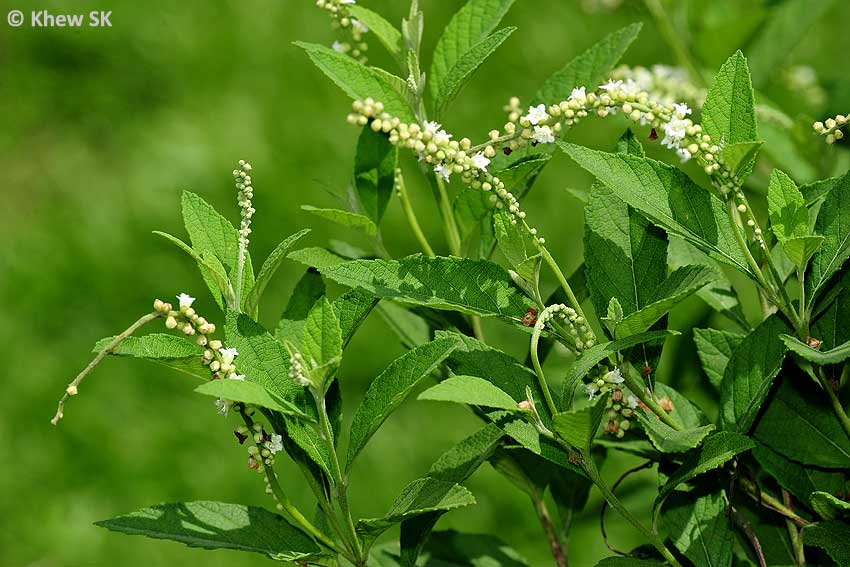
Flowering spikes of the String Bush that are attractive to butterflies

Perhaps NParks could considering bringing this plant back for the Park Connectors and various gardens and parks around Singapore to provide a greater diversity and choice of nectaring plants for butterflies and other critters to feed on.


Plant Biodata :
Family : Boraginaceae
Genus : Cordia
Species : cylindristachya
Country of Origin : Tropical America
English Common Name : String Bush


The String Bush (Cordia cylindristachya) belongs to the Heliotrope family, of which another related plant, the Indian Heliotrope (Heliotropium indicum) is a plant to which species of the Danainae family have a special affinity.  The String Bush is a bushy shrub, growing to 1-1.5m tall.  In larger and older bushes, the stems of the plant are woody and firm.


A top view of young leaves of the String Bush

The leaves of the String Bush are rough and velvety to the touch, relatively hairy, and dull green. Each leaf is eillptical or ovate with a sawtooth edge. The mature leaves are around 5-10cm long. The leaves grow from the stem in alternate arrangement. Young stems are light green, turning woody brown as the bush matures.


The elliptical and sawtooth edged leaf of a Stringbush (above) and the flower spike with the small white flowers (below)

The flowers are small, crowded in terminal spikes.The corolla of the flower is bell-shaped, light whitish cream in colour and measure about 4-6mm long. The pistil is creamy white whilst the stamens are pale buff. The fruits are globose , pale green and about 5mm in diameter attached on the spikes but turns red when ripe.


Lush bushes of the String Bush at Pasir Ris Park Butterfly Garden

It was a common hedge plant after its introduction from tropical America until the 60's in Malaysia and Singapore, gradually disappearing, most probably due to the introduction of a beetle Schematiza cordiae that was imported from Trinidad to control the String Bush from spreading too fast. Both the adult and larvae of the beetle feed on the leaves of the plant. Given that the plant is no longer very commonly seen in recent years, would this beetle still be around, or has moved on to feed on other plants in the family?


The String Bush can be grown as a hedge as the thick foliage can be used as a privacy screen

The String Bush has been observed growing wild at the old Mandai Orchid Garden (which is now no longer in existence), at the Butterfly Hill at Pulau Ubin, and at the Pasir Ris Butterfly Garden. The last named location features a good stock of several large healthy plants of the String Bush with lush growth of leaves and flower spikes attracting a myriad of butterflies on a daily basis.


The plant is drought resistant and can grow in relatively poor soil.However, in fertile soil, the plant grows lushly, reaching more than a metre high in a few months.It does better in locations with full sun.


Common Danainae species feeding on the flowers of the String Bush

The flowers do not produce any strong scent, but is highly popular with butterflies. It is interesting to observe that butterflies of various sizes from the larger Papilionidae to the small Lycaenidae all feed on the flowers of this plant. Of the larger Papilionidae, we have observed the common butterflies like the Lime Butterfly, Common Mormon, Common Mime and even the fast-flying Common Bluebottle feeding on the flowers.


The Pierids are also fond of the flowers of the String Bush, with the Emigrants, Grass Yellows and Striped Albatross seen feeding on the flowers. Nymphalidaes include all the four Pansys, the Baron and the occasional Autumn Leaf. The Danainaes love the flowers of the String Bush, in particular the Glassy Tigers, Plain/Common/Black Vein Tigers and even the odd King Crow!


The Lycaenidae that are attracted to the flowers of the String Bush shows quite a wide diversity, particularly at Pasir Ris Park. The smallest species of butterfly in Singapore, the Pygmy Grass Blue has also been seen feeding on the nectar from the String Bush flowers.  Various genera of Lycaenidae were observed to feed on the flowers and these include the Rapala, Tajuria, Prosotas, Hypolycaena, Anthene, Chilades, Catochrysops, Zizula, Zizina and Zizeeria.


Of the Hesperiidae, spotted at the flowers of the String Bush are the Polytremis, Pelopidas, Cephrenes, Hasora, Potanthus and Caltoris.


Although the String Bush is not an aesthetically attractive plant to landscape designers and gardeners, it is certainly an important addition to any garden that wants to attract butterflies.  It is hoped that this plant will make a comeback in Singapore's butterfly-friendly environment in the near future.

Text by Khew SK : Photos by Khew SK; Loke PF & Simon Sng

References :
  • Keng, Hsuan : The Concise Flora of Singapore, 1990 ; Singapore University Press
  • Foo, Tok Shiew : A Guide to the Wildflowers of Singapore, 1985 ; Singapore Science Centre
  • Boo, CM; Omar-Hor, K & Ou-Yang CL : 1001 Garden Plants in Singapore, 2nd Edition, 2006 ; National Parks Board
 

27 November 2012

Random Gallery - The Harlequin

Random Butterfly Gallery
The Harlequin (Taxila haquinus haquinus)


Here is another shot of a female Harlequin (Taxila haquinus haquinus) taken by ButterflyCircle member CK Chng a couple of weekends ago. This species is in critical danger of disappearing from the Singapore Butterfly fauna, as the solitary known site where a small colony of the Harlequins can be found with regularity is slated for development. ButterflyCircle had earlier attempted a translocation effort, but was unable to replicate all the ideal conditions for the species' continued survival. Hence the days for this pretty butterfly's existence in Singapore may be numbered.

Ironical though it may seem, the site where the last remaining Harlequin colony is found is earmarked for a development "focusing on hosting an environmentally friendly industry, the complex is being developed with an eye towards environmentally responsible practices, with "green" buildings and maintenance of natural terrain".

24 November 2012

Life History of the Common Disc Oakblue

Life History of the Common Disc Oakblue (Arhopala epimuta epiala)


Butterfly Biodata:
Genus:
Arhopala Biosduval 1832
Species: epimuta Moore 1858
Subspecies:
apiala Corbet 1941
Wingspan of Adult Butterfly: 40-42mm
Caterpillar Local Host Plants:
Vatica pauciflora (Dipterocarpaceae), Vatica rassak (Dipterocarpaceae), Vatica maingayi (Dipterocarpaceae).

A female Common Disc Oakblue resting on a leaf perch between oviposition runs.


Physical Description of Adult Butterfly:
Above, the male is deep shinning blue with a thread-line dark border on both wings, and on the forewing there is a broad circular discal patch; the female is shinning blue with very broad dark borders on both wings. Below, the wings are brown bearing brown spots outlined with whitish to yellowish brown striae. On the forewing, the post-discal spot in space 4 is shifted towards the termen and not aligned with spots in spaces 5 and 6. On the tailless hindiwng, (a) the post-discal spot in space 6 is placed mid-way between the spot in space 5 and the end-cell bar, with its inner edge aligned with the outer edge of spot in space 7; (b) there is a very short tooth at end of vein 2; (c) bluish scales are present in the margin of space 1b and upper end of space 1a, and (d) a small tuff of white cilia is present just below the end of vein 1b.


21 November 2012

Random Gallery - Common Palm Dart

Random Butterfly Gallery
The Common Palm Dart (Telicota colon stinga)


The Palm Darts - genus Telicota are moderately sized skippers with black and orange wings.  They are fast-flying and zip around rapidly amongst open grassy areas on hot sunny days.  Many of the species stop to sunbathe in the usual skipper fashion, with the hindwings opened flat, whilst the forewings are held opened at a 45deg angle to the body.  At other times, they perch proudly, almost on tip-toe, with their wings folded shut upright.

This shot showing a Common Palm Dart perched elegantly on a curved grass blade was taken by ButterflyCircle member Lemon Tea recently at an open wasteland in the eastern part of Singapore. The classic sharp and well-composed shot with a pleasing smooth green background makes for an excellently executed shot of this relatively common skipper.

19 November 2012

Random Gallery - Banded LineBlue

Random Butterfly Gallery
The Banded LineBlue (Prosotas lutea sivoka)


ISO800 1/200s F/8 , Fill-flashed , Handheld

A much-needed outing for ButterflyCircle member Sunny Chir on Sunday yielded a very nice shot of the Banded LineBlue.  This species was a recent discovery in Singapore and first found in the Bukit Brown cemetery area.  It remains a mystery why the Banded Line Blue has not been observed here in Singapore after so many years.

Sunny's shot is an example of a well-executed photograph in butterfly photography in many aspects :
  • A clean and creamy background that is well-lit
  • A flowering perch with yellow flowers that complement the rather drab butterfly
  • A well-composed shot using the rule of thirds (vertically and horizontally) on both the perch and the main subject
  • A butterfly that is feeding (note proboscis extended into the flower) and not just sitting there doing nothing
  • Sharply focused subject throughout
  • Well-balanced and pleasing lighting with good contrast between the subject and its background that allows the butterfly to stand out prominently in the photo

17 November 2012

Butterfly of the Month - November 2012

Butterfly of the Month - November 2012
The Sumatran Sunbeam (Curetis saronis sumatrana)


The month of November 2012 has certainly been an eventful one for global politics.  Two of the world's largest economies - China and the United States of America saw leadership 'adjustments'. In the case of the USA, the results of the elections put President Barack Obama back into the White House for a second four-year term in office. It would appear that many of the Asian economies prefer President Obama for his more open foreign policy.


On the other side of the globe, the world's most populous nation, China, saw the changing of the guard at its 18th Congress when President Hu Jintao relinquished his key posts to pave the way for the General-Secretary of the Chinese Communist Party Xi Jinping to take over the post of President in March 2013.


Back at home, the Singapore Parliament has just adjourned after another session of active debate over issues like the death penalty, casino (or gambling) control and a number of other less contentious Bills. The scandal of the NUS law scholar and his girlfriend's exhibitionist escapades on their blog took centrestage on social media for quite a few days this month. It does leave one wondering how the power of social media and the internet, and how the world communicates today, literally at the speed of light, will affect us in the years to come.


Back to nature. The flower of the month of November traditionally belongs to the Chrysanthemum. This flowering plant belongs to the family Asteraceae which are native to Asia and Eastern Europe. The Chrysanthemum can grow between 50-150cm tall, has deep leaves and large flower heads with dozens of petals. The Chrysanthemum is most commonly found in shades of white, pink, red and yellow. Yellow or white chrysanthemum flowers of the species C. morifolium are boiled to make a sweet drink in some parts of Asia. The resulting beverage is known simply as "chrysanthemum tea" (菊花茶, pinyin : júhuā chá).


Our feature butterfly of the month is the Sumatran Sunbeam (Curetis saronis sumatrana). This species belongs to the sub-family Curetinae of the family Lycaenidae. The Curetis spp., collectively referred to by their English name "Sunbeams" are fast-flying butterflies featuring usually bright orange-red or light orange uppersides in most of the species.


Two female Sumatran Sunbeams feeding on juices of the Noni fruit (Morinda citrifolia)

Only two Curetis species are reliably recorded from Singapore in the past few decades : the Malayan Sunbeam and the Sumatran Sunbeam. The latter species, our butterfly of the month, is often found in mangrove habitats where its host plant, Derris trifoliata grows in abundance. They can be seasonally common, where more than a dozen individuals may be spotted in a single outing.


Females are more often seen than males, probably because of their presence in the vicinity of their host plants, whilst males are more likely found at the tree tops. The butterfly is a strong flyer, skittish and has a habit of hiding on the underside of a leaf with its wings folded upright when disturbed. At other times, the species is fond of sunbathing with its wings partially opened, showing off its orange and black uppersides in sunlit spots along open paths in the mangrove habitats.


The male of the Sumatran Sunbeam has more angular wings and orange-red uppersides with narrower borders

The much rarer male of the Sumatran Sunbeam has a bright orange-red upperside with a narrow black border. The wings are more angular when compared to the females. The female has more rounded wings and the upperside is paler orange with broad black-dusted borders on the fore and hindwings. The undersides are silvery-white with lunulate post discal striae. The legs are red-banded.


The slug-like caterpillars feed on the host plant Derris trifoliata, a common creeper often found in mangroves and back-mangroves. This creeper is also a host plant of the Hesperiidae, the Common Awl (Hasora badra badra). The life history of the Sumatran Sunbeam has been documented in full on this blog.


Text by Khew SK : Photos by Sunny Chir, Chng CK, Federick Ho, Khew SK, Loke PF & Horace Tan.


15 November 2012

Random Gallery - Bigg's Brownie

Random Butterfly Gallery
Bigg's Brownie (Miletus biggsii biggsii)


The Bigg's Brownie is a relatively common species in Singapore.  It is most often seen fluttering restlessly in well-shaded areas at the fringes of the nature reserves as well as in various urban parks.  The species is associated with mealy bugs, aphids and coccids, on which their caterpillars feed.  The adult butterflies are observed flying around ant-infested young shoots of various plants.  The ants "farm" the mealy bugs for their sugary discharge, and do not seem to attack the intruding butterflies.

The species is light brown on the upperside, with an oblique white band on the forewings, which can vary across different individuals.  The underside is light greyish brown with dark markings outlined in white.  This individual was shot by ButterflyCircle member Koh Cher Hern recently.