15 November 2012

Random Gallery - Bigg's Brownie

Random Butterfly Gallery
Bigg's Brownie (Miletus biggsii biggsii)


The Bigg's Brownie is a relatively common species in Singapore.  It is most often seen fluttering restlessly in well-shaded areas at the fringes of the nature reserves as well as in various urban parks.  The species is associated with mealy bugs, aphids and coccids, on which their caterpillars feed.  The adult butterflies are observed flying around ant-infested young shoots of various plants.  The ants "farm" the mealy bugs for their sugary discharge, and do not seem to attack the intruding butterflies.

The species is light brown on the upperside, with an oblique white band on the forewings, which can vary across different individuals.  The underside is light greyish brown with dark markings outlined in white.  This individual was shot by ButterflyCircle member Koh Cher Hern recently. 

09 November 2012

Life History of the Leopard Lacewing

Life History of the Leopard Lacewing (Cethosia cyane)


Butterfly Biodata:
Genus: Cethosia Fabricius, 1807
Species: cyane Drury, 1773
Wingspan of Adult Butterfly: 80mm
Caterpillar Local Host Plants: Passiflora foetida (Passifloraceae), Adenia macrophylla var. singaporeana (Passifloraceae)


A female Leopard Lacewing visiting the flower of Bidens alba.

A female Leopard Lacewing.

A female Leopard Lacewing showing its uppersidevisiting Lantana flowers.

Physical Description of Adult Butterfly:
Above, the male is orange with apical two-thirds of the forewing black with a white and oblique band lying within. The termen of both forewing and hindwing  is indented and lined with a broad and black marginal area containing a lace-like pattern of white markings. The female is mostly similar but with the orange background replaced with a  pale yellowish to whitish coloration, and has its hindwing endowed with more discal and postdiscal black spots.    Underneath, the wings are variegated with orange, red, white, black and blue. In the forewing, the cell area is transversed with bars of black, bluish-white and  red coloration, beyond which a broad, white and oblique band lies just below the subapical area. In the hindwing, the ground colour is orange in the male and pale creamy yellow in the female. The basal area and the costal margin are crossed by short black lines, with the ground colour more reddish in the male. A somewhat broad discal band and a narrow post-discal band, both white, are  bordered with  black spots and striae.  As in the upperside, the terminal margins are black and house lace-like white markings, with additional short white straie pointing from the margin inwards to the tip of the V-shaped markings. 

03 November 2012

Another New Discovery makes it #305!

Another New Discovery makes it #305!
The Yellow Flat (Mooreana trichoneura trichoneura)


The year 2012 must be a particularly lucky one for ButterflyCircle member Federick Ho. Of the four new species observed by ButterflyCircle members this year, Federick contributed a hat-trick (i.e. 3 hits) to the Singapore Checklist! Spotting new and unrecorded species of butterflies out in the field is a combination of being out at the right time of the day, a pair of sharp eyes, and a matter of being at the right place at the right time, and Federick is doing exactly that so far !


All the four new additions to the Singapore Checklist this year were considered new discoveries, as all four species were not recorded by the early authors in their respective checklists [Ref 1 & 2]. These species are therefore considered new to the Singapore butterfly fauna and it is quite consistent with some of the discoveries from the past years during this period of the north-easterly winds. One theory is that the NE monsoon winds may have carried some species southwards to Singapore from across the Causeway. Of course, some of these new finds could already have existed in the less-explored forested areas of Singapore, just waiting for someone to spot them.


This morning, a quartet of ButterflyCircle members - Federick Ho, Loke PF, Simon Sng and newbie Huang CJ, were out on their usual weekend butterfly shooting hunt when Federick spotted something that he hadn't seen before in Singapore. He signalled for the rest of the team to hurry to his location, whilst taking shots of his new find.


As it turned out, this attractive Hesperiidae from the sub-family Pyrginae (or commonly referred to as the "Flats") known as the Yellow Flat (Mooreana trichoneura trichoneura) has been seen for the first time in Singapore.  This skipper has not been recorded in Singapore before, and is thus a new discovery. ButterflyCircle records it as species #305 in the Singapore Checklist.

The Yellow Flat is described as a forest-dependent species found in lowland jungles up to 2,500ft. In the males, both the mid- and hind-tibiae feature a hair tuft. Its distribution is relatively wide, stretching from India to Thailand and Malaysia and all the way to the Philippines. The upperside is dark brown with a number of hyaline spots on the forewings.  The hindwing has a series of wedge-shaped discal spots and the tornal area is prominently yellow.  On the underside, the colours are more muted, appearing as a pale yellowish white.


Males and females are similar in appearance. The butterfly has a habit similar to many other members of the sub-family and flies swiftly, often perched on the underside of a leaf with its wings spread open flat. The butterfly is described as "rare on the forested plains in Malaya"


Was the species extant in Singapore all this time? Or is it a newcomer "foreign talent" that had just migrated into the forests of Singapore? This rather pristine individual spotted this morning suggests that the species was not one that had travelled far as it showed relatively little wear and tear on its wings. Whatever its origins, we welcome another new species to our sunny little island. And we hope that Federick's lucky streak will continue!

Text by Khew SK : Photos by Federick Ho, Huang CJ, Loke PF & Simon Sng

References:

  1. The Butterflies of The Malay Peninsula, A.S. Corbet and H.M. Pendlebury, 4th Edition, Malayan Nature Society. 1991
  2. Butterflies of West Malaysia and Singapore, WA Fleming, 2nd Edition, Longmans, 1983
  3. Butterflies of Thailand, Pisuth Ek-Amnuay, 2nd Edition, Amarin Printing & Publishing, 2012.


01 November 2012

Random Gallery - Apefly

Random Butterfly Gallery
The Apefly (Spalgis epius epius)


This diminutive butterfly, the Apefly (Spalgis epius epius) belongs to the family Miletinae, collectively referred to as the 'Harvesters'. The caterpillars of the butterfiles of this family are typically carnivourous and feed on coccids, mealy bugs, aphids and even ant larvae. The Apefly is brown and usually unmarked on the upperside, whilst the underside is a greyish buff covered with striations

This Apefly resting on some young leaves, was photographed last weekend by ButterflyCircle member Loke PF at an urban hill park.  The rounded forewings indicate that this is a female of the species, where males typically have sharper wings, particularly a more angled apex on the forewings.

30 October 2012

Random Gallery - Cruiser

Random Butterfly Gallery
The Cruiser (Vindula dejone erotella)


Last Sunday was scorching hot out in the field, and ButterflyCircle member EC Goh managed to nail an excellent shot of this puddling male Cruiser (Vindula dejone erotella) within the Central Catchment Area nature reserves.  The Cruiser is a common forest butterfly that makes rare forays into urban areas.  The species is dimorphic, in that the male and female are different in appearance.

This shot was taken under direct sun, and EC did well in maintaining the exposure of the underside of the butterfly without blowing out the details. The added bonus that makes this shot special, are the extended legs of the butterfly, that makes it look like a ballerina on tip-toe.


27 October 2012

Butterfly of the Month - October 2012

Butterfly of the Month - October 2012
The Orange Emigrant (Catopsilia scylla cornelia)
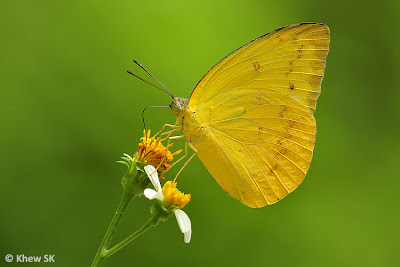


"The falling leaves drift by the window... The autumn leaves of red and gold", so goes the lyrics of an oldie, Autumn Leaves.  This version of the Autumn Leaves is in tribute to Andy Williams, who passed away at the age of 85 last month.  This crooner was very much a part of my growing up years as he entertained my family with many of his golden sentimental hits of yesteryear.  As the colours of autumn begin to paint the landscapes of the northern hemisphere, we are now almost at the end of October 2012.   
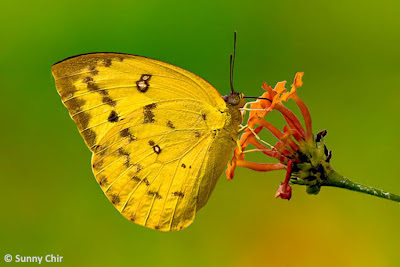

A heavily-marked female Orange Emigrant feeding on the flowers of Lantana

A couple of months back in my August 2012 article, I mentioned how social media has pervaded many aspects of our lives, and how we interact and relate to the community at large.  Whilst social media platforms like Facebook has its positive side of bringing people and communities together to share information, a grim reminder of the 'dark side' of being too open and vocal with one's thoughts was played out in Singapore recently.


An Assistant Director of the Singapore National Trades Union Congress, probably irritated at the noise from activities at the void deck of her residential block, posted rather inflammatory and racist comments on her Facebook wall.  She was summarily terminated from her employment in all of 24 hours, and the cyberworld was aflame with comments from all and sundry.
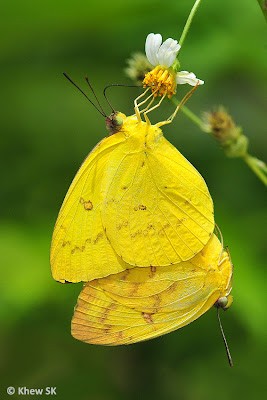

A "multi-tasking male Orange Emigrant feeds as it remains mated to the female

A grim reminder indeed, at the seriousness with which racist comments can be dealt with, in multi-racial Singapore, where its delicate racial harmony cannot be taken for granted. And also a timely reminder that in social media platforms like Facebook, one cannot be too careful about saying something and assume that it is only for private viewing. The speed at which socially unacceptable comments can go viral is quite literally, at the speed of light!
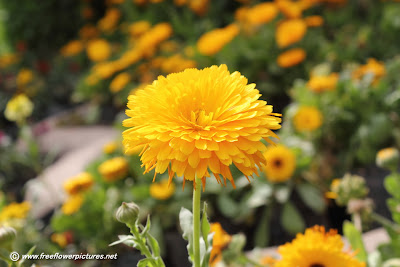


Coming back to our world of nature, a definitely more benign and peaceful world, the month of October is associated with the Calendula or Marigold. It belongs to a genus of about 20 perennial or herbaceous plants belonging to the daisy family Asteraceae. The Calendula normally has layered petals that are oval in shape and can grow to be 3-7cm across. The colours range through various shades of yellow and orange.
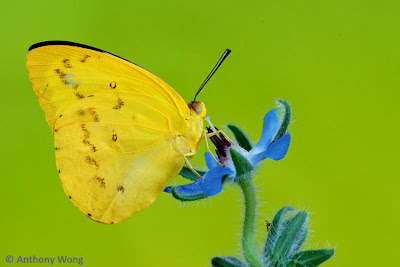


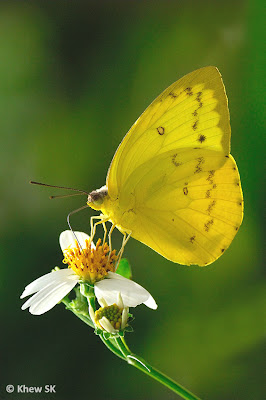
Also featuring a rich orange-yellow colour, is our butterfly of the month, the Orange Emigrant (Catopsilia scylla cornelia).  A predominantly urban butterfly, the Orange Emigrant is often observed in the company of other Pierids, flying powerfully and restlessly in parks and gardens in Singapore.  It has a strong and erratic flight, and is skittish.
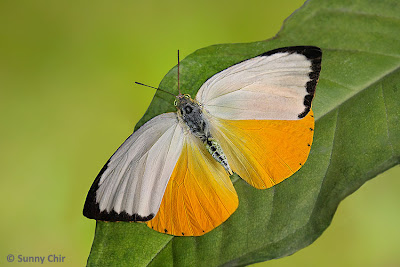

A rare upperside shot of a male Orange Emigrant

The Orange Emigrant has white forewings with black borders and deep orange-yellow hindwings on the upperside.  On the underside, both the fore and hindwings are orange-yellow with dark brownish spots and markings.  The female has a series of irregular sub-marginal spots on the forewing above and a broad black marginal border on the hindwing.  The underside markings of the female are more prominent and often of a deeper orange than the male.
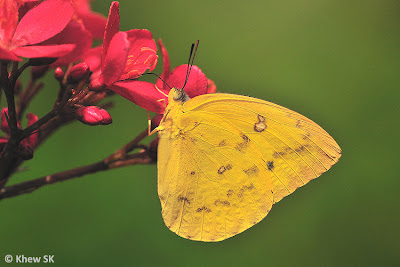


The butterfly is often found fluttering around the bushes of its preferred caterpillar host plant, Senna surattensis (Scrambled Egg Bush or Glaucous Cassia).  This roadside plant is common in Singapore, and is cultivated as a popular landscaping bush with its green foliage and bright yellow flowers.
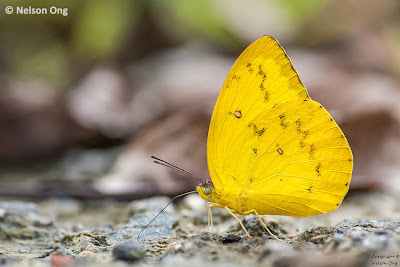

A puddling male Orange Emigrant

The Orange Emigrant is relatively common although the species cannot be said to be abundant or as common as its relative, the Lemon Emigrant. Unlike the Lemon Emigrant, which has many male and female forms, the Orange Emigrant occurs in only a single consistent physical appearance. It is most active on hot sunny days, and flies at treetops as well as coming down frequently to feed on flowers of its favourite nectaring plants.  Occasionally, males of the species are observed to puddle on damp forest paths.


Text by Khew SK : Photos by Sunny Chir, Khew SK, Nelson Ong, Anthony Wong & Benjamin Yam


23 October 2012

A New Taxon for Singapore!

A New Taxon for Singapore!
Discovery of the Banded Lineblue (Prosotas lutea sivoka)


Our new addition to the Singapore Checklist, Prosotas lutea sivoka

It's rather intriguing that when we least expect it, a species that may have been hiding in certain localised patches of forests in Singapore suddenly turns up out of the blue.  In this particular instance, a very small butterfly at that!  Last weekend, ButterflyCircle member Federick Ho was out exploring the relatively urban forested area of Bukit Brown cemetery when he came across something that looked strange fluttering amongst the bushes.  He managed to take a relatively good shot of it that sufficed to identify it as the Banded Lineblue (Prosotas lutea sivoka)

According to the two tomes about butterflies of Malaysia and Singapore - Corbet & Pendlebury's "Butterflies of the Malay Peninsula (C&P4) and W.A. Fleming's "Butterflies of West Malaysia and Singapore", this species is normally found in primary forest below 2,500 ft.  It has not been recorded from Singapore before.  


Another shot of a Prosotas lutea sivoka taken at Fraser's Hill in Malaysia for comparison

Another recce trip a couple of days later by ButterflyCircle member Horace Tan also yielded a further sighting of this species at the same location, validating Federick's earlier find.  We now add this diminutive Lycaenidae to the Singapore Butterfly Checklist as species #304.  Whilst a number of new species to be added to the checklist are still under investigation by various experts, this little Prosotas, that is so distinctly marked as to eliminate any doubt as to its identity, will be henceforth included in the checklist.  


A heavily cropped shot of another individual of the new find shot by Horace Tan on a different day

The hindwing subapical spot in space 6 and sometimes in space 5 as well as the two tornal spots, one in space 2 and a much smaller one in space 1b, puts it beyond doubt that this is Prosotas lutea sivoka.  It is a new find for Singapore, and more importantly first found in the 0.86 km2 Bukit Brown cemetery - an area that had sparked off some controversy when the Land Transport Authority announced plans to construct a new road across the site.  

Why is it that after all these years, this species eluded all the butterfly watchers in Singapore?  Did it just recently appear, or was it hiding in the Bukit Brown area, just waiting for someone to discover it?  We cannot say for sure.  We only hope that with the adjusted alignment of the proposed road at Bukit Brown, this species will still continue to survive at its current habitat, and perhaps other parts of Singapore.

Text by Khew SK : Photos by Federick Ho, Lemon Tea & Horace Tan

References: