20 June 2012

Random Gallery - Arhopala aurea

Random Butterfly Gallery
(Arhopala aurea)


Sightings of the very rare Arhopala aurea are limited to a few locations around the Central Catchment Nature Reserves in Singapore.  However, they have been quite regularly sighted over the years.  Males are a brassy green on the upperside with a slight bluish tint at the wing bases.  Females are the usual Arhopala purple.  This excellent shot of Arhopala aurea was taken by ButterflyCircle member Sunny Chir in June 2012. Sightings of this species are few and far between, so this shot is extra special in terms of photographic quality and the pristine specimen of this rare Lycaenid.


16 June 2012

Butterfly of the Month - June 2012

Butterfly of the Month - June 2012
The Great Helen (Papilio iswara iswara)


We head towards the halfway mark of 2012 as the month of June is already upon us.  We had the Festival of Biodiversity at the end of last month, and ButterflyCircle was given its due exposure at the festival, particularly with the launch of our 2nd book, Caterpillars of Singapore's Butterflies.  The contributions of our members to further the knowledge of butterflies in the region have been significant.  


As the excitement of the new caterpillar book took centrestage for us at the festival, I had to leave Singapore on the evening of the launch for a significant event for the company that I work for. Over in Beijing, some landmark events took place with all the formal pomp and ceremony expected of the Chinese culture. It was a happy occasion and no doubt a memorable one for me.


Hall of Supreme Harmony - Beijing, China.  Note the blue skies and clear air - something that I was told not to take for granted in Beijing.

It was the first time in my life, that I had stepped foot in the city of Beijing.  My hosts and bosses spared no effort to making my experience a good one, with sumptuous meals and a short tour of the many landmarks in the Chinese capital.  Beijing is full of history and culture, yet bustles with all the modern conveniences that any city in a developed country would boast.  


Beijing National Stadium - fondly referred to as the "Bird's Nest"

Back here in Southeast Asia, the 'butterfly season' has begun.  Already, ButterflyCircle members have been spotting species that are seldom seen, besides observing a larger number of butterflies around Singapore.  A few members also made it further afar during the school holiday month in Singapore, going to various parts of Malaysia, Hong Kong and even the USA!  


June's Flower of the Month is the ever popular rose.  The rose is a beloved flower for its beauty and fragrance with a long history of symbolism and meaning. The ancient Greeks and Romans associated the roses with their goddesses of love Aphrodite and Venus which is probably what has led to the red rose being considered the rose of love in today's modern culture.


We feature a 'giant' amongst butterflies here in Singapore this month - the Great Helen (Papilio iswara iswara).  Interestingly, the Latin name iswara probably originated from the Sanskrit word ishvara.  In Sanskrit and in the languages of some Indianized countries that have borrowed vocabulary from Sanskrit, "Ishvara" is also used to denote a "lord" in a temporal sense, as any master or king.


A male Great Helen

An apt name for a large and spectacular butterfly, the Great Helen.  This large and showy species, with a wingspan that often exceeds 130mm, usually seen flying erratically in the forested nature reserves of Singapore.  It is a sight to behold, as it flies past an observer, with the white hindwing patches and large spatulate tails as it weaves amongst the shrubbery and tree canopy in the forests.  


A female Great Helen - note the large black red-ringed ocelli at the tornal area of the hindwings

The large black butterfly has white streaks on the forewings and a white patch on the hindwing that extends from vein 4 to the apex.  The female has large black ocelli ringed with deep red in spaces 1a and 2 on the hindwing above, reminescent of a pair of roses.  On the underside the white patches are obvious with black red-ringed ocelli at the tornal area of the hindwing, with blue submarginal spots.  The is a large and thick spatulate tail at vein 2.


The butterfly folds is forewings over its hindwings such that the white hindwing patches are concealed.  Upon taking flight, a sudden white flash is displayed.  This is believed to startle would-be predators into taking a moment's hesitance that could give the flying butterfly a momentary opportunity to escape.  The butterflies often visit flowering trees and shrubs like Syzygium, Saraca and Ixora in the forests.


Two males and one female Great Helens frolicking high at the treetops whilst feeding on the flowering Syzygium tree


4th instar caterpillars of the Great Helen

The Great Helen is essentially a forest-dependent butterfly and its caterpillar host plant is Maclurodendron porteri (Rutacaea).  The life history has been recorded in detail by ButterflyCircle's Horace Tan on this blog here.   It is also noteworthy that Malaysian carmaker Proton Industries, even named one of its car models after the name of the Great Helen.  This was the subcompact model Proton Iswara that was launched in 1992 and was in production until 2003.


The wet weather in the early months of 2012 appeared to have made way for scorching hot and humid days in June.  Already, the yearly scourge of environmental irresponsibility of a certain neighbouring country, largely due to the way forests are cleared by burning, is upon the region.  The Malaysian capital city of Kuala Lumpur was shrouded in choking haze for the past couple of days, and it will be a matter of time before Singapore's quality of air deteriorates.

When will Man ever learn that Mother Earth can only take so much abuse?  


Text by Khew SK : Photos by Khew SK, Henry Koh, Koh CH, Bobby Mun, Nelson Ong, Tan CP & Horace Tan

13 June 2012

Random Gallery - Semanga superba deliciosa

Random Butterfly Gallery
(Semanga superba deliciosa)


This week's random butterfly needs no introduction.  With a name like superba and deliciosa, who needs a common name to remember it! : )   This beautiful Lycaenid never fails to attract ButterflyCircle members whenever it appears.  A fast-flying but small species, it is moderately rare, but has a wide distribution across parks, gardens and the nature areas in Singapore.  Here, ButterflyCircle member Loke PF shot this pristine female perched elegantly on a blade of grass.   Females of this species feature three pairs of tails, whilst males have only two pairs.  


09 June 2012

Life History of the Acacia Blue

Life History of the Acacia Blue (Surendra vivarna amisena)


Butterfly Biodata:
Genus: Surendra Moore, 1881
Species: vivarna Fabricius, 1793

Sub-species: amisena Fruhstorfer, 1912
Wingspan of Adult Butterfly: 28-32mm
Caterpillar Local Host Plants:
Falcateria moluccana (Leguminosae, common name: Albizia), Parkia speciosa (Leguminosae, common name: Petai), Saraca thaipingensis (Leguminosae, common name: Yellow Saraca), Archidendron jiringa (Leguminosae, common name: Jering), Mimosa pigra (Leguminosae, common name: Giant Sensitive Tree).


A male Acacia Blue displaying its upperside.

Physical Description of Adult Butterfly:
Above, the male is shining purplish blue with broad black apical border on the forewing and broad black borders on the costal and inner margins of the hindwing. The female is steely blue with thin black borders on both wings.  Underneath, both sexes are brown with an irregular dark brown post-discal line on both wings but with that on the hindwing outwardly edged with white. Both wings have a series of dark submarginal striae and a dark rounded submarginal spot is present in space 6 of the hindwing.  Both wings have a more obscure sub-basal series of dark striae  with the striae in space 7 of the hindwing inwardly edged in white. The hindwing has a white-tipped tail at vein 2, and a tooth at vein 3, both being longer in the female than in the male. There is an obscure dark tornal spot and another similar marginal spot in space 2 on the hindwing, with metallic bluish green scalings overlay these spots and covering the marginal/sub-marginal space between these two spots.

A female Acacia Blue displaying its upperside.


Field Observations of Butterfly Behaviour:
The Acacia Blue is relatively common in Singapore. The adults can be sighted in  forested areas within the nature reserves and wastelands, and occasionally in urban parks and gardens. They have a a rapid flight and can be observed to sun-bathe with fully open wings in sun-lit conditions. A good opportunity to photograph the skittish adults is when they visit the ripening fruits of the Singapore Rhododendron for their energy intake. The females are more likely to be seen in the vicinity of their host plants.


Early Stages:
The immature stages of Acacia Blue are polyphagous. To date 5 plants in Leguminosae have been recorded as its local hosts. Caterpillars of all instars feed on young   leaves of the host plants, and are fond of imbibing nectary fluid from the glands occuring on the petiole and rachis of the host plants. In the field, the caterpillars live in association with ants visiting the same plants for nectary intake. However, in home breeding settings, the caterpillars have no problem reaching adulthood in the absence of ants.

Local host plant #1: Parkia speciosa.

Local host plant #2: Falcateria moluccana.

Eggs are laid on the underside of a young leaf or other parts of a young shoot of the host plant. The egg is whitish with a green undertone and is about 07-0.8mm in diameter. It is shaped like a slightly flattened chinese bun with the surface is reticulated with interconnecting ridges which raise sharply at the intersections.  As is typical, the depressed micropylar is found in the polar region.

A mother Acacia Blue laying an egg on the underside of an Albizia leaf.

Two views of an egg of the Acacia Blue. Diameter: 0.7-0.8mm.

A young shoot of Mimosa pigra with 3 eggs deposited on the stalk of a flower bud.

Each egg takes about 3 days to hatch. The young caterpillar emerges after nibbling away sufficiently large upper portion of the egg shell. Measured at a length of about 1.3-1.4mm, its dark yellow  body bears lateral brown patches. Long white-tipped dark setae occur dorso-laterally and whitish long setae along the peripheral rim of the body. Its head capsule is dark brown to black, and both its prothoracic shield and anal plate are colored as per the body base colour.

A group of three eggs over the span of four days, with those in the right panel have the polar part of the egg shells nibbled away by the soon-to-emerge caterpillars.

As the caterpillar feeds and grows, the body base colour becomes paler yellow with a strong green undertone. This instar lasts for about 3 days with the body length reaching up to 3mm.

Two views of  1st instar caterpillar, early in this stage, length: 1.9mm.

Two views of a 1st instar caterpillar, length: 3mm.

Two views of a 1st instar caterpillar, dormant prior to its moult, length: 2.5mm.

Covered with numerous short setae, the body of the 2nd instar caterpillar is  yellowish green with obscure white oblique stripes occurring laterally. The prothoracic shield is marked with two vertical dark stripes, and the head capsule has changed to a pale yellowish brown coloration. The dorsal nectary organ on the 7th abdominal segment and the tentacular organs on the 8th abdominal segment are now distinguishable. The body colour gradually loses the yellow tone and becomes much greener. The growth in this stage brings the caterpillar to a length of about 6mm, and after about 4-5 days in this stage, it moults again.

Two views of a 2nd instar caterpillar, early in this stage, length: 3.8mm.

Two views of a 2nd instar caterpillar, late in this stage, length: 5.8mm.

The 3rd instar caterpillar resembles the 2nd instar caterpillar closely with minor changes observed. The oblique lateral stripes are now more prominent,  being more whitish and outlined with darker green than the base green colour. A faint dorsal band, in darker green, run lengthwise. The peripheral rim of the body is yellowish to whitish. Both DNO and TOs are now rather proiminent, with the eversion of the TOs readily observed. This instar takes 4-5 days to complete with the body length reaching about 12mm before the next moult.

Two views of a 3rd instar caterpillar, length: 8.5mm.

Two views of a 3rd instar caterpillar, late in this stage, length: 9.8mm.

A 3rd instar caterpillar stationed next to the nectary gland of the host plant with ants in attendance.

A close-up view of the posterior end of a 3rd instar caterpillar, showing the dorsal nectary organ (DNO) and tentacular organs (TOs).

The 4th instar caterpillar bear similar markings as the 3rd instar but with greater colour contrast throughout. The lateral white stripes are now broader and flanked with broader dark green stripes. The dark green dorsal band is also broader and more prominent.   This final instar lasts about 9-11 days with length reaching 20mm.

Two views of a newly moulted 4th instar caterpillar, length: 11.5mm.

Two views of a 4th instar caterpillar, length: 14.5mm.

A 4th instar caterpillar imbibing fluid from a nectary gland of a Petai plant in the nature reserve


An ant attending to an Acacia Blue caterpillar. Note the eversion of the TOs at the 24th second mark.

Towards the end of the 4th instar, the caterpillar ceases eating and its body turns mostly reddish to purplish brown. It wanders around for a pupation site, and  in most cases chooses a spot on a leaf surface. At this time, the caterpillar's body shrinks in length and its body has changed to mostly purplish brown with dark green lateral patches. At the pupation site, the caterpillar spins a silk pad and a silk girdle to secure itself and becomes an immobile pre-pupa.

A late 4th instar caterpillar with body color already changed to reddish/purplish brown.

Two views of a pre-pupa of the Acacia Blue.

Pupation takes place after 1.5-2 days of the pre-pupal stage. The pale brownish pupa has the typical lycaenid shape,  and numerous irregular shaped dark brown to black speckles. Length of the pupa: 10-11mm.


An Acacia Blue caterpillar moults to its pupal stage.

Two views of a pupa of the Acacia Blue.

7.5-8 days later, the mature pupa turns dark in the thoracic and wing case areas,  with bluish markings apparent in the wing case. The next day the adult butterfly emerges from the pupa

Two views of a mature pupa of the Acacia Blue.

A newly eclosed Acacia Blue.

References:
  • [C&P4] The Butterflies of The Malay Peninsula, A.S. Corbet and H.M. Pendlebury, 4th Edition, The Malayan Nature Society.
  • A Field Guide to the Butterflies of Singapore, Khew S K, Ink on Paper Comm. Pte. Ltd., 2010. 
  • Butterflies of Thailand, Pisuth EK-Amnuay, 1st Edition, 2006.
Text by Horace Tan, Photos by Jonathan Soong, Bobby Mun, Nelson Ong, Sunny Chir and Horace Tan

02 June 2012

ButterflyCircle at the Festival of Biodiversity

ButterflyCircle at the Festival of Biodiversity


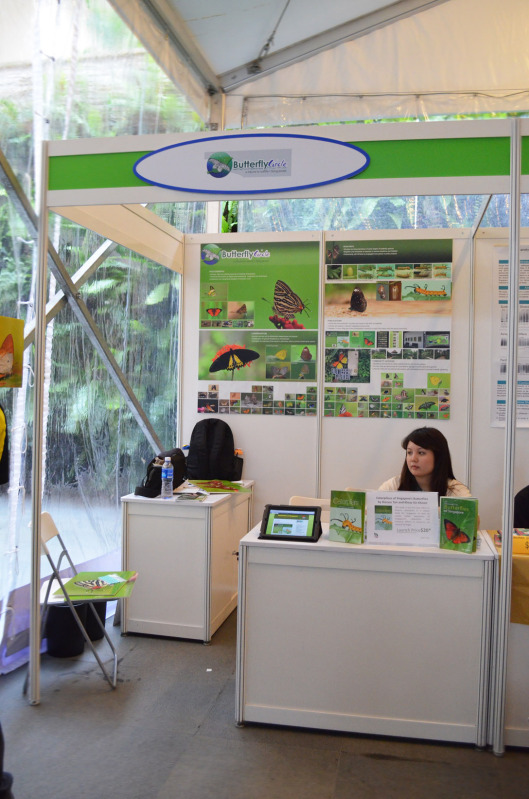
Last Saturday and Sunday, 26/27 May 2012 saw the largest ever gathering of Singapore's nature-loving community, at the Botany Centre of the Singapore Botanic Gardens.  Called the Festival of Biodiversity, it was a two-day event with many nature groups featuring their different types of work and effort on Singapore's biodiversity.  The Festival was jointly organised by the National Parks Board and the Biodiversity Roundtable as a platform to showcase the nature community's efforts and raise awareness of Singapore's biodiversity.


This was the first time ButterflyCircle was represented at a public event and we made the extra effort to showcase our mission and objectives of our online community of butterfly enthusiasts and photographers.  A good start was to portray ButterflyCircle members' works in a poster collage of photos and projects in which we were involved.  The poster was ably designed and put together by CJ, who spent a commendable effort on the two A0-sized boards.


On Saturday, ButterflyCircle's booth was manned by several volunteers, notably our two young and energetic 'youth-wing' members, Brian Goh and Jonathan Soong.  They were there at the booth as early as 9am, and joined later by our infamous twins, Mark and Anthony.  NParks' Rachel Lim, who commenced the sale of the "Caterpillars of Singapore's Butterflies" at the special Festival price of S$20 (normal price S$26).

ButterflyCircle's Youth Wing members

As the day wore on, more ButterflyCircle members turned up to support.  Our booth was teeming with activity as the caterpillar book sales picked up with more members of the nature community and public showing keen interest in a book that exclusively features caterpillars for the first time in Singapore.  Horace and I were there to autograph the books for the buyers who were keen to get the authors signatures to their latest book to add to their collection.  


At around 3:30pm, just before the official launch of the Festival of Biodiversity by President Tony Tan Keng Yam, the President of the Republic of Singapore, more members showed up in full support of ButterflyCircle.  At least 30 of our more active members showed up, including several members who had gone into hibernation due to their own work or family commitments.  It was a time to catch up with old friends and make new ones!

Satisfied customers!

When the President arrived, the crowd gathered at the Function Hall.  Minister of State, BG(NS) Tan Chuan Jin gave the opening address to the nature community. He shared many government initiatives to enhance Singapore's biodiversity and to encourage the public to be aware and conserve our rich natural heritage.  


President Tony Tan then went on stage to launch two new books - "Our Fragile Rainforest" by Leong Tzi Ming and James Gan and ButterflyCircle's own "Caterpillars of Singapore's Butterflies" by Horace Tan and Khew Sin Khoon.  Our special thanks also, to MOS Tan Chuan Jin for penning the foreword in our book. 

Presenting the Caterpillars of Singapore's Butterflies to President Tony Tan

After the formalities, the VIP entourage went on a tour to the exhibitions and booths on the 1st and 2nd levels of the Botany Centre.  Thanks to NParks, all the booths were well organised and adequately protected from the elements with transparent plastic curtains.  Fortunately, the rains stayed away, and everyone enjoyed good sunny (albeit hot and humid) weather.

President Tony Tan with ButterflyCircle members

President Tony Tan was given a quick tour of ButterflyCircle's booth and I also presented him a copy of our first book, "A Field Guide to the Butterflies of Singapore".  The President gamely posed for a group shot with ButterflyCircle's members who were there at the booth.

Getting MOS Tan Chuan Jin's autograph

MOS Tan sportingly autographed the books of our members who were brave enough to request for his signature, starting with our enthusiastic Brian Goh.  As the other members saw how approachable and friendly MOS Tan was, there was soon a queue to get his autograph!  It was heartwarming to note that MOS Tan carefully penned a few personalised words for each of our members, rather than just signing his name.  Thanks MOS Tan!  :)  

Sunny with the President

ButterflyCircle's youngest and oldest member also managed to collect President Tony Tan's autograph for their respective copies of the Caterpillars of Singapore's Butterflies books!  

ButterflyCircle members' group shot!  Well done everyone!

All too soon, it was time to bid farewell as everyone left with a memorable experience of this special day for ButterflyCircle, and also the nature community in Singapore.  As I had to rush to the airport to catch a late night flight to Beijing, I missed the further excitement of Part II of the Festival on Sunday.  All in all, it was a good experience for everyone involved in the Festival, and I would like to take this opportunity to thank our members who turned up in force to support us.  

We look forward to the next Festival of Biodiversity in 2013!  

Text by Khew SK : Photos by Loke PF, Huang CJ, Bobby Mun, Sunny Chir and Chng CK.

Acknowledgements : Special thanks to Huang CJ for the design and production of ButterflyCircle's posters for the booth.  Thanks to Mark Wong, Anthony Wong, Jonathan Soong, Goh EC, Brian Goh, Loke PF, Sum CM & Federick Ho for helping out at the booth.  Rachel Lim and staff of NParks for kindly agreeing to sell our book at the BC booth.  And of course, my hardworking co-author, Horace Tan for contributing his effort and time to make the book a reality!  

Other Links to the Festival of Biodiversity