02 June 2012

ButterflyCircle at the Festival of Biodiversity

ButterflyCircle at the Festival of Biodiversity


Last Saturday and Sunday, 26/27 May 2012 saw the largest ever gathering of Singapore's nature-loving community, at the Botany Centre of the Singapore Botanic Gardens.  Called the Festival of Biodiversity, it was a two-day event with many nature groups featuring their different types of work and effort on Singapore's biodiversity.  The Festival was jointly organised by the National Parks Board and the Biodiversity Roundtable as a platform to showcase the nature community's efforts and raise awareness of Singapore's biodiversity.


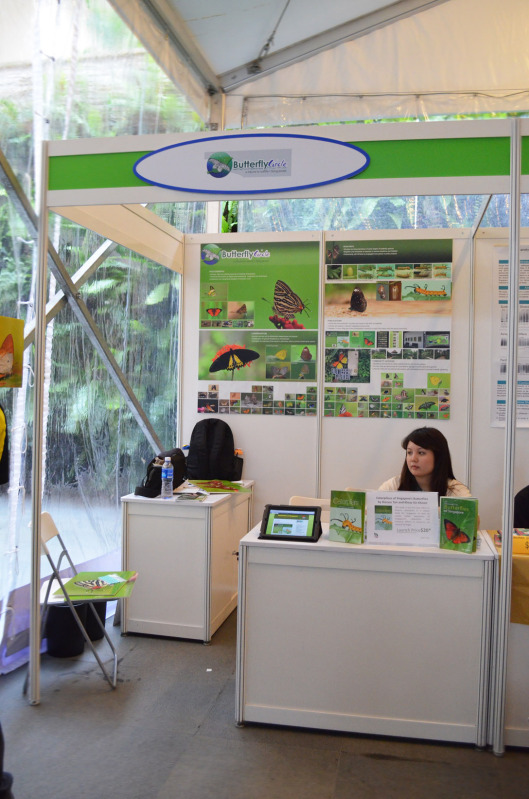
This was the first time ButterflyCircle was represented at a public event and we made the extra effort to showcase our mission and objectives of our online community of butterfly enthusiasts and photographers.  A good start was to portray ButterflyCircle members' works in a poster collage of photos and projects in which we were involved.  The poster was ably designed and put together by CJ, who spent a commendable effort on the two A0-sized boards.


On Saturday, ButterflyCircle's booth was manned by several volunteers, notably our two young and energetic 'youth-wing' members, Brian Goh and Jonathan Soong.  They were there at the booth as early as 9am, and joined later by our infamous twins, Mark and Anthony.  NParks' Rachel Lim, who commenced the sale of the "Caterpillars of Singapore's Butterflies" at the special Festival price of S$20 (normal price S$26).

ButterflyCircle's Youth Wing members

As the day wore on, more ButterflyCircle members turned up to support.  Our booth was teeming with activity as the caterpillar book sales picked up with more members of the nature community and public showing keen interest in a book that exclusively features caterpillars for the first time in Singapore.  Horace and I were there to autograph the books for the buyers who were keen to get the authors signatures to their latest book to add to their collection.  


At around 3:30pm, just before the official launch of the Festival of Biodiversity by President Tony Tan Keng Yam, the President of the Republic of Singapore, more members showed up in full support of ButterflyCircle.  At least 30 of our more active members showed up, including several members who had gone into hibernation due to their own work or family commitments.  It was a time to catch up with old friends and make new ones!

Satisfied customers!

When the President arrived, the crowd gathered at the Function Hall.  Minister of State, BG(NS) Tan Chuan Jin gave the opening address to the nature community. He shared many government initiatives to enhance Singapore's biodiversity and to encourage the public to be aware and conserve our rich natural heritage.  


President Tony Tan then went on stage to launch two new books - "Our Fragile Rainforest" by Leong Tzi Ming and James Gan and ButterflyCircle's own "Caterpillars of Singapore's Butterflies" by Horace Tan and Khew Sin Khoon.  Our special thanks also, to MOS Tan Chuan Jin for penning the foreword in our book. 

Presenting the Caterpillars of Singapore's Butterflies to President Tony Tan

After the formalities, the VIP entourage went on a tour to the exhibitions and booths on the 1st and 2nd levels of the Botany Centre.  Thanks to NParks, all the booths were well organised and adequately protected from the elements with transparent plastic curtains.  Fortunately, the rains stayed away, and everyone enjoyed good sunny (albeit hot and humid) weather.

President Tony Tan with ButterflyCircle members

President Tony Tan was given a quick tour of ButterflyCircle's booth and I also presented him a copy of our first book, "A Field Guide to the Butterflies of Singapore".  The President gamely posed for a group shot with ButterflyCircle's members who were there at the booth.

Getting MOS Tan Chuan Jin's autograph

MOS Tan sportingly autographed the books of our members who were brave enough to request for his signature, starting with our enthusiastic Brian Goh.  As the other members saw how approachable and friendly MOS Tan was, there was soon a queue to get his autograph!  It was heartwarming to note that MOS Tan carefully penned a few personalised words for each of our members, rather than just signing his name.  Thanks MOS Tan!  :)  

Sunny with the President

ButterflyCircle's youngest and oldest member also managed to collect President Tony Tan's autograph for their respective copies of the Caterpillars of Singapore's Butterflies books!  

ButterflyCircle members' group shot!  Well done everyone!

All too soon, it was time to bid farewell as everyone left with a memorable experience of this special day for ButterflyCircle, and also the nature community in Singapore.  As I had to rush to the airport to catch a late night flight to Beijing, I missed the further excitement of Part II of the Festival on Sunday.  All in all, it was a good experience for everyone involved in the Festival, and I would like to take this opportunity to thank our members who turned up in force to support us.  

We look forward to the next Festival of Biodiversity in 2013!  

Text by Khew SK : Photos by Loke PF, Huang CJ, Bobby Mun, Sunny Chir and Chng CK.

Acknowledgements : Special thanks to Huang CJ for the design and production of ButterflyCircle's posters for the booth.  Thanks to Mark Wong, Anthony Wong, Jonathan Soong, Goh EC, Brian Goh, Loke PF, Sum CM & Federick Ho for helping out at the booth.  Rachel Lim and staff of NParks for kindly agreeing to sell our book at the BC booth.  And of course, my hardworking co-author, Horace Tan for contributing his effort and time to make the book a reality!  

Other Links to the Festival of Biodiversity


26 May 2012

Butterfly of the Month - May 2012

Butterfly of the Month - May 2012
The Malayan Sunbeam (Curetis santana malayica)


Another month zips by in a flash as the month of May 2012 is almost over.  It was a hectic month for me, both on the work and non-work fronts.  Juggling my time between a new and challenging role at work, with the writings, blogs and the books that I've been working on was a stressful affair.  This month, I had the opportunity to visit Sanya on the island of Hainan in China for the first time and enjoyed the scenic views of the seafront as well as baked in the hot humid weather on the island.  


In my spare time, I was juggling writing and processing photos between two books - the soon-to-be launched Caterpillars of Singapore's Butterflies, which I co-authored with Horace Tan, and the short monographs that I was writing for Raffles Museums forthcoming Private Lives series, featuring the Rainforests of Singapore.  Fortunately, amidst a few heart-stopping moments, progress on the first book in Singapore featuring exclusively butterfly caterpillars went well with lots of help from NParks staff Rachel Lim, Ng Li-San and Cindy Ong.


This weekend, the Caterpillars of Singapore's Butterflies will be launched at the Festival of Biodiversity.  ButterflyCircle will also be featuring our members' works at our booth.  Come join us and get your copy of the book and get the authors to autograph the book for you! 


The flower of the month for May is Lily of the Valley (Convallaria magalis).  It is a small, bell shaped flower that gives off a large scent that attracts not only people, but bees that like to collect the pollen that the flower produces.  The flowers are normally white, with an occasionally pink hue. The flower is distributed throughout the northern hemisphere and first grows in the spring and creates six little stamens. The Lily of the Valley has some medicinal qualities to it. The leaves and petals have been used in medicine because they contain cardiac glycosides.


Our butterfly of the month is the diminutive but robust Malayan Sunbeam.  It is one of two species of the subfamily Curetinae that is found in Singapore.  A fast flyer, it often stops to bask with its wings partially opened.  Males of the species can sometimes be found puddling at damp sandy spots in the nature reserves.  It is widely distributed in Singapore, and is found as often in the forested nature reserves as well as in urban parks and gardens.  


The Malayan Sunbeam is a bright coppery red above with a black border on both the fore and hindwings.  It is probably the bright orange-red upperside that suggested its common English name sunbeam.  The silvery-white underside has obscure light grey markings and is generally peppered with small black spots on both wings.     


Usually, only individuals are observed flying at high speeds amongst bushes and up tree tops.  At certain times of the day, some individuals have a habit of perching on some favourite vantage points, returning repeatly to the same perches time and again, occasionally stopping with wings half opened to show its contrasting uppersides.  The species has red-banded legs.


 The caterpillar host plant of the Malayan Sunbeam are Callerya atropurpurea (synonym: Millettia atropurpurea; Leguminosae) and Millettia pinnata (synonym: Pongamia pinnata; Leguminosae). The caterpillar features a pair of strange processes that makes it appear almost slug-like. When the caterpillar is disturbed or stressed, tentacles with tuffs of white and black hairs at their apices, are everted from these procesess and whirled around at great speed.


The fifth month of 2012 draws to a close as the world celebrates the International Day of Biological Diversity (the actual day declared by the United Nations was 22 May 2012). The International Day of Biological Diversity was created to increase the understanding and awareness of biodiversity issues.


Over here in Singapore, the nature community and nature lovers look forward to the Festival of Biodiversity on 26 & 27 May where different nature groups come together to create a greater awareness of Singapore's biodiversity. 


To quote my good friend Ria Tan who wrote in her very popular blog,  Wild Shores of Singapore, "Be bedazzled by butterflies and birds, awed by trees and seagrasses, tickle your curiosity with crabs and colugos. Singapore is wilder that you might imagine. Find out more about our biodiversity and what you can do to make a difference!"  See you at the Festival!


Text by Khew SK : Photos by Sunny Chir, Khew SK, Koh CH, Loke PF, Bobby Mun, Nelson Ong, Jonathan Soong & Benjamin Yam.  Life History page by Horace Tan, featured in Caterpillars of Singapore's Butterflies

23 May 2012

A Sneak Peek

A Sneak Peek :
Caterpillars of Singapore's Butterflies


The first inaugural Festival of Biodiversity jointly organised by the National Parks Board and the Biodiversity Roundtable will be held this Saturday 26 May 2012 at the Botany Centre of the Singapore Botanic Gardens. This Festival is organised as a platform to showcase the nature community's efforts and raise awareness of Singapore's biodiversity.


At the Festival, ButterflyCircle will be launching our 2nd book, the Caterpillars of Singapore's Butterflies.  This guide book features mainly the work of Horace Tan, who meticulously documented the early stages of butterflies over a period of 5 years.  A total of 80 species of butterflies' life histories are featured in this 208-page book. This is the first book to exclusively feature the caterpillars of Singapore's butterflies. Caterpillars of Singapore's Butterflies is published and sponsored by NParks.


A concise introduction describes some important biological and ecological aspects of the early stages of a butterfly's life, first as an egg, then caterpillar and finally pupa, before the adult butterfly ecloses.  Each of the 80 species is featured on two pages, showing the adult butterfly, all the instars of the caterpillars, pupa and information about the host plants and so on.


A section of the book deals with butterfly friendly landscaping and design strategies to lay out a butterfly garden.  Some suggested butterfly nectaring and host plants are listed for gardening enthusiasts, parks managers and landscape designers who are keen to set up a butterfly garden. 


ButterflyCircle is pleased to present our 2nd guide book about butterflies, that is targeted towards creating awareness and as an educational resource for nature enthusiasts and the public alike.  Our first book, the Field Guide to the Butterflies of Singapore, launched in 2010, features the adult butterflies that can be found in Singapore.  This time, the Caterpillars of Singapore's Butterflies take a peek into the secret lives of caterpillars before they transform into the beautiful butterflies that we admire.


Come visit ButterflyCircle's booth at the Botany Centre and get your copy of the Caterpillars of Singapore's Butterflies at the cost of only S$26!  See you at the Festival of Biodiversity this weekend!

Text by Khew SK : Sample pages of the Caterpillars of Singapore's Butterflies courtesy of the authors and NParks.  

19 May 2012

Life History of the Tawny Palmfly

Life History of the Tawny Palmfly (Elymnias panthera panthera)


Butterfly Biodata:
Genus: Elymnias
Hübner, 1818
Species: panthera Fabricius, 1787
Subspecies: panthera
Fabricius, 1787
Wingspan of Adult Butterfly: 50-60mm
Caterpillar Local Host Plants:
Caryota mitis (Arecaceae, common name: Fish Tail Palm), Licuala spinosa (Arecaceae, common name: Mangrove Fan Palm), Ptychosperma macarthurii (Arecaceae, common name: MacArthur Palm).


Physical Description of Adult Butterfly:
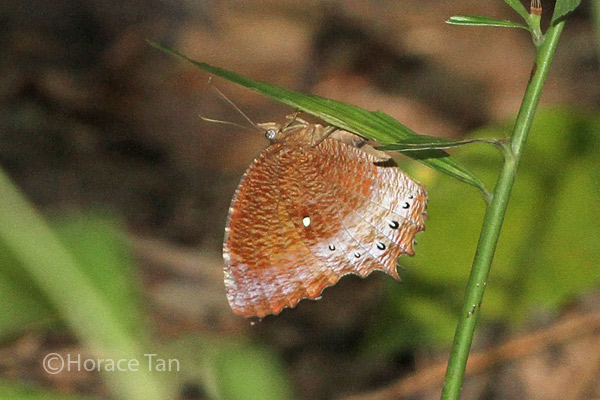
Termens of both wings are prominently scalloped. The hindwing is strongly toothed at vein 4. Above, the wings are dark brown. On the hindwing, there is  a submarginal pale buff band bearing fuscous interneural (between the veins) spots.  Underneath, the wings are strongly mottled brown, with the submarginal to post-discal areas pale buff. On the hindwing there is a series of black-crowned white interneural spots in spaces 1b,2,3,4,5 and 6, with the white spot in space 6 much larger and ringed in black.


Field Observations of Butterfly Behaviour:  
The Tawny Palmfly is moderately common in Singapore and can be found in the nature reserves, forested areas of wastelands in the west, Sungei Buloh wetland reserve and Kranji nature trail.  The adults are typically shade-loving, and are usually sighted flying along the edge of forested area and in the vicinity of a clump of palm trees. The adults have the habit of  visiting flowers and ripened fruits of the Singapore Rhododendron for mineral and energy intakes.


Early Stages:
The early stages of the Tawny Palmfly is polyphagous and feed on the leaves of a number of host plants in the Arecaceae (Palmae) family. Thus far, three of the local host plants haven been  confirmed and identified (see list of host plants given earlier).

Host plant: Fish tail Palm.
  
A mother Tawny Palmfly laying an egg on the underside of a frond of the Fish Tail Palm.

The eggs of the Tawny Palmfly are laid singly on a leaf blade of the host palm tree, typically on the underside. Each white egg is nearly  spherical with a diameter of about 1.5mm. Unlike the  eggs  of the Common Palmfly, the egg does not turn yellow as it develops. 

Two views of an egg of the Tawny Palmfly.

Two views of a mature egg of the Tawny Palmfly.

The egg takes about 4-4.5 days to hatch. The young caterpillar emerges by eating away part of the egg shell. The rest of the egg shell becomes the first meal for the newly hatched, which has a length of about 2.8mm. Its cylindrical body is pale whitish. The large head capsule is dark brown to black in color and has three pairs of prominent protuberances lining the perimeter with the apical pair being the largest and longest. Each protuberance ends with a thick setae bearing a transparent droplet at its tip. Rows of fine setae, also bearing terminal droplets, run along the length of the body dorso-laterally and laterally. A pair of long whitish processes occur at the posterior end of the body, each of which ends with a droplet-bearing black setae.

A newly hatched Tawny Palmfly caterpillar pausing next to its empty egg shell, length: 3mm.

Once the newly hatched moves on to feed on the young leaves, its body turns yellowish green in colour. Several contrasting longitudinal bands, pale yellowish  in color and of varying widths, adorn the body surface dorso-laterally and laterally. This instar lasts 4-6 days with the length reaching up to 6.5-8mm.

Two views of 1st instar caterpillar, length:6.75mm.

The body of the 2nd instar caterpillar is similarly marked as in the late 1st instar. The most obvious change is in the head capsule where the three pairs of protuberances becomes longer and the setae they bear shorter. The apical pair also takes on a few short side branches.  The pair of anal processes are longer proportionately and mostly black in coloration. Numerous short fine setae cover the body surface. Of the several yellowish bands running lengthwise, the dorso-lateral pair running up to the upperside of the anal processes becomes the most prominent of all. This instar lasts about 3-5 days with the body length reaching up to 11-13mm before the moult to the 3rd instar.

Head capsules: 1st instar (left) and 2nd instar (right).

Two views of a newly moulted 2nd instar caterpillar.

Two views of a 2nd instar caterpillar, length: 11mm

The 3rd instar caterpillar is similar in appearance to the 2nd instar caterpillar with the only obvious change being in the appearance of the head capsule. Small pale yellow patches appear laterally and apically on the head capsule which also has its two lower pairs of protuberances turn yellowish to orangy brown  with their short terminal setae still brown to black in color.  The yellow dorso-lateral longitudinal bands are enlarged slightly in each of abdominal segments. This instar takes about 4-5 days to complete with body length reaching about 18-20mm.

Two views of a newly moulted 3rd instar caterpillar.

Two views of a 3rd instar caterpillar, length: 20mm.

Retaining very much the same body features from the earlier two instars, the 4th instar caterpillar distinguishes itself in having a head capsule with proportionally longer apical protuberances (with the base of side protuberances in orangy brown)  and larger lateral and frontal yellowish patches. The anal processes being mostly yellowish to salmon red in coloration. The nodal enlargement in the dorso-lateral yellow bands is also more pronounced in this stage. This instar lasts about 5  days with the body length reaching about 32-34mm.

Head capsules: 3rd instar (left) and 4th instar (right).

Two views of a 4th instar caterpillar, length: 25mm.

Two views of a 4th instar caterpillar, dormant before its moult, length: 33mm.

The 5th and final instar brings about another change in the appearance of the head capsule. Now white patches cover the frontal and middle area, stretching up into the two apical protuberances. The long and slender anal processes are mostly salmon red in coloration. The nodes in the dorso-lateral yellow band are much more prominent and could be rather large in certain specimens. A variable aspect of these nodes is that each node could be entirely yellow,  or be adjoined with a dark green spot, or has a pale orange patch embedded in it.

Two views of a newly moulted 5th instar caterpillar, length: 31mm.

Head capsule of the 5th instar caterpillar.

Two views of a  5th instar caterpillar, length: 32mm.

Two views of another 5th instar caterpillar, length: 42mm.

The 5th instar lasts for 8-10 days, and the body length reaches up to 48-51mm. On the last day, the caterpillar ceases feeding, its body becomes shortened but with essentially no change in body color. It wanders around in search of a pupation site. Typically it comes to a halt on the underside of leaf blade (of the host plant)  where the caterpillar spins a silk pad to which it attaches its claspers and then rests in a head-down posture.

Two views of a pre-pupa of the Tawny Palmfly in a head-down posture.


The pupation event of a Tawny Palmfly caterpillar.

Pupation takes place 1 day after the caterpillar assumes the haed-down posture. The green pupa has yellowish strips running on the dorsum of the thorax, dorso-laterally and laterally on the abdomen and the leading edges of the wing case. These yellow strips are outlined in a reddish to deep pink. The pupa also has a pair of short cephalic horns, and the dorsum of its thorax is sharply raised. Length of pupae: 20-24mm.

Two views of a pupa of the Tawny Palmfly.

Two views of a mature pupa of the Tawny Palmfly.

After about 7 days of development, the pupal skin turns translucent as the development within the pupal case comes to an end. The pupa is mostly black at this point. The following day, the adult butterfly emerges from the pupal case. It then perches on the pupal case or nearby to expand and dry its wings before taking its first flight.


The eclosion event of a Tawny Palmfly.

A newly eclosed Tawny Palmfly.

References:
  • The Butterflies of The Malay Peninsula, A.S. Corbet and H.M. Pendlebury, 4th Edition, The Malayan Nature Society.
  • A Field Guide to the Butterflies of Singapore, Khew S K, Ink on Paper Comm. Pte. Ltd., 2010.
  • Butterflies of Thailand, Pisuth Ek-Amnuay, 1st Edition, 2006
Text by Horace Tan, Photos by James Chia, Bobby Mun, Nelson Ong, Anonthy Wong, Loke P F,  Federick Ho and Horace Tan