16 May 2012

Random Gallery - The Rustic

Random Butterfly Gallery
The Rustic (Cupha erymanthis lotis)


This week's random butterfly is the very skittish Rustic (Cupha erymanthis lotis).  In the field, the Rustic is always on the move, and is an active butterfly.  Even when it is feeding on flowers or puddling on muddy forest paths, it will flap its wings and twist and turn, making photography challenging.  I encountered this individual in the nature reserves two weekends ago.  Despite being skittish, and giving the two photographers who were chasing it a wide berth, it continued to stay in the area and flew from perch to perch in a small area repeatedly.  It finally settled low enough on one of its favourite perches and allowed me to get a near full-frame shot of it, with the tall bushes in the background.

12 May 2012

A Seasonal Migrant Visits Singapore

A Seasonal Migrant Visits Singapore
Species #303 - Plain Puffin (Appias indra plana)

A single male Plain Puffin shot in Singapore on 5 May 2012

On a routine Saturday morning outing, our group of ButterflyCircle members were out at our usual beat location within the nature reserves on 5 May 2012.  There were the usual species up and about on this sunny morning and we hadn't expected anything unusual.  


However, at the reservoir edge, we spotted a fast-flying white butterfly fluttering around the low bushes just at the entrance of the path leading to the reservoir.  It looked like one of our usual white Pieridae in Singapore, but had a more powerful flight.  It landed at a low bush next to ButterflyCircle member Loke PF.  He managed to get a shot of it before it took off up the trees and disappeared from sight.  


Upon close examination of the shot, we were surprised that this strange butterfly was something that had not been spotted in Singapore before!  Bearing in mind that during the months of the "butterfly season" in Malaysia, we have often spotted migratory species, particularly of the Pieridae, in Singapore.  In the past, there have been reliable sightings and photos taken of Pierids like the Wanderer, Great Orange Tip and more frequently, the Chocolate Albatross.  


We were quite surprised that a single male of the Plain Puffin (Appias indra plana) actually made it this far south into the nature reserves area of Singapore.  Whilst it is not likely that the species will establish a longer-term colony in Singapore after the migratory season is over, we will nevertheless record it as a valid species in the Singapore Checklist.


The Plain Puffin is described to range from Sri Lanka and India to south China and Sundaland.  In Malaysia, it occurs in well-wooded country at moderate elevations and is not rare.  The wings are white, with a broad irregular black margin on the forewing extending from mid costa to the tornus.  Females have their hindwings margined with black.  Neither sex is likely to be confused with any other local species. (Butterflies of the Malay Peninsula : Corbet & Pendlebury, 1992)


The species has been photograph quite regularly on ButterflyCircle members' trips to Malaysia, and has been recorded from Langkawi, Endau Rompin Nature Reserve and Fraser's Hill.  Invariably, males are encountered, usually puddling at damp sandy riverbanks with other butterflies from various families like the Papilionidae, Pieridae, Lycaenidae, Nymphalidae and Hesperiidae.

Checklists in reference books indicate that this species was not encountered in Singapore before.  We record this new migrant as species #303 in the Singapore Butterfly Checklist as a  "very rare" (seasonal migrant).  It is hoped that we will see more of this species in the future in Singapore! 

Text by Khew SK  : Photos by Loke PF (in Singapore), Bob Cheong, David Fischer, Federick Ho, Khew SK & Nelson Ong (in various locations in Malaysia)

References:
  • [C&P4] The Butterflies of The Malay Peninsula, A.S. Corbet and H.M. Pendlebury, 4th Edition, The Malayan Nature Society.
  • Butterflies of Thailand, Pisuth Ek-Amnuay, 1st Edition, 2006
  • Butterflies of West Malaysia and Singapore, WA Fleming, 2nd Edition, 1991 

09 May 2012

Random Gallery - The Yellow Palm Dart

Random Butterfly Gallery
The Yellow Palm Dart (Cephrenes trichopepla)

Canon 7D, Tamron 180mm, AV mode, F11, 1/200, ISO640, Handheld, fill-flash

This week's random butterfly photo is a recent immigrant to Singapore, the Yellow Palm Dart (Cephrenes trichopepla).  The species originates from the Indo-Australian region.  Read the blog article of this species when it was first discovered in SIngapore by ButterflyCircle members.  This excellent shot of the skipper perched with the usual Hesperiidae pose was taken by member Loke Peng Fai.


05 May 2012

Life History of the Spotted Black Crow

Life History of the Spotted Black Crow (Euploea crameri  bremeri)


Butterfly Biodata:
Genus: Euploea Fabricius, 1807
Species: crameri Lucas, 1853

Subspecies: bremeri C & R Felder, 1860
Wingspan of Adult Butterfly: 70-90mm
Caterpillar Local Host Plants: 
Gymnanthera oblonga (Apocynaceae, common name: Sea Rubber Vine), Parsonsia helicandra (Apocynaceae).

A  Spotted Black Crow  visiting flowers of a Syzygium species in Pasir Ris Park.

Another Spotted Black Crow resting on a tree trunk.

Physical Description of Adult Butterfly:
Above, both sexes are dark brown and feature marginal and submarginal series of white spots. Among the sub-marginal series of spots on the forewing, the spot in space 5 is large and wedge-shaped, while the spot in space 6 is twice as long, and the spots in spaces 7-9 are smaller and lens-shaped. The male does not have a brand above.  Underneath, the wings are brown with marginal and sub-marginal white spots similar to those on the upperside. On the hindwing, there are additional small white spots near the base of spaces 2 to 7.  On the forewing, there are small white spots in spaces 2-4. Both wings have a white spot in the cell.


Field Observations of Butterfly Behaviour:  
The  Spotted Black Crow is relatively uncommon in Singapore. Though not abundant, the adults have been observed in the nature reserves and mangrove habitats in Sungei Buloh Wetland Reserve, Pasir Ris Park and Pulau Ubin. The adults are attracted to flower blooms, and are easiest to approach for photo-taking when they are occupied during their flower visits.  


Early Stages:
The Spotted Black Crow is polyphagous and its two currently known host plants are both in the  Apocynaceae families. The caterpillars feed on leaves and young shoots of the host plants, typically with those in  early instars focusing on  young tender leaves and  those in later instars  on  more mature leaves. The caterpillar has the habit of first cutting the mid-rid or the petiole of a leaf  before eating the leaf lamina beyond the severed point. If the petiole is cut for this purpose, the caterpillar would spin a web of silk threads to secure the severed portion of the leaf.

Local host plant: Gymnanthera oblonga.

The eggs of the Spotted Black Crow are laid singly on the underside of a leaf (typically young leaf) or on the vine of the host plants. The pale creamy yellow eggs are tall standing  (about 1.8mm in height) and somewhat ovoid (diameter: 1mm). The egg surface is covered with  shallow polygonal pits.

Two views of an egg of the Spotted Black Crow.

Two views of a mature egg of the Spotted Black Crow.

Hatching and eating of egg shell by a Spotted Black Crow caterpillar.

The egg takes about 3 days to hatch. The young caterpillar emerges by eating away part of the egg shell. The rest of the egg shell becomes the first meal for the newly hatched, which has a length of about 3mm. The newly hatched has a pale yellowish  body and black legs. The large head capsule is black in color. A pair of very short and inconspicuous dorso-lateral protuberances can be found  on each of the following four segments: 2nd and 3rd thoracic segments, the 2nd and 8th abdominal segments.

Two views of a newly hatched caterpillar, length: 3.2mm.

A 1st instar resting within the marked out zone of a leaf.

Once the newly hatched moves on to feed on the leaf lamina, its body starts to take on a green undertone. The newly hatched has this interesting  habit of marking out a  portion of the leaf with  a series of small bite-marks before eating away the marked out portion. In the final half day of the 1st instar, the body takes on reddish brown transverse stripes on all segments. This instar lasts for 1.5-2 days with the  the body length doubled up to 6 mm.

Two views of a 1st instar caterpillar,  late in this instar, ength: 5mm

The body of the 2nd instar caterpillar has a yellowish orange ground color. From the 2nd thoracic segment to the 8th abdominal segments, there are dark brown  transverse rings interspersed with broad whitish bands. On each of these segments, one broad dark brown transverse is broader than the rest and extending further down to the yellowish orange ventrum ( reaching and passing the spiracles). The most obvious change is the lengthening of the 8 tiny protuberances seen in the 1st instar to short processes, each of which is almost entirely dark brown to black. There are two small black spots on the dorsum of the prothorax, and one large black patch (anal plate) on the posterior end of the body. This instar lasts only 1  day  with the body length reaching about 11.5mm before the moult to the 3rd instar.
Two views of a newly moulted 2nd instar caterpillar, length: 3.2mm

Two views of a 2nd instar caterpillar, length: 9mm

The 3rd instar caterpillar is similar in appearance to the 2nd instar caterpillar. One obvious change is in the 4 pairs of  processes which become proportionately longer. Another change is in the head capsule where two faint whitish lateral streaks have appeared.This instar takes about 1.5 days to complete with body length reaching up to 17mm.

Two views of a newly moulted 3rd instar caterpillar.

Two views of a 3rd instar caterpillar, length: 13mm.

Compared to the 3rd instar, the 4th instar caterpillar has proportionately longer processes.   The black head capsule features two   oblique and joined white stripes and  an outer peripheral white ring. On some specimens, the white stripes on the dorsum take on a pale creamy white coloration. This instar lasts 2 to 2.5 days with the body length reaching about 30mm.

Two views of a 4th instar caterpillar, early in this stage,  length: 18mm.

Two views of a 4th instar caterpillar, length: 27mm

The 5th instar caterpillar again has proportionately longer processes. Otherwise it is rather similar to appearance to the 4th instar caterpillar. On the upper half of the body segment the black stripes are now interspersed with pale creamy yellow bands.

A newly moulted 5th instar caterpillar eating its exuvia on a vine of Gymnanthera oblonga.

As is the case of the Striped Blue Crow, the Spotted Black Crow caterpillar does not have the prosternal gland previously discovered  in caterpillars of  the Blue Spotted Crow (E. midamus singapura) and the King Crow (E. phaenareta castelnaui). When the caterpillar was  intentionally agitated, it would adopt a rather common head-tugged defensive stance.

Two views of a 5th instar caterpillar, length: 36mm.

Two views of a 5th instar caterpillar, late in this instar, length: 45mm.


A Spotted Black Crow going through the chores of becoming a hanging pre-pupa.

The 5th instar lasts for 3.5-4 days, and the body length reaches up to 51-53mm. On the last day, the caterpillar ceases feeding, and its body becomes shortened and decolorised slightly. For pupation, the caterpillar typically chooses a spot on the mid-rib of a leaf underside. At this pupation site, the caterpillar spins a silk pad from which it then hangs vertically to take on the pre-pupatory pose.

A pre-pupatory larva of the Spotted Black Crow.

Pupation takes place 0.5 days after the caterpillar assumes the hanging posture. The pupa  suspends itself from the silk pad with no supporting silk girdle. Initially, the pupa is in a light shade of yellowish brown, but the surface gradually takes on a silvery metalic glitter about a day later. The pupa is rather rotund, and has rows of small dorso-lateral black spots in the abdomen, and three large black spots in the wing pad. Length of pupae: 19-21mm.

A Spotted Black Crow caterpillar moults to its pupal stage.

Three views of a fresh pupa of the Spotted Black Crow, 3-4 hours after pupation.

Three views of a shining pupa of the Spotted Black Crow, one day  after pupation.

Three views of a mature pupa of the Spotted Black Crow, night before eclosion.

After about 7 days of development, the pupal turns black as the development within the pupal case comes to an end. The white spots on the forewing upperside become discernible through the now translucent skin. In the following morning, the adult butterfly emerges from the pupal case, and  perches nearby to expand and dry its wings before taking its first flight.


A Spotted Black Crow emerges from its pupal case.


A newly eclosed male Spotted Black Crow drying its wings on its pupal case.

References:
  • [C&P4] The Butterflies of The Malay Peninsula, A.S. Corbet and H.M. Pendlebury, 4th Edition, The Malayan Nature Society.
  • The Life Histories of Euploea crameri bremeri and Idea hypermnestra linteata, L.G. Kirton, Tan M.W. and C.G. Kirton, Malayan Nature Journal, 36: 29-43 (1982).
  • Butterflies of Thailand, Pisuth Ek-Amnuay, 1st Edition, 2006
  • A Field Guide to the Butterflies of Singapore, Khew S K, Ink on Paper Comm. Pte. Ltd, 2010.
Text by Horace Tan, Photos by James Chia, Jonathan Soong, Federick Ho,  Sunny Chir  and Horace Tan

02 May 2012

Random Gallery - The Green Baron

Random Butterfly Gallery
The Green Baron (Euthalia adonia pinwilli)


This week's random butterfly is the Green Baron (Euthalia adonia pinwilli).  This male was photographed feeding on the ripening fruit of Melastoma sp. by ButterflyCircle member, Koh CH.  The Green Baron is not rare, and is widely distributed across the island.  It is often observed in urban parks and gardens in locations where its caterpillar host plant, the parasitic Dendrophthoe pentandra is found.  Both males and females are attracted to fermenting fruits.

28 April 2012

Butterfly of the Month - April 2012

Butterfly of the Month - April 2012
The Chocolate Grass Yellow (Eurema sari sodalis)


All too soon, the fourth month of 2012 will be over.  In a few days, we will be looking towards the month of May, and most of the working population of Singapore look eagerly forward in anticipation of the public holiday on 1 May, which is Labour Day.  The wet weather from last month has not yet changed much, and Singapore has been receiving above average rainfall in April according to the meteorological information from the National Environment Agency in Singapore.  


On the work front, a momentous event happened just around 8:30pm last evening.  The company that I work for, officially changed hands from the Australians to the Chinese. At a rather quiet and private event between the two parties a small group of 10 of us partook in the little ceremony that will change the lives of my fellow employees and our future outlook.  After 7 years of 'colonialist rule', this Singapore company moves back into the hands of an Asian owner.  Hopefully, it will mean better prospects for all our staff.


The world acknowledges that Asia, and in particular China, will be the engine of economic growth in the coming years.  There will be much to do in this region, and a whole spectrum of challenges to face.  The global economy is swinging more like a rapid-beat metronome rather than a slow pendulum.  Changes will come fast and furious, and businesses have to be agile on their feet to face daily trials.  


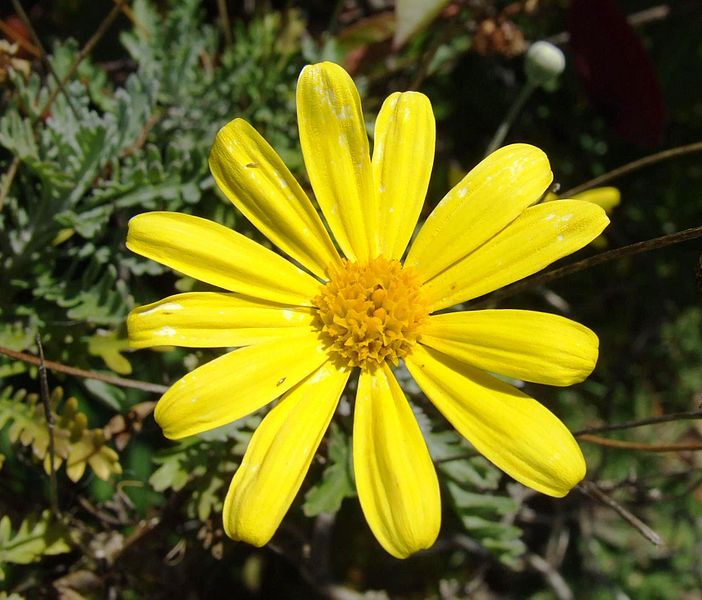
As spring makes its way towards summer in the Northern hemisphere, flowers awaken from their cold slumber and add colour to the world of nature.  This flower of the month for April is traditionally accepted to be the Daisy (Bellis perennis).  The Daisy is actually an herb which symbolizes innocence, stability, sympathy, youth and cheerfulness.  In certain cultures the flower also signifies departure and goodbye  (a rather apt symbolism for the current situation at my workplace).  The common colour of the flower is typically white or yellow, but there are hybrids that comes in various colours and shades in between.  


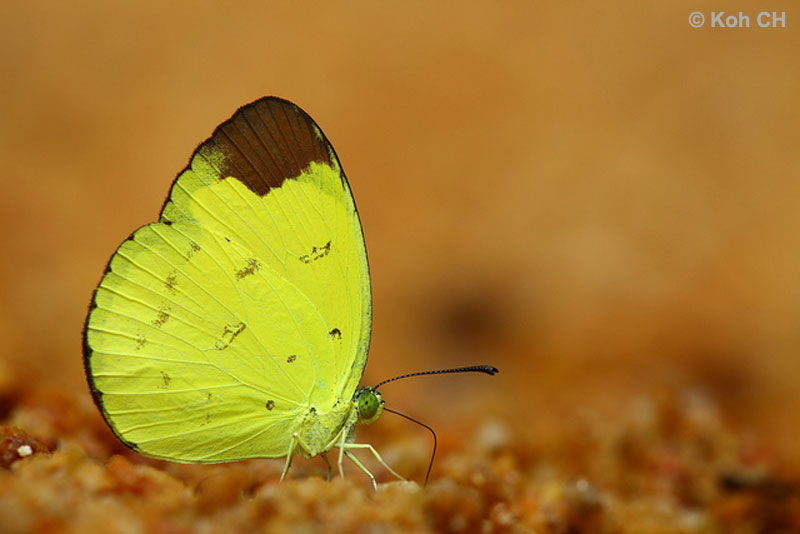
This month, we feature another butterfly with the word "Chocolate" in its common name, after our March's feature butterfly.   Another Pierid, this month's Butterfly of the Month is the Chocolate Grass Yellow (Eurema sari sodalis).  One of six members of the genus Eurema, this small and usually actively flying yellow butterfly is relatively common in Singapore.  Like the other members of its genus, it can be seasonally common.


The Chocolate Grass Yellow's distinct dark brown apex on the forewing beneath instantly sets it apart from its closely-related cousins.  The upperside of the species is a bright lemon yellow with black marginal borders on both the fore and hindwings.  


Another characteristic feature that distinguishes it from the other species amongst the Grass Yellows is the single cell spot on the underside of the forewing.  Earlier articles on this blog describe the key features of the Eurema species in Singapore.  


The Chocolate Grass Yellow is quite common, and is widespread in distribution across Singapore.  It can be found deep in the nature reserves as well as in urban parks and gardens.  Like the other Grass Yellow species, it usually flies restlessly and erratically in search of food.  Photographing this species can be quite challenging at it is active and skittish.


Males of the Chocolate Grass Yellow are regularly observed puddling at damp sandbanks near streams, and muddy forest footpaths.  When puddling they can remain distracted and allow an observer to approach them for a closer look.  Watch closely at the puddling butterfly when the opportunity presents itself, and observe how it excretes fluids whilst it feeds.  This videoclip below, taken by ButterflyCircle member Loke PF, shows the process of feeding and excreting in a Chocolate Grass Yellow.


The female Chocolate Grass Yellow is typically rarer and may be found feeding at flowering plants.  On the upperside, females have broader black marginal borders where the hindwing border is thicker and inwardly diffuse.  The wings of the females are usually also more rounded when compared to the males. 


The species is a fair-weather butterfly, and normally encountered on bright sunny days rather than on overcast days.   The species can be seasonally common and a number of individuals may be encountered puddling at the same spot.  It is always amazing to see so many individuals of the same species feeding together, and then taking off in a cloud of yellow as one approaches them.  


So we bid farewell to the month of April 2012, and look forward to the remaining eight months of the year as we move closer towards the prophetic 12 Dec 2012 with curiousity and for some, even with a bit of trepidation.  For the rest of us, however, life goes on..


Text by Khew SK : Video by Loke PF : Photos by James Chia, Sunny Chir, Goh LC, Federick Ho, Khew SK, Koh CH, Lim WY & Benjamin Yam

25 April 2012

Random Gallery - The Brown Awl

Random Butterfly Gallery
The Brown Awl (Badamia exclamationis)


This week's random butterfly was a newly-eclosed individual of the Brown Awl (Badamia exclamationis) shot by veteran ButterflyCircle member, Sunny Chir.  His excellent shot of the Brown Awl on a colourful flower won him various accolades in nature and photography online websites including Image of the Week at NatureScapes.Net and Photo of the Month at Nature Photographic Society Singapore.