10 December 2011

Book Review by Dr Albert Orr

Book Review :
A Field Guide to the Butterflies of Singapore
by Dr Albert Orr

204 Australian Entomologist, 2011, 38 (4)

BOOK REVIEW

A Field Guide to the Butterflies of Singapore by Khew Sin Khoon. Ink on Paper Communications Ltd, 2010; xxv + 342 pp. Price (in Australia) $50. ISBN 978 981 08 7018 8 (paperback).

The city state of Singapore is home to nearly 300 species of butterfly. Perhaps this richness should come as no surprise for a place which styles itself as the ‘Garden City’ and which lies just off the tip of the Malay Peninsula, itself boasting nearly 1000 species; nonetheless it is an impressive total given Singapore’s small area of just 700 km2 and largely urban environment.


This charming book is the first ever to depict almost all species currently known from Singapore. A glossy production in standard octavo field-guide format, it begins with a concise but adequate introduction to the butterflies, covering the topics of nomenclature, adult morphology, early stages, ecology and behaviour, where to find butterflies in Singapore (together with a map of local hotspots) and the techniques of butterfly watching and photography.


A lot of information is packed into a very few pages. A section on how to use the book explains clearly the conventions adopted with regard to describing abundance, habitat, speed of flight and other information.


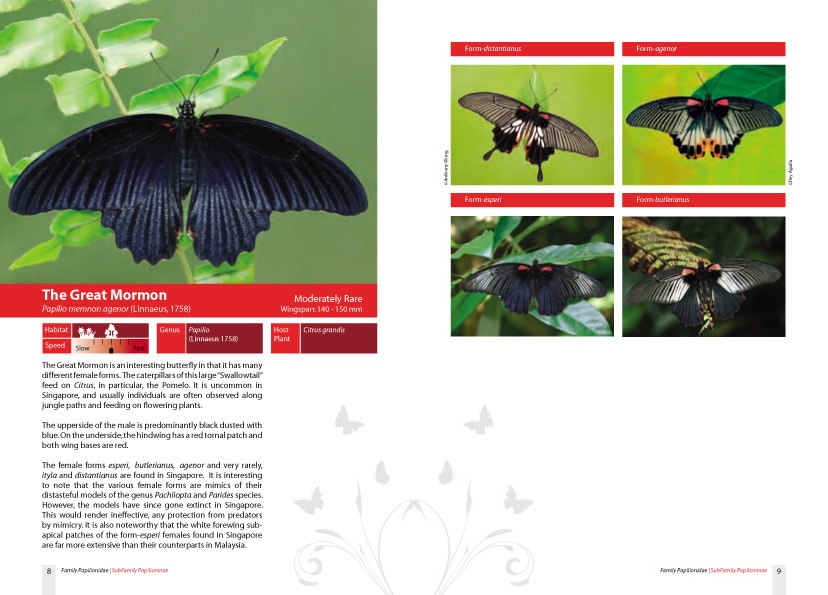
There follows a family by family, subfamily by subfamily, species by species account. Typically, each species receives a single page, with two pages for the highly polymorphic Papilio memnon agenor (Linnaeus, 1758).


Half the page is devoted to a large scale portrait of the species, typically perching or feeding, occasionally in flight. Virtually every one of these main photos is stunning. In many cases, particularly in the smaller species, individual rows of scales may be discerned, a level of resolution that was almost unobtainable using film.


The main image is supplemented by two thumbnail photos, generally showing a different posture and frequently the opposite side of the wings to those depicted in the main portrait. Each species is identified primarily by an English common name. Many of these have been in use for years but a few are of more recent coinage. However, all are evocative and appealing and give the impression that they have established their worth by natural selection within the very active Singapore butterfly interest group.

Australian readers may be surprised to find that Graphium agamemnon (Linnaeus, 1758) is known as ‘The Tailed Jay’ and ‘The Palm Dart’ is not Cephrenes augiades (C. Felder, 1860) but Telicota augias (Linnaeus, 1763). In finer print is given the full trinomial designation with author and date, its abundance class, ranging from common to very rare, and its wingspan in mm. (Here forewing length would have been a more useful measure, especially as most species are photographed with wings folded). Habitat is indicated by one of four icons: Urban, Parks and Gardens, Forests, Mangroves/Coastal.

Speed of flight is shown on a five point scale from slow to fast. Larval hostplants are listed in another small box (with family names sometimes wrongly italicised). A brief text describes habits, habitats and salient identification features. The formula is extremely easy to use and much information can be obtained for little effort. For ease of reference the six families have a colour code visible along the fore edge of the book when closed.

The book is very definitely aimed at the butterfly watcher and photographer, rather than the collector. Not a single photograph of a dead butterfly appears within its pages. It will, however, surely become indispensable to every local enthusiast and interested visitor to the island state and be useful elsewhere in the region.


Dr Albert Orr

About the Reviewer
Dr Albert Orr is a professional entomologist of 35 years standing. He is a retired lecturer in ecology and invertebrate zoology and has been an Honorary Research Fellow at Griffith University since 1996. Dr Orr is a writer and illustrator, as well as a consultant and scientific editor.

A Selection of Books by Dr Albert Orr
Acknowledgments : Special thanks to Dr Albert Orr for reviewing my "Field Guide to the Butterflies of Singapore" in the Australian Entomologist.  The original PDF article can be found here.


03 December 2011

Life History of the Orange Awlet

Life History of the Orange Awlet (Burara harisa consobrina)


Butterfly Biodata:
Genus: Burara Swinhoe, 1893
Species: harisa Moore, 1866

Sub-species: consorbrina Plötz, 1884
Wingspan of Adult Butterfly: 45-50mm
Caterpillar Local Host Plant: Arthrophyllum diversifolium (Araliaceae)


Physical Description of Adult Butterfly:
Burara harisa  (The Orange Awlet) is the look-alike cousin of the larger (and less common)  Burara etelka  (The Great Orange Awlet). Above, the male is coppery brown with no brand; the female is deep steely blue with greenish wing base. Underneath, both sexes are shaded in dark orangy brown and have pale orange streaks beyond the cell-end on both wings. Basal halves of the forewings are shaded purplish blue, more extensive and prominent in the female.  Orange  cilia are found on the hindwings, along the termen from spaces 1 to 3. The head, palpi, legs and the ventral surface of the thorax and abdomen are colored orange.


Field Observations of Butterfly Behaviour:

The adults can be found in the nature reserves as well as the Southern Ridges. They are more likely to be encountered in early morning hours and late afternoon, frequenting shaded forest areas. At times adults can be found nectaring at  flowering plants and puddling at damp grounds. Compared to the adults,  the larval stages are more readily found in leaf shelters on its host plant, Arthrophyllum diversifolium, which is a relatively common plant growing in the reserves as well as urban parks. The adults fly with swift, strong and darting flights. 


Early Stages:
The caterpillars of the Orange Awlet feed on the leaves of the host plant, Arthrophyllum diversifolium, and seek concealment and protection in  a leaf shelter. For its shelter, an early instar caterpillar typically makes a sinuous cut from the leaf edge, and proceeds to fold the leaf fragment onto the leaf underside where silk threads are used to secure the leaf edge to the leaf surface. The shelters for the much larger caterpillars in late instars are simply made by joining the two opposing edges of a leaf.

 
The leaf shelter of an early instar caterpillar seen on the leaf underside of the host plant.


A leaf shelter of a late instar caterpillar of the Orange Awlet.

 
A young specimen of the local host plant: Arthrophyllum diversifolium.

A far view of an Arthrophyllum diversifolium in a Hill Park  bearing signs of an infestation of the Orange Awlet.

The eggs are laid singly on the leaf upperside of a middle-aged or mature leaf of the host plant. Each dome-shaped egg is creamy white with a beige tinge. The micropylar sits atop and a number of vertical ridges running longitudinally from it to the base. An equatorial series of short, reddish, intermittent patches can be seen as the egg develops. The diameter is about 1mm.

Two views of an egg of the Orange Awlet
 
 
A sequence of three views of a maturing egg of the Orange Awlet over a span of 2 days.

It takes 3-4 days for the collected egg to hatch. The young caterpillar eats just enough of the shell to emerge, and has a length of about 2.9mm. Its pale  yellowish brown body is cylindrical in shape with rather long lateral and sub-spiracular white setae. There are dorso-lateral dark brown markings on a number of body segments.   The large head is pale brown with three black roundish markings. The head also bears similar white setae as those on the body. 

Newly hatched 1st instar caterpillar, length: 3mm

The body soon takes on a green undertone after a few feeding sessions on the leaf. Its movement on leaf was observed to be rather quick-paced.  By the time the caterpillar lies dormant for its moult to the 2nd instar, its length has reached 4.5mm. The 1st instar takes a total of 2.5-3.0 days to complete.

1st instar caterpillar, late in this stage,  length: 4.5mm

Top: late 1st instar caterpillar prior to its moult. Bottom: newly moulted 2nd instar caterpillar.

The body of the 2nd instar caterpillar is yellowish green and has prominent black dorso-lateral patches on the thoracic segments, 2nd, 4th, 6th, 8th and 9th abdominal segments. The black marking on the 10th segment form a black stripe across the dorsum. There is a pair of faint yellowish dorsal bands and faint obligue markings between the black spots.   The head is pale orange with two rows of black spots.  This instar lasts about 3-4 days with the body length reaching about 9mm.

2nd instar caterpillar, early in this stage, length: 6.5mm

2nd instar caterpillar, dormant prior to its moult, length: 8mm.

The 3nd instar caterpillar resembles the 2nd instar caterpillar closely in markings and coloration. The dorsal bands and dorso-lateral bands/stripes are more prominent now, yellowish in abdominal segments and becoming whitish in the thorac segments.  This instar lasts a total of 3-4 days with the body length reaching about 14mm.

3rd instar caterpillar, length: 11.5mm.

3rd instar caterpillar, dormant prior to its moult,  length: 13.8mm.

The 4th instar caterpillar resembles the 3rd instar caterpillar closely but has additional black spots/markings appearing between the yellowish/whitish dorsal and dorso-lateral bands.   Both the body and the head sport numerous short setae. This instar lasts 3-4 days with the body length reaching up to 25mm.

4th instar caterpillar,  length: 24mm.

4th instar caterpillar, dormant prior to its moult, length: 23mm

The 5th instar caterpillar has larger and very prominent black spots and markings on all body segments. With more black patches filling in the spaces between the whitish/yellowish dorsal and dorso-lateral bands, it gives the impression of large saddle patches, one to each segment,  being traversed and criss-crossed by the whitish/yellowish lines.  This instar takes about 6-7 days to complete with the body length reaching 40mm.

A newly moulted 5th instar caterpillar, length: 23mm.

Two views of a 5th instar caterpillar, length: 35mm.

Two views of a 5th instar caterpillar, late in this stage, length: 40mm

Towards the end of  5th instar, the body of the caterpillar shortens gradually and its body base colour decolorised to a shade of beige with pink tinge between the black spots.  It then stays in its leaf shelter to become a pre-pupatory larva. Within the shelter, the pre-pupa prepares for the pupal phase with a series of silk construction work with the main pieces being a silk girdle across the dorsum of its anterior abdominal segments, and a short and thickened transverse silk band on the substrate near its posterior end. Both the dorsal point of the girdle and the transverse band are further secured by vertical/oblique threads to the inner wall of the shelter. Soon the pre-pupa becomes dormant in its leaf shelter and enters the prepupatory phase which lasts for about 0.5 to 1 day.

A final instar caterpillar of the Orange Awlet eating away on a nearly defoliated branch in the nature reserve.

Two views of a pre-pupa of the Orange Awlet.

Pupation takes place within the leaf shelter. The pupa is secured  with its cremaster attached to the short transverse band on the substrate and has a silk girdle. It has a short thorax, a rather long abdomen, a short and pointed rostrum. The body is initially orangy with reddish patches and large black spots. However all these markings fade away after a day and  the base color becomes a uniform pale milky yellow. The body becomes coated in a thin layer of whitish powerdery substance. There is a series of small dorso-lateral black spots on all body segments. Another series lines  the leading edge of mesothorax and one solitary spot sits atop the dorsum of mesothorax. Length of pupae: 22-23mm.


An Orange Awlet catarpillar moults to a pupa.

Two views of a  pupa of the Orange Awlet

After 8-9 days, the pupa becomes mostly black in color in the wing pads and parts of  the body segments, signally the end of development of the adult lying within. Eclosion takes place the next day.

Two views of a mature pupa of the Orange Awlet.

A newly eclosed Orange Awlet.

References:
  • [C&P4] The Butterflies of The Malay Peninsula, A.S. Corbet and H.M. Pendlebury, 4th Edition, Malayan Nature Society.
  • Butterflies of Thailand, Pisuth Ek-Amnuay, 1st Edition, 2006
  • A Field Guide to the Butterflies of Singapore, Khew S.K., Ink On Paper Communications, 2010.
Text by Horace Tan, Photos by Loke PF,  Sunny Chir  and Horace Tan

30 November 2011

Butterfly Portraits - Yellow Flash

Butterfly Portraits
The Yellow Flash (Rapala domitia domitia)


Nikon D700 ; Nikkor 105mm micro with TC III 2.0x, Manual Mode, 1/90s, f/6.3, ISO 800, No Flash, Handheld 

It was around this time last year that I crossed path with this fast and elusive Lycaenidae - The Yellow Flash. I had encountered this ‘special’ one on a few occasions during that time but couldn’t get a good enough close up shot. This had prompted me to return to the same place every weekend.

It was during one of those weekends that I chanced upon a good opportunity. While I was nearing its usual hangout, I scanned the area attentively and out of the low green foliage I noticed a tiny yellow ‘speck’. This is the familiar yellow ‘speck’ that I have been tracking down during the past weeks. I stopped momentarily, double checked my camera’s setting and proceeded to tread slowly towards it.

From my prior encounters with Yellow Flash, I knew that it was averse to flash and I needed to approach it in ‘stealth’ mode so as not to spook it off. As the subject was perched amongst very low leaves, I needed to be in prone position way before the safety distance. And soon enough I was down on the ground crawling my way towards it like a caterpillar.

As I wobbled myself towards the subject, I took some shots along the way. Surprisingly, this yellow character seemed to be oblivious to my presence as it stood there, perched proudly on the leaf.  Soon, I was near enough to have 3/4 of my viewfinder filled up by the subject. More shots were fired away to capture this special and rare species.

Since picking up butterfly photography 2 years ago, I have made many new friends. And through them I have learnt a lot about butterfly behavioural habits and patterns to really appreciate these marvels of nature. ButterflyCircle members' willingness to share and guide has greatly enhanced the learning experience, from the technical details of photography to the behavioural aspects of these wonderful Flying Jewels. Butterfly photography is all about perseverance, observance and patience and literally to “put your chest on the ground” to get that shot.

ButterflyCircle Photographer : Nelson Ong in his early 40's, working in the finance industry

27 November 2011

Butterfly Photography at Our Local Parks

Butterfly Photography at Our Local Parks
Featuring : Tampines Eco Green


Tampines Eco Green is a 36.5 Ha urban park that was recently opened in early April 2011. It is situated at the fringe of Tampines Town at the north-eastern part of Singapore. The park is bounded by Tampines Expressway, Tampines Avenue 12 and Sungei Tampines canal.


Tampines Eco Green is a haven for biodiversity and has various natural habitats such as marshes, secondary rainforests, open grasslands and freshwater ponds. The features in the ecologically-themed park include a viewing platform, an eco-toilet, vegetated bioswales, bird hides, and green roofs on all the rest shelters and toilet. A unique feature of the park is the wide Zoysia grass main trails that is easy on the feet and suitable for visitors of all ages.


A typical bioswale drainage at the park


NParks and the consultants involved in the park should be commended for making every attempt to design eco-friendly features in the park. Whilst areas were cleared and additional landscaping and amenities added, this park is an excellent example of leaving large parts of the site 'natural' and no attempt was made to remove the natural flora on site.


So a visitor can encounter areas which appear rather "unkempt" with uncontrolled growth of Lallang, wild weeds, exotic tree species like Acacia auriculiformis.and so on.


All park furniture such as the signage, benches, bird hides, earth mounds and hedges were designed using recycled materials and environmentally-friendly labelled products.


Every attempt was also made to harmonise signage, seats and other park paraphernalia to appear like natural objects in the park.


The main sign - Tampines Eco Green fronting the primary access to the site off Tampines Ave 9 is made from recycled wood.


Having large water bodies and luxuriant greenery, the park is home to many dragonflies, butterflies and birds. In various parts of the park, areas are left waterlogged and submerged, with snags, or dead trees and branches emerging from the water.


A bird-watching hide made of dead twigs and branches


These perches are favourites amongst the bird photographers, who lay in wait for a perfect shot of some of the birds that abound in the park.


Signage is ample around the park, and it is unlikely that anyone would get lost in this urban 'jungle'. Paths are clearly marked and safe, and forks and junctions along the main trail have directional signs to point visitors to other areas and features in the park.


A view towards the main entrance to the park


The managed planting of some flowering plants and butterfly-attracting plants like Crotalaria and Leea rubra has helped sustain a good population of species at Tampines Eco Green.


Two Silverline species at one go!


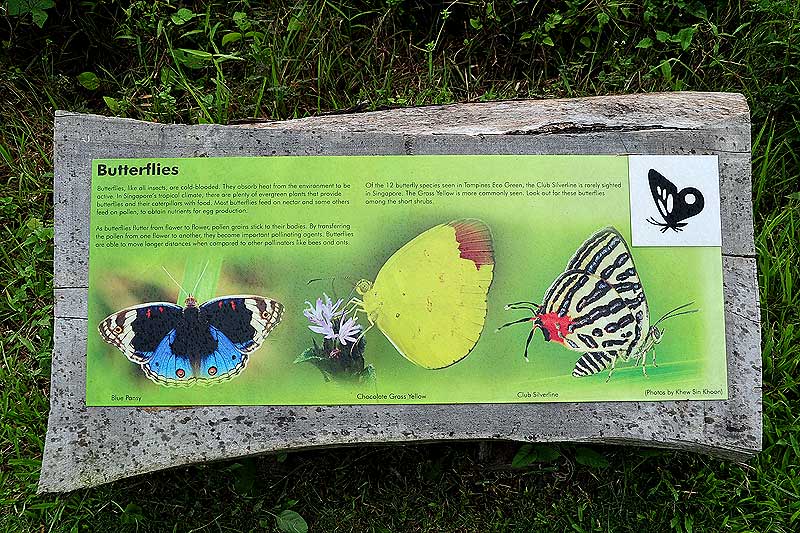
Amongst the more spectacular ones are the Lycaenidae from the Spindasis genus. Both the Silverlines - the Long-Banded and Club Silverlines, can be found here. At times, up to even a half a dozen of these pretty hairstreaks can be found on the ruby-red flowers of the Leea rubra bushes!


A Pea Blue on the flower of the Crotalaria


Closer to the secondary forested areas, vines of the Stinking Passionflower (Passiflora foetida) can be found. This explains the presence of two of our 'foreign talent' species, the Tawny Coster and the Leopard Lacewing, being spotted at this park.


Other species are more of the urban butterflies and those that feed on the monocotyledonous plants. Examples are the Satyrinaes and Hesperiinaes. With the ample supply of Leguminosae plants like Mimosa spp and Paraserianthes (Albizia), the park's resident Grass Yellows are quite evident as they flutter amongst the wild flowers on a hot sunny day.


And so we have another new destination in eastern Singapore for close encounters with nature, a peaceful walk to enjoy quality time with family members or a jog in the park to keep up with a healthy lifestyle. 

How to get there :
There are several bus services that bring visitors to the bus stops along Tampines Ave 9.  For those taking the MRT, alight at Tampines MRT station and it's a 20 minute walk to Tampines Eco Green.  Drivers can park at Tampines Housing Estate Block 408, 409, 412,413 and 414, where parking is free on Sundays and Public Holidays. 

Map of Tampines Eco Green.  The blue dot shows the main entrance


The initial base checklist of butterflies at Tampines Eco Green is as follows :

  1. Lime Butterfly (Papilio demoleus malayanus)
  2. Common Mime (Chilasa clytia clytia)
  3. Common Mormon (Papilio polytes romulus)
  4. Common Bluebottle (Graphium sarpedon luctatius)
  5. Lemon Emigrant (Catopsilia pomona pomona)
  6. Orange Emigrant (Catopsilia scylla cornelia)
  7. Mottled Emigrant (Catopsilia pyranthe pyranthe)
  8. Striped Albatross (Appias libythea olferna)
  9. Psyche (Leptosia nina malayana)
  10. Painted Jezebel (Delias hyparete metarete)
  11. Common Grass Yellow (Eurema hecabe contubernalis)
  12. Chocolate Grass Yellow (Eurema sari sodalis)
  13. Black Veined Tiger (Danaus melanippus hegesippus)
  14. Dark Glassy Tiger (Parantica agleoides agleoides)
  15. Common Palmfly (Elymnias hypermnestra agina)
  16. Nigger (Orsotriaena medus cinerea)
  17. Dark Brand Bush Brown (Mycalesis mineus macromalayana)
  18. Chocolate Pansy (Junonia hedonia ida)
  19. Blue Pansy (Junonia orithya wallacei)
  20. Peacock Pansy (Junonia almana javana)
  21. Tawny Coster (Acreae violae)
  22. Lesser Grass Blue (Zizina otis lampa)
  23. Pea Blue (Lampides boeticus)
  24. Ciliate Blue (Anthene emolus goberus)
  25. Club Silverline (Spindasis syama terana)
  26. Long Banded Silverline (Spindasis lohita senama)
  27. Common Tit (Hypolycaena erylus teatus)
  28. Bush Hopper (Ampittia dioscorides camertes)
  29. Palm Bob (Suatus gremius gremius)
  30. Lesser Dart (Potanthus omaha omaha)
  31. Palm Dart (Telicota augias augias)
Text by Khew SK : Photos by Chng CK, Loke PF,  Khew SK, Jonathan Soong, Mark Wong & Zhuang YY