04 January 2011

Butterfly Photography at Our Local Parks - AMK Town Garden West

Butterfly Photography at Our Local Parks
Featuring : Ang Mo Kio Town Garden West


This urban park, developed on a hillock, is the bigger of two town parks at Ang Mo Kio Town. Flanked on two sides by roads - Ang Mo Kio Ave 5 and Ave 6, and on the other two sides by residential estates, this park boasts a total area of about 21 Hectares.


A 120-step concrete staircase takes you up to a small shelter mid-way and up to a plaza right at the top where you can view the lush greenery and landscaping from a high vantage point.


Rows of majestic Livistonia palms rising a few stories high, line the steep slope, creating a formal colonnade of natural columns, drawing the eye upwards and towards the plaza at the top of the hill. At the entrance to the park from AMK Ave 6, there is a small pergola adorned with the pink flowers of the Honolulu creeper (Antigonon leptopus). To the right of this pergola is a large pond covered with water lilies.


A small patch of Lantana surrounded by tall Dracaena marginata shrubs and other palms, greet visitors to the park. The Lantana flowers attract several species of butterflies, like the Peacock Pansy, Lemon Emigrant and the Leopard.


Along the foot of the slope the landscaping changes to patches of Snakeweed (Stachytarpeta indica) and another larger related species, the Pink Snakeweed (Stachytarpeta mutabilis) interspersed with lower ground cover of various other flowering plants.


The patches of Snakeweeds wind sinously up the slope and the flowers of both species of the "weed" attract many butterflies like the Chocolate Pansy, Lemon Emigrant and Common Grass Yellow.


Moving up the slope the planting changes further with patches of Singapore Rhododendron and the Powderpuff Flower (Calliandra haematocephala) and various other leafy plants. Past the shelter (which comes in handy if it rains) one moves further up and the planting along the slope changes again, but this time of the green leafy varieties.


At the final flight of steps up to the small plaza right at the top of the slope is a diamond-shaped kerbed planter that is filled with more Snakeweed, Peacock Flower and a rather lush growth of Bidens sp. It was interesting to note that the Bidens sp. sport exceptionally tall and leafy green leaves and not too many flowers. At the location, there were many skippers like the Small Branded Swift, Formosan Swift, Grass Demon as well as the fast-flying Pierids like the Striped Albatross and Lemon Emigrant.


A Common Mormon flies past, as I was trying to shoot a sun-bathing Formosan Swift, as several individuals of Common Grass Yellow flutter around the flowers and leaves of the Peacock Flower - some ovipositing on the leaves. A couple of Chocolate Pansies frolick in the warm morning sunshine.. A solitary Common Mime makes a hurried pit-stop at the purple flowers of the Snakeweed, taking a quick sip of nectar, before flying off quickly.


As I sat at the plaza watching the butterfly activity, there were several people practising Qi Gong on the lower level, and many joggers running by, obviously regulars at this park. Several families with their kids screaming gleefully can be seen (and heard) on the lower terrace jogging paths. A lady sat on the granite balustrade of the plaza, totally absorbed in her book, and oblivious to the butterflies that were fluttering beside her.


Danger lurks amongst the bushes. This Changeable Lizard waits stealthily for its prey

Just below the plaza platform, was a patch that was allowed to grow "wild". It appears that this patch was reserved as a community gardening patch with various recognisable herbs and spice plants like Lemon Grass, Pandan, Banana and so on.


As the morning grew hotter, I made my way back down towards the pond. Along the way, I encountered a few Leopard butterflies frolicking restlessly near their host plant of Flacourtia inermis. Back at the Lantana patch, I was surprised to see a Copper Flash and the Yellow Palm Dart (our new migrant from Australia). It was some time since I last saw one of these species that we can now consider one of our "foreign talents" that has made Singapore its home. You can read about the discovery of this species in an earlier blog article.


The Yellow Palm Dart, Cycad Blue, Common Dartlet and a Bamboo Paintbrush Swift

At the road level, the pond is a welcoming sight to visitors, particularly in the early morning when the vibrant pink water lily flowers dot the surface of the pond.


This waterbody is a dragonfly enthusiast's haven, with at least 10 or more species flying around the edges of the pond and resting on their favourite perches, returning time and again, even when disturbed.


Along the fringe of the pond, a number of Saraca cauliflora trees were in full bloom, with their attractive orange-yellow flowers busy with Lemon Emigrants and Painted Jezebels.


Location Map of Ang Mo Kio Town Garden West

Here we have an urban oasis, with lush greenery, attractive flowers, butterflies, dragonflies and birds all thriving in proximity to HDB apartments and the busy traffic thoroughfare in Ang Mo Kio New Town. I have not explored the full 21 Ha of the park, with its many jogging tracks, a bird-singing plaza and several other features. But the landscaped area, busy with butterflies would keep many an enthusiast occupied for an hour or two.


So if you have a couple of hours to spare and would like to shoot some urban butterflies, this park is conveniently located, and on Sundays, the limited number of carparks alongside Ang Mo Kio Ave 6 is free of charge! And if you're hungry or thirsty after the short walk and a morning of butterfly watching, the MacDonald's outlet is just about 100m away from the main plaza.

Text & Photos by Khew SK

Acknowledgements :


Ms Chong Siew Chuen, Parks Officer, Community Parks, National Parks Board, who was a key person who helped to create the butterfly-attracting landscaping at AMK Town Garden West.

Further Reading :


NParks Website - AMK Town Garden West

01 January 2011

Re-Discovery of the Detached Dart

Re-Discovery of the Detached Dart (Potanthus trachala tytleri)
Species #296 of the Singapore Butterflies Checklist


Happy New Year to all ButterflyCircle members and blog readers. It is the 1st of January of the year 2011, and we start off the year with some good news with the addition of one more species to the Singapore Checklist. The checklist is now at 296 species and counting, and we hope that the year 2011 will bring more good cheer.


A clump of the host plant of at least 4 different species of skippers - all on the same plant!

A shot of the inflorescence of the host plant and a close up of the florets

On a late Sunday afternoon, whilst out on a short butterfly photography outing at a urban park when I came across a number of leaf shelters on a clump of long grass (possibly Panicum maximum - to be confirmed). Knowing that there would likely be caterpillars of the Hesperiidae, I checked the leaf shelters and discovered at least 5-6 caterpillars of various instars on the grass blades.


A female Formosan Swift (Borbo cinnara) ovipositing on the host plant that three other species of caterpillars were found, including that of the Detached Dart

Interestingly, the caterpillars appeared different and were likely to be of different species. As this was an opportune moment to record the life histories of some of these skipper species, I passed the caterpillars to Horace Tan, our avid cat farmer, in whose good hands I would be certain would see the caterpillars bred successfully and documented in Horace's usual meticulous recording.


Amongst the species that were successfully bred were the Palm Dart (Telicota augias augias), Full Stop Swift (Caltoris cormasa) and a Potanthus sp. which we could not identify with certainty. Horace later obtained a few more eggs to complete the life history of this Potanthus from the same clump of host plant.


However, the early stages of the caterpillar seemed to coincide with the pictures documented in the Butterflies of Hong Kong (Bascombe, Johnston & Bascombe) for the species Lesser Band Dart (Potanthus trachala). The distinctive head capsule and anal plate of the 5th instar caterpillar matches the same species on Plate 105 of the book, showing in full colour the early stages of this species.


Upon eclosion, the male and female specimens were examined and matched against the various references and ID keys. After consulting two experts - one from Hong Kong and one from Malaysia, it was confirmed that the species thus bred from the eggs and caterpillar found at this urban park was indeed Potanthus trachala tytleri.

It is curious though, that the same species is given different common English names in different regions. In the Hong Kong references, this species is called the Lesser Band Dart. In Indian website references, this species is called Detached Dart. In our main Thai reference, Butterflies of Thailand, also calls it the Detached Dart. However, another Thai website calls it the Broad Bident Dart.


For consistency of the common names given to the species in the South East Asian region covering Thailand, Malaysian and Singapore, we will give preference to the name Detached Dart, taking reference from the name given in the Butterflies of Thailand book by Pisuth Ek-Amnuay.


The Detached Dart is larger than the typical Potanthus species and usually larger than the more commonly encountered Lesser Dart (Potanthus omaha omaha). It has a wingspan of about 28-30mm, compared the the Lesser Dart's 20-24mm. and the Large Dart's (Potanthus serina) 30-35mm.


The species can usually be separated from the other species in the genus in that the spots in spaces 4 and 5 of the forewing above are detached and out of line from the spots below. The post-discal spots in spaces 2 and 3 are outwardly concave and deeply excavated. On the upperside of the hindwing, there is usually a conspicuous spot in space 7 and none in space 6. The underside is dark brown with yellow dusting.


In the field, it is not easy to spot the differences amongst the lookalike Potanthus species, and it was only with this chance discovery of the early stages of this species that we now re-instate the Detached Dart to the Singapore Checklist. Given this find, there is always the possibility that more of the Potanthus species occur in Singapore as well. It will only be matter of time and luck that will yield more of these lookalike species to be added to the checklist in due course. Special thanks to Horace Tan for re-discovering this species through his recording of the early stages of the Detached Dart.

Text by Khew SK ; Photos by Horace Tan & Khew SK

References :
  • [C&P4] The Butterflies of The Malay Peninsula, A.S. Corbet and H.M. Pendlebury, 4th Edition, The Malayan Nature Society.
  • Butterflies of Thailand, Pisuth Ek-Amnuay, 1st Edition, 2006
  • The Butterflies of Hong Kong, M. Bascombe, G. Johnston, F. Bascombe, Princeton University Press 1999

Acknowledgments :

  • National Biodiversity Centre, National Parks Board, Singapore for issuing official research permits to selected members of ButterflyCircle to collect and document early stages of butterflies on State Land under NParks' jurisdiction

25 December 2010

Life History of the King Crow

Life History of the King Crow (Euploea phaenareta castelnaui)


Butterfly Biodata:
Genus: Euploea Fabricius, 1807
Species: phaenareta Schaller, 1785
Subspecies: castelnaui C & R Felder, 1865
Wingspan of Adult Butterfly: 105mm
Caterpillar Local Host Plant: Cerbera odollam (Apocynaceae, Common name: Sea Apple, Yellow-Eyed Pong Pong).


A King Crow showing us its upperside while resting on a leaf of the Wild Cinnamon on an urban hill park.


Another King Crow on a leaf perch, showing us its wing underside.

Physical Description of Adult Butterfly:
Euploea phaenareta is the largest species of its genus. As is typical of this genus, the termens are slightly crenulate. Above, the wings are dark brown. On the forewing, there is a series of discal spots, post-discal spots and submarginal spots, all whitish with a slight violet tinge. The discal and post-discal spots are larger in size towards the apex. There is also a small white spot in the forewing cell. On the hindwing, there is a whitish patch at the apex. Underneath, the wings are marked similarly as per the upperside though with variation in size of the white spots. The male has a large and raised scent patch in the hindwing cell.


A King Crow on a leaf perch.


Another King Crow found in an urban park.

Field Observations of Butterfly Behaviour:
The King Crow is considered rare in Malaysia (C&P4) but in Singapore, it is not uncommon especially at sites where its host plant, the Pong Pong Tree, is found growing naturally (such as in mangrove areas and parts of the nature reserves) or cultivated in abundance. In the recent past, the host plant was commonly planted as a roadside tree and as a result, King Crow was brought into urban areas and parks. However this practice has changed over time, and nowadays, the cultivation of the plant is confined to various urban parks. This change has an effect of restricting the appearance of King Crow to such sites. Sightings of the slow flying adults includes individuals or small groups visiting flowering trees and puddling on wet ground.


A King Crow balancing itself on a tiny perch.

Early Stages:
In the region, the host plants recorded for this species are the Yellow-Eyed Pong Pong (Cerbera odollam) and the Red-Eyed Pong Pong (Cerbera manghas). In Singapore, only the former has been recorded as the host plant, due largely to the very rare occurrence of the latter. The caterpillars of King Crow feed on leaves of the Pong Pong Tree.


Host plant: Cerbera odollam (Yellowed-Eyed Pong Pong).


A mother King Crow laying egg on a leaf of the Pong Pong tree

The eggs of the King Crow are laid singly on the underside of a leaf (typically young leaf) of the host plant. The creamy yellow eggs are tall (about 1.6mm in height) and somewhat cylindrical (diameter: 1.2mm) with a rounded top. The egg surface is ribbed.


Two views of an egg of the King Crow.


Two views of a mature egg of the King Crow.

The egg takes about 3.5 days to hatch. The young caterpillar emerges by eating away part of the egg shell. The rest of the egg shell becomes the first meal for the newly hatched, which has a length of about 3mm. Its cylindrical body is pale yellowish. The large head capsule is black in color. A pair of very short and inconspicuous protuberances can be found on the dorsum of each of the following three segments: 2nd and 3rd thoracic segments, and the 8th abdominal segment.


Two views of a newly hatched caterpillar eating the last of the egg shell, length: 3mm.

Once the newly hatched moves on to feed on the leaf lamina, its body starts to take on a green undertone. The growth is rather rapid with the body length doubled to 6mm in about 1.5-2 days. Towards the final half day of the 1st instar, the body takes on yellowish brown ring markings on all segments with the exception of the prothoracic segment. Laterally, the body also assumes a yellowish tinge above and below the spiracles.


Two views of a 1st instar caterpillar, several hours old, length: 3.6mm


Two views of a 1st instar caterpillar, late in this stage, length: 6mm.

The body of the 2nd instar caterpillar has a white ground color. There are black rings on each of the body segments except for the very 1st segment. The most obvious change is the lengthening of the 6 tiny protuberances seen in the 1st instar to short processes, each of which is almost entirely black. There are two small black spots on the dorsum of the prothorax, and one large black patch (anal plate) on the posterior end of the body. The body is also colored yellowish to orangy in the super- and sub-spiracular areas. This instar lasts only 1.5-2 days with the body length reaching 12.5mm before the moult to the 3rd instar.


Two views of a newly moulted 2nd instar caterpillar, length: 3.2mm


Two views of a 2nd instar caterpillar, late in this stage, length: 11mm

The 3rd instar caterpillar is similar in appearance to the 2nd instar caterpillar with the only obvious change being the proportionally longer processes. The 6 processes are still mostly black in color with a touch of grey towards the base. When at rest, the 6 thoracic processes are typically kept at a forward pointing horizontal position. This instar takes about 1.5-2.5 days to complete with body length reaching up to 20mm.


Two views of a newly moulted 3rd instar caterpillar, length: 12mm.


Two views of a 3rd instar caterpillar, late in this stage, length: 20mm.

The 4th instar caterpillar has proportionally longer processes. The lower half and the tip of each process are colored in white. On the body segments, the dark rings from the previous instar are replaced with grey-colored rings outlined in dashes of black. The black head capsule now has two frontal, prominent but disjoint white stripes and two shorter lateral white stripes. This instar lasts 2 to 2.5 days with the body length reaching about 30mm. In the half day leading to the moult, the body of the 4th instar caterpillar discolorizes dramatically to almost a complete snow-white.


Two views of a 4th instar caterpillar, length: 26mm


Two views of a 4th instar caterpillar, late in this stage, length: 30mm.

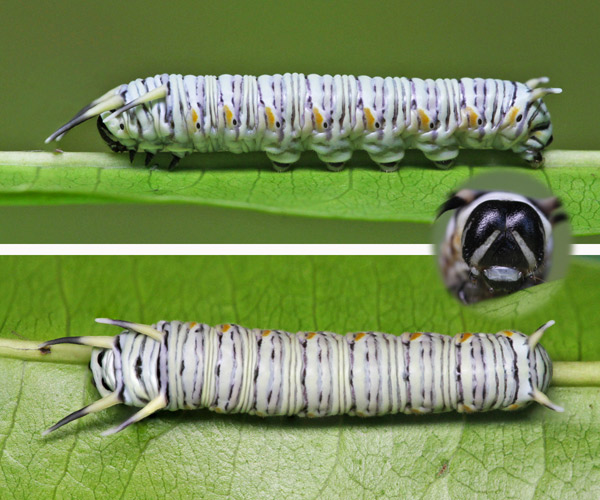
The 5th instar caterpillar initially resembles a decolorized version of the 4th instar caterpillar. The frontal and lateral white stripes on the black head capsules are now more prominent and joined together. But within hours, the white base colour is replaced by a dark shade of purplish brown. The proportionately longer processes are still white tipped but the basal portion are now colored purplish brown. The spiracles have also become more prominently marked in black spots.


A newly moulted 5th instar caterpillar, with its exuvia lying near by.


A final instar King Crow caterpillar flashing its adenosma.

The King Crow caterpillar, just like the Blue Spotted Crow (E. midamus singapura), has an adenosma (located just ahead of the 1st pair of thoracic legs). The green-colored adenosma is everted when the caterpillar feels threatened.


Two views of a 5th instar caterpillar, length: 46mm.


Two views of a 5th instar caterpillar, late in this stage, length: 43mm.

The 5th instar lasts for 3.5-4 days, and the body length reaches up to 53mm. On the last day, the caterpillar ceases feeding, and its body becomes shortened and decolorised somewhat with the sub- and super-spiracular area turned yellowish. The basal portion of the six processes turn bright reddish. For pupation site, the caterpillar typically chooses a spot on the mid-rib of a leaf underside. At this site, the caterpillar spins a silk pad from which it then hangs vertically to take on the pre-pupatory pose. At this point the body color decolorises further to a greyish white color.


A pre-pupatory larva of the King Crow.


The pupation event of a King Crow caterpillar.

Pupation takes place 0.5 days after the caterpillar assumes the hanging posture. The pupa of the King Crow suspends itself from the silk pad with no supporting silk girdle. Initially, the pupa is in a light shade of yellowish brown, but the surface gradually takes on a silvery metalic glitter about a day later. The pupa is rather rotund, and has a few black spots and dark brown patches on the dorsum. Length of pupae: 26mm.


Three views of a shining pupa of the King Crow, day 2 after pupation.


Three views of a mature pupa of the King Crow, minutes prior to eclosion.

After about 8 days of development, the pupal turns black as the development within the pupal case comes to an end. The white spots on the forewing upperside also become discernible. The following day, the adult butterfly emerges from the pupal case. It then perches nearby to expand and dry its wings before taking its first flight.


A newly eclosed King Crow drying its wings on its pupal case.


References:
  • [C&P4] The Butterflies of The Malay Peninsula, A.S. Corbet and H.M. Pendlebury, 4th Edition, The Malayan Nature Society.
  • Butterflies of Thailand, Pisuth Ek-Amnuay, 1st Edition, 2006
Text by Horace Tan, Photos by James Chia, Ben Jin Tan, Sunny Chir, Khew SK and Horace Tan