19 November 2010

Butterfly of the Month - November 2010

Butterfly of the Month - November 2010
Tawny Palmfly (Elymnias panthera panthera)


The winds have shifted and now the prevailing winds are coming from a North-Easterly direction, usually bringing heavy rains to many parts of South-East Asia. The monsoon months traditionally brings closure to many activities in nature areas in Malaysia, where the national parks and nature reserves are closed for the safety of visitors. I recall being shown the flood level at Endau-Rompin National Park in Malaysia, where the debris from a recent flood clearly indicated the water line before the water receded. Nothing out of the ordinary, except that the debris line was about two-thirds up a line of trees that was about 15m high!


The 11th month of the year, November always brings happy anticipation of the Christmas holiday season. Indeed, cheery and glittering decorations are already up in many shopping malls in Singapore. In multi-cultural Singapore, November 2010 also saw the celebration of Deepavali and Hari Raya Haji by the Hindu and Muslim communities respectively.


This month, we feature a relatively 'plain-Jane' butterfly, the Tawny Palmfly (Elymnias panthera panthera). The English common name of the butterfly is rather curious, as "tawny" often refers to a "warm sandy colour" which the species displays very little of. Perhaps the pale buff submarginal border on the upperside of the hindwing is distinctive enough to give the butterfly a 'tawny' descriptor.


Another unique feature of this species is its scientific name. It is one of only a handful of butterfly species to share the name of mammals and in this case, a specific genus of the big cats, Panthera. A rather interesting reference, since the butterfly bears no resemblance in any way to the famous carnivorous and predatory cats.


The Tawny Palmfly is a forest denizen, where it skulks close to the forest floor in well-shaded localities. It is usually very skittish and flies off the moment it senses any movement towards it. The species is best observed when feeding on the ripened fruits of the Singapore Rhododendron (Melastoma malabathricum) - when it is less skittish and allows an observer to move in closer to it.


It doesn't fly rapidly but displays an erratic flight when flying around, searching for food sources or moving around its preferred habitats. Very often, it stops and perches on the upper surfaces of leaves with its wings folded upright. In the field, we have, thus far, not encountered an individual sunbathing with its wings opened flat before.


The Tawny Palmfly is dark brown above and the hindwing has a pale buff border bearing a series of white-centred black submarginal spots. The underside bears the usual reddish-brown striations of the genus Elymnias (collectively called the Palmflies) which helps to camouflage the butterfly when settled amongst the forest litter.


The female of this species makes an interesting audible clicking sound with its hindwings when it flutters about its host plant laying eggs. The caterpillar of this species feeds on a variety of palms found in the forests.


Although it is a species that is primarily found in forested areas, and in particular, in habitats where various species of Palmae grow, it has also been observed with regularity at urban parks and gardens as well. Sometimes it flies in the company of its closely related species, the Common Palmfly.


Text by Khew SK : Photos by James Chia, Chng CK, Federick Ho, Khew SK, Koh Cher Hern, Loke PF, Bobby Mun, Ellen Tan & Anthony Wong

14 November 2010

Life History of the Plain Tiger

Life History of the Plain Tiger (Danaus chrysippus chrysippus)


Butterfly Biodata:
Genus: Danaus Kluk, 1802
Species: chrysippus Linnaeus, 1758
Subspecies: chrysippus Linnaeus, 1758
Wingspan of Adult Butterfly: 65mm
Caterpillar Local Host Plant: Calotropis gigantea (Asclepiadaceae, common name: Giant Milkweed), Asclepias curassavica (Asclepiadaceae, common name: Blood Flower).


A Plain Tiger found visiting a flower.


Physical Description of Adult Butterfly:
Above, the forewings are orangey brown with a series of white spots in a broad black apical border. The hindwings have a narrow dark border and a few black spots featured at both the cell edge and end-cell. In form chrysippus, the hindwings are orangy brown, but in form alcippoides, the hindwings are almost white throughout. The male has a subtornal brand on the hindwing just below vein 3. Underneath, the wings are similarly marked as per the upperside but with apical border orangy brown on the forewing, and wing margins marked with a series of prominent and white marginal spots.


A Plain Tiger form chrysippus sunbathing on a fern frond.


A Plain Tiger form alcippoides displaying its upperside.


Plain Tiger adults imbibing fluid/sap from parts of two different plants.

Field Observations of Butterfly Behaviour: Both forms of the Plain Tiger can be found in Singapore with form alcippoides being the more common of the two. This species is typically found where its host plants are cultivated. Such locations include HortPark, butterfly trails, butterfly gardens in schools and housing estates and even certain park connectors. The adults typically visits flowers in the vicinity of its host plant and has a fondness for sap exuded by Crotalaria spp.


A Plain Tiger perching on a fern frond in a closed-wing pose.


A newly eclosed Plain Tiger

Early Stages:
Caterpillars of Plain Tiger feed on leaves of its host plants, Giant Milkweed and Blood Flower, both of the Asclepiadaceae family (the Milkweed family).


Local host plants for the Plain Tiger: Giant Milkweed (left) and Blood Flower (right).

A mating pair of Plain Tiger.

The eggs of the Plain Tiger are laid singly on the leaf of the host plant, typically on the underside. The milky white egg is shaped somewhat like a bullet-head (diameter: 0.95mm, height: 1.3mm). The egg surface is ribbed with ridges running longitudinally. The micropyle sits atop.

A mother Plain Tiger ovipositing on its host plant.

Two views of an egg of the Plain Tiger.

The egg takes about 2.5-3 days to hatch. The young caterpillar emerges by eating away part of the egg shell. The rest of the egg shell becomes the first meal for the newly hatched, which has a length of about 2.2mm. Its cylindrical body is mostly white with a yellowish undertone, and has a fair number of short fine setae. The large head capsule is black in color and there is a small black patch at the posterior end. A pair of short sub-dorsal protuberances can be found on each of the following four segments: 1st and 2nd thoracic segments, 2nd and 8th abdominal segments. Of these, the prothoracic pair is black in color and the remaining pairs in orangey brown. The thoracic legs and prolegs are all black in color.


Two views of a newly hatched caterpillar, length: 2.2mm.

Once the newly hatched moves on to feed on leaf lamina over the next few hours, its body starts to take on a green undertone. The growth is rather rapid with the body length doubling to about 4.5mm in 1.5 day, and after just 1.5 to 2 days from hatching, it moults to the 2nd instar. Towards the final hours of the 1st instar, the last three pairs of protuberances turn dark brown and pairs of oval-shaped yellow spots appear on the dorsum from the 2nd thoracic segment to the 8th abdominal segment.


Two views of a 1st instar caterpillar, length: 3.5mm.

Two views of a 1st instar caterpillar, late in this stage, length:4.3mm.

The body of the 2nd instar caterpillar is whitish in ground color. One obvious change is the lengthening of those black protuberances on the 2nd thoracic segment, 2nd and 8th abdominal segments The pair of protuberances on the 1st thoracic segment remains subdued in size. A diffused yellow band runs sub-spiracularly. The subdorsal paired yellow spots are embedded in dark patches which extend laterally to the subspiracular yellow band. Noteworthy is that there is only one (rather than two) elongated yellow dorsal spot on the 9th abdominal segment. The black head capsule now has a triangular white patch on the frons and a prominent white arch. This instar lasts only 1 to 1.5 days with the body length reaching 9mm before the moult to the 3rd instar.


Two views of a 2nd instar caterpillar, early in this stage, length: 5.7mm


Two views of a 2nd instar caterpillar, late in this stage, length: 8.5mm

The 3rd instar caterpillar is similar in appearance to the 2nd instar caterpillar, One obvious change is in the three pairs of processes which are proportionately longer. The head capsule also has an outer white arch at the rear periphery. This instar takes about 1-1.5 days to complete with body length reaching about 12mm.


3rd instar caterpillar, newly moulted, length: 8.5mm


3rd instar caterpillar, late in this stage, length: 12mm.

Retaining very much the same body features from the previous instar, the 4th instar caterpillar distinguishes itself in having proportionately longer processes, with the mesothoracic pair the longest and having a strong tendency to flex forward. This instar lasts 2 days with the body length reaching about 21mm.


Two views of a 4th instar caterpillar, late in this stage, length: 12mm.


Two views of a 4th instar caterpillar, late in this stage, length: 16mm.


4th instar caterpillar, late in this stage, length: 21mm.


A group of Plain Tiger caterpillars defoliating a Blood Flower plant.

The 5th and final instar appears similar to the previous two instars but again with proportionately longer and filamentous processes, particularly so for the mesothoracic pair. All six processes now have a crimson coloration at the basal portion.


Two views of a 5th instar caterpillar, early in this stage, length: 26mm.


Two views of a 5th instar caterpillar, length: 34mm.


Two views of a 5th instar caterpillar, late in this stage, length: 39mm.

The 5th instar lasts for 2-3 days, and the body length reaches up to 42mm. On the last day, the caterpillar ceases feeding, and its body becomes shortened and decolorized, most notably in the yellow and crimson coloration. It wanders around in search of a pupation site. Typically it comes to a halt on a branch/stem or a leaf underside, where the caterpillar spins a silk pad from which it soon hangs vertically to take on the pre-pupatory pose.

Two views of a 5th instar caterpillar, a atypical whiter form.


A pre-pupatory larva of the Plain Tiger.

Pupation takes place about 0.75 days after the caterpillar assumes the hanging posture. The barrel-shaped pupa suspends itself from the silk pad with no supporting silk girdle. The pupa could be green, pink even white in coloration. It has a median transverse line marked with a series of black spots and an outer series of yellow spots. Length of pupae: 19-20mm.

The pupation event of a Plain Tiger caterpillar.


Two views of a pupa of the Plain Tiger, green form.

Two views of a pupa of the Plain Tiger, white/pink form.


Two views of a mature pupa of the Plain Tiger.

After about 5 days of development, the pupal skin turns translucent as the development within the pupal case comes to an end. The prominent white spots on the forewing upperside also become discernible. The following day, the adult butterfly emerges from the pupal case.
The eclosion event of a Plain Tiger butterfly.


A newly eclosed Plain Tiger drying its wings on its pupal case.

References:

  • The Butterflies of The Malay Peninsula, A.S. Corbet and H.M. Pendlebury, 4th Edition, The Malayan Nature Society.
  • Butterflies of Thailand, Pisuth Ek-Amnuay, 1st Edition, 2006
Text by Horace Tan, Photos by Liyana Zolpakar, Tan Ke-Yang, Mark Wong, Anthony Wong and Horace Tan

11 November 2010

Butterfly Re-Introduction - Boon or Bane?

Butterfly Re-Introduction Programme
Boon or Bane?


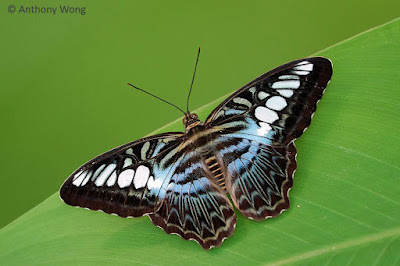
Clipper (Parthenos sylvia lilacinus) extinct in Singapore, but successfully bred and showcased in regional butterfly farms

Mention the word re-introduction to conservation ecologists or purist nature enthusiasts and you may get a bit more than just raised eyebrows - experience has shown that there have been passionate objections and heated arguments about this. There are, of course, valid causes for concern, but the other side of the argument also has pertinent points favouring re-introductions.

For those who may not be aware, re-introduction is the intentional and deliberate release of species back into the wild. These species are either bred, or captured and released from other areas where the species still exists. In various taxonomic groups, it usually involves species that are critically endangered or extinct in the wild. Technically, re-introduction usually involves the returning of species into locations or regions where they were previously found or recorded with a fair measure of confidence, but are now extinct. Hence some practitioners of re-introduction programmes prefer to call it "re-establishment".
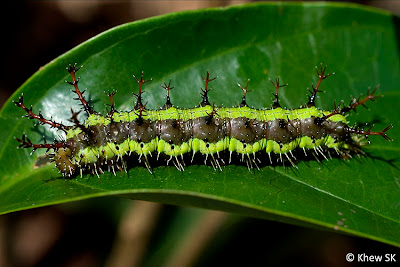

Caterpillar of the Clipper (Parthenos sylvia lilacinus)

Re-introduction programmes have been more predominantly focused on mammals and vertebrates like birds and occasionally amphibians. There are some well-known programmes since the early 1980's where biologists have studied the impacts of re-introducing a species into the habitat it once existed in.
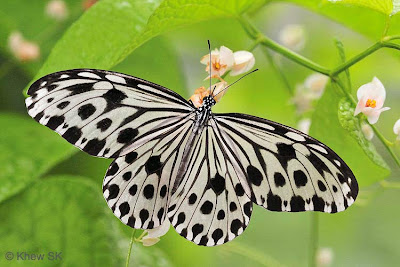

Smaller Wood Nymph (Ideopsis gaura perakana) - extinct in Singapore

For butterflies, any initiative to re-introduce species that have since gone extinct should take into account the following considerations :

  • Habitat and preferred localities that the butterfly can survive and thrive - those species which survive in the forested areas which are protected are more likely to be sustainable.
  • Larger and more robust species that are easier to be bred and withstand environmental pollution.
  • Availability of its caterpillar host plants and whether another extant species shares this host plant with the re-introduced species
  • Its early stages and whether the caterpillars may cause other species (even besides butterflies) to be affected by their presence.
  • Whether the intentional cultivation of the host plant may affect the floral ecological balance.
  • The correct subspecies must be ascertained.

There have been several successes of butterfly re-introduction programmes in the west, in particular, two examples being the Karner Blue (Lycaeides melissa samuelis) in Ohio, USA and the Large Blue (Phengaris arion) butterfly which was declared extinct in the UK in 1979, but has been successfully re-introduced.
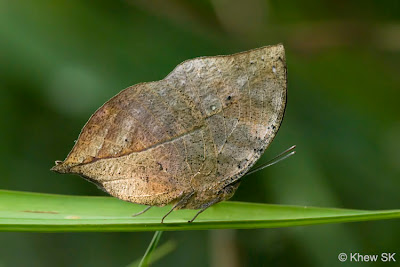


Underside of the Leaf Butterfly (Kallima limborgii amplifura)

It is not known whether there have been any similar re-introduction programmes in SouthEast Asia, nor any research papers done to document if there have been any successes. Thus far, Internet searches have delivered only reports of butterfly re-introductions from western countries.
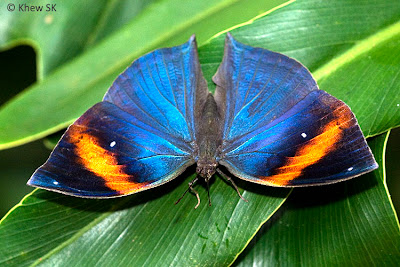


Leaf Butterfly (Kallima limborgii amplifura) extinct in Singapore but commonly bred at butterfly farms in the region

If such a re-introduction programme were to be carried out in Singapore, what would be the possible species that could be targeted? Should Singapore even consider a butterfly re-introduction programme?
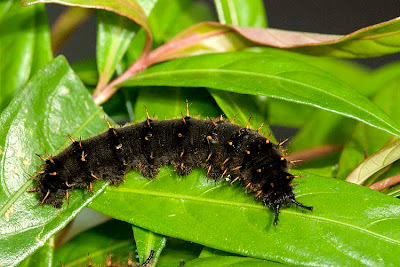


Caterpillar of the Leaf Butterfly (Kallima limborgii amplifura)


From those checklists, a selection of e.g. 5-6 species could be done, and studies conducted on populations of these species where they still exist. The nearest populations of some of these species would be a mere hour's drive up north into the Malaysian state of Johor.


Wanderer (Pareronia valeria lutescens) male - extinct in Singapore, but seasonally common in forested areas in Johor


Once observations and reports are made of these species in their natural habitats and general behaviour and habits of the species, host plants, early stages and so on, the search for possibly similar habitats be made in Singapore, where the species could be re-introduced. One premise that should be established would be the availability of the caterpillar host plant in Singapore, its abundance, and extent of spread across the island. Care must be taken, of course, that the host plant is already native to the Singapore flora checklist and not to introduce an exotic species of plant to Singapore.
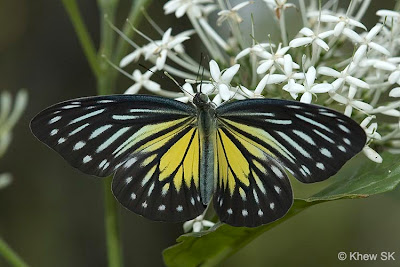


Wanderer (Pareronia valeria lutescens) female - extinct in Singapore, but seasonally common in forested areas in Johor

Prior to the re-introduction programme, the host plant must be cultivated, perhaps under the National Parks Board's supervision, at locations like Singapore's urban parks, gardens, park connectors and so on, where the cultivation of the plants can be supervised and observed.
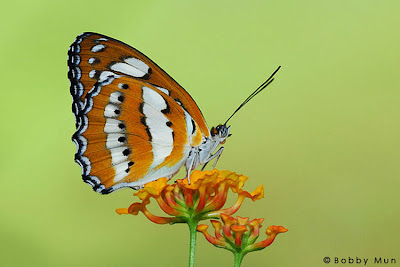


Common Sergeant (Athyma perius perius) a common butterfly bred in butterfly farms in Malaysia

Once there is enough critical mass of the host plant (that is, assuming that the plant is not common in the first instance), then the import of pupae or wild-captured males and females of the target species is released into the wild. Unlike mammals, there is no need to 'train' the released butterflies to hunt or adapt to its new surroundings.
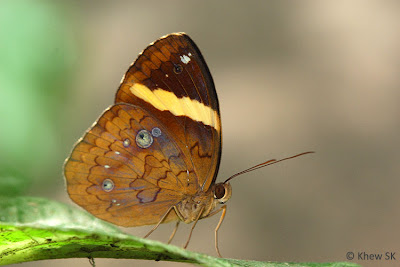


The Yellow Barred (Xanthotaenia busiris busiris) extinct in Singapore since the late 19th century

It has always been a subject of debate, whether human intervention is advisable where the survival of a species is concerned. They may have gone extinct for a good reason, and bringing them back into the environment may not necessarily be a good thing. However, one can always argue that a species has gone extinct, precisely because of human intervention in the first instance (like development, land clearing, removal of a plant species, pollution in the environment, and so on). Hence where humans have been the cause for the extirpation of a species, it would only be right that humans make amends to bring the species back.


The debate will not ever end, as there will always be proponents on both sides, extolling the pros and cons of whether to re-introduce a species, or not. As a supporter of butterfly re-introduction, I would personally recommend that further observations and studies continue to be carried out before a pilot scheme for a re-introduction be attempted.
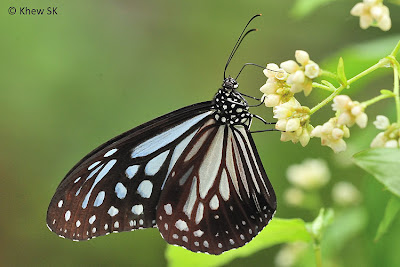


Chocolate Tiger (Parantica melaneus sinopion) extinct in Singapore

Some suggested butterfly species that could be studied and considered for re-introduction in Singapore would be as follows :

  • Smaller Wood Nymph (Ideopsis gaura perakana)
  • Chocolate Tiger (Parantica melaneus sinopion)
  • Yellow Barred (Xanthotaenia busiris busiris)
  • Wanderer (Pareronia valeria lutescens)
  • Clipper (Parthenos sylvia lilacinus)
  • Common Sergeant (Athyma perius perius)
  • Leaf Butterfly (Kallima limborgii amplifura)

Text by Khew SK ; Photos by Bobby Mun, Khew SK & Anthony Wong


Further Reading & References :