06 August 2010

What Next, MOG?

What Next, MOG?
The end of the road for Mandai Orchid Garden?


When we read the news that the land lease of the Mandai Orchid Garden (MOG) would end in six months' time, it was with sadness and frustration that yet another venue for nature photography and also a garden that is part of Singapore's heritage and memorable destinations may be gone soon.


Mandai Orchid Garden was started in 1951 by the late John Laycock, a founder of the Orchid Society of Southeast Asia (OSSEA), and continued under him until his death in 1960. He purchased five acres of land on which to grow his ever-increasing collection of orchids. He leased a further five acres of land for commercial cut flower growing, this land and more forms the Mandai Orchid Garden today.* (Write up credits : Mandai Orchid Garden website)


Many orchid-loving Singaporeans visited MOG, which is also a tourist destination, to get their fill of orchids and to learn how to cultivate the difficult species, seeding, propagation, pests, and so on.


A change in management of MOG occurred in 2002, and facilities like a fine-dining F&B outlet and more feature gardens were added. The MOG currently sits on a 4Ha site along Mandai Lake Road and is adjacent to the Night Safari.
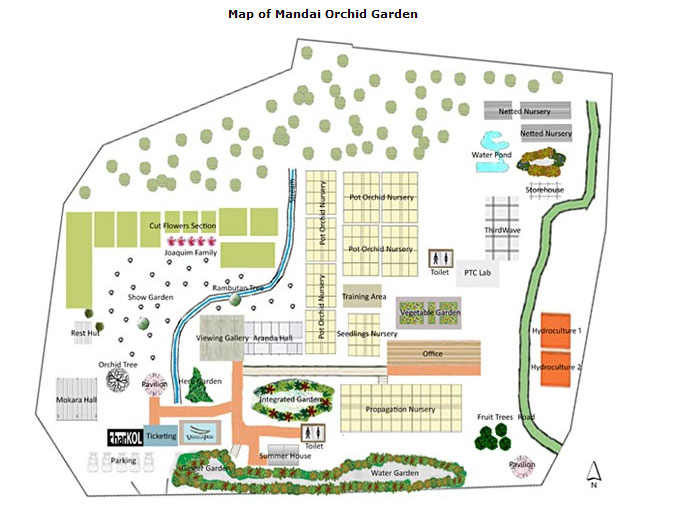


Map of Mandai Orchid Garden, © Mandai Orchid Garden

MOG is a favourite venue for nature photographers as well. It is no secret that many newbie bird photographers cut their teeth at MOG, learning the ropes of bird photography amongst the lush landscaping at the Water Garden. The Crimson Sunbird and Little Spiderhunter are favourites with bird photographers, as these birds love the Torch Ginger flowers and return again and again to feed on them. Over time, these birds seem to have gotten used to the flashes of the nature paparazzi and appear to be much braver than their counterparts seen in other places. There was a time when I was even able to shoot a full-frame shot of a Crimson Sunbird with my 180mm macro lens! There are also other rare resident birds at MOG.


A signature shot of a Crimson Sunbird on the flower of the Torch Ginger

For more bird shots by nature photographers, please see this thread set up at local photography forum ClubSnap started to create awareness about the fate of MOG.


A newly-eclosed Atlas Moth - a common moth species found at MOG

Macro photographers and particularly butterfly photographers will also sorely miss MOG if it were gone. There are also many dragonfly species at the Water Garden, as there are species of butterflies that are not often found elsewhere in Singapore.


The Metallic Caerulean found at MOG, where a small but local colony of this butterfly can be found

Of special mention is the recently re-discovered Metallic Caerulean (Jamides alecto ageladas). The caterpillars of this species depend on the flowers of the Torch Ginger. The life history, as recorded by ButterflyCircle early stages expert, Horace Tan, can be found here on this blog. Although clusters of the Torch Ginger plants can be found elsewhere in Singapore, the special habitat at MOG somehow makes them stay for all these years.


Two rare skippers found at MOG - Top : Dark Banded Ace (Halpe ormenes vilasina) and Bottom : Pugnacious Lancer (Permara pugnans)

Also, because of the various bamboo species and the proximity to the Night Safari's rather pristine rain forest habitat, many rare Hesperiidae can also be found on the grounds of MOG. Once in a while many rare Lycaenidae can also be observed. Indeed, it was near MOG (just outside its boundaries) where Steven Neo our ButterflyCircle veteran, first discovered the Chocolate Sailor (Neptis harita harita) in the early 1990's. This species is a new taxon to the Singapore checklist at that point in time.


The rare Chocolate Sailor, Palm King and Bamboo Tree Brown are species that can be found at MOG. Bottom shot : A mating pair of the Dark Brand Bush Brown

ButterflyCircle is already working with the NParks' National Biodiversity Centre to start translocation efforts for the butterfly species for which their caterpillar host plants are known.

Another shot of the Metallic Caerulean on the flowers of Leea rubra at MOG

Habitat duplication is being attempted at undisclosed locations to start the process, whilst consideration is being given on the techniques of translocating species like the Metallic Caerulean before the imminent destruction of its favoured habitats give way to the developers' exacavators and cranes.


To the ordinary Singaporean, MOG is all about orchids. The nature loving and nature photography communities have added another dimension (and value) to MOG that is not often known or appreciated by most. The rich biodiversity at MOG cannot be ignored, and once habitats are destroyed, the birds, dragonflies, butterflies and other taxonomic groups of animals may not return again.


Even if the Water Garden at MOG can be preserved as development of a "potential gated nature attraction" proceeds, a careful study of the phasing and the impact to biodiversity has to be done before work starts. Whilst there are no delusions that Singapore's infrastructural development and improvements will carry on, with or without damage to the biodiversity, consideration for our natural heritage and their sustainability should be given their appropriate place in any future development of a "nature attraction". It is hoped that the Singapore Tourism Board, the Singapore Land Authority, Urban Redevelopment Authority and the future tenants of the 30Ha site will give due consideration and attention to the biodiversity that is already found at the site, and not destroy what we have, in the name of progress.


So whilst the nature community waits with bated breath for the decision on the fate of MOG, here are photographs of the site, and a sample of the butterfly diversity that can be found at the site for all to enjoy. For it may be the last time that we may see some of these species of our winged jewels in Singapore.

Text by Khew SK : Photos by Sunny Chir, Khew SK, Horace Tan, Johnny Wee & Mark Wong

31 July 2010

Life History of the Common Sailor

Life History of the Common Sailor (Neptis hylas papaja)


Butterfly Biodata:
Genus: Neptis Fabricius, 1807
Species: hylas Linnaeus, 1758
Subspecies:
papaja Moore, 1875
Wingspan of Adult Butterfly: 50mm

Caterpillar Local Host Plants: Calopogonium mucunoides (Fabaceae), Canavalia cathartica (Fabaceae), Aeschynomene americana (Fabaceae), Senna alata (Fabaceae), Psophocarpus tetragonolobus (Fabaceae), Centrosema molle (Fabaceae).


A Common Sailor enjoying ripened fruits of the Singapore Rhododendron.


A Common Sailor sunbathinng on a cluster of flower buds of the Singapore Rhododendron.

Physical Description of Adult Butterfly:
On both wings the cells are open, and vein 8 on the hindwing ends on the costa. Above, the wings are dark brown to black in ground colour and feature the usual white markings for Sailor species. A distinguishing feature is that post-discal spots in spaces 2 and 3 of the forewing are in echelon and are directed to the termen. There is no whitish ring on the abdomen. Underneath, the wings are rich golden ochreous in ground color, and nearly all white markings prominently outlined with black borders.


A Common Sailor resting on a perch.

Field Observations of Butterfly Behaviour: This species is rather common in Singapore, and has a wide distribution across the main Singapore island. The adults can be found along the fringes of nature reserves and in many wastelands where its multiple host plants grow in abundance. As with other Sailor species, the Common Sailor adults are sun-loving and fly in a slow "sailing" fashion. They also visit flowers and ripening fruits for energy intakes. Adults can be easily confused with those of the Short Banded Sailor on the upperside, but the two can be differentiated with their drastically different undersides.


A mating pair of Common Sailor adults.

A sunbathing Common Sailor in a wasteland.

Early Stages:
Throughout its wide range of occurrence globally, Common Sailor is highly polyphagous with its early stages feeding on leaves of various plant species in the families: Leguminosae, Malvaceae and Tiliaceae
. In Singapore, so far five plants in the Leguminosae family have been recorded as larval hosts. Three of these plants (see pictures attached below) are readily found in wastelands, thus allowing the Common Sailor to have a strong foothold in these habitats.


Another pair of the Common Sailor adults mating under the midday sun.

Caterpillars of the Common Sailor feed on mature leaves of the host plant. As with other Neptis spp., the early instars of the Common Sailor eat the lamina of each leaf from the tip, or from a damaged and protruding edge, with the midrib typically left uneaten and used as a resting site. It does not construct frass chain as is the case for the Chocolate Sailor. Rather it has the habit of
cutting and hanging leaf fragments for concealment as part of its feeding routine. In this regard, it is similar to the Short Banded Sailor.


Host plant: Canavalia cathartica.


Host plant: Calopogonium mucunoides.


Host plant: Aeschynomene americana.

The eggs of the Common Sailor are laid singly at the tip of a leaf on the host plant After landing on a selected leaf and concluding that it belongs to a suitable host, the female Common Sailor reverses along the leaf surface until its abdomen tip reaches the leaf tip. At this moment, an egg is then deposited.


Two views of an egg laid at a leaf tip of Calopogonium mucunoides. Base diameter: 0.9mm.
Each egg is somewhat globular in shape, with the surface marked with hexagonal pits and and thin spines at pit corners. The micropylar sits atop. Freshly laid eggs are green in colour, but turning pale green and then yellowish when maturing. Each egg has a base diameter of about 0.9mm and a height about 1mm.


Two views of a mature egg.

The egg takes about 3-3.5 days to hatch. The young caterpillar emerges by eating away part of the egg shell. Measuring about 2.2mm in length, the newly hatched proceeds to consume the remaining egg shell as its first meal. Its cylindrical dark green body is covered with many small tubercles and short setae. The head capsule is brown to pale brown and dotted with a few short setae.


Two views of a newly hatched caterpillar, length: 2.2mm.

Four pairs of subdorsal tubercles, found on the 2nd and 3rd thoracic segments, 2nd and 8th abdominal segments, become somewhat larger than the rest as the caterpillar grows in this instar. These will go on to become more prominent branched spines in later instars. After reaching about 4.5mm in 2.5-3 days, the caterpillar moults to the 2nd instar.


Two views of a 1st instar caterpillar resting on the midrib, length: 4mm.


1st instar caterpillar doing maintenance work on a leaf fragment.

The body color of the 2nd instar caterpillar is yellowish green to dull green with many tiny pale tubercles covering its body surface. Obscure and oblique dark patches appear laterally. White-tipped branched spines, still short in length and yellowish brown in colour, replaces the four pairs of subdorsal tubercles seen in the 1st instar. The pale yellowish brown head capsule is now more elongated vertically, and its surface is dotted with a number of whitish conical tubercles amongst with the pair near the apex is the longest. This instar lasts about 2-3 days with the body length reaching about 6.5-7.5mm.


Two views of a 2nd instar caterpillar, early in this stage, length: 4.5mm


Two views of a 2nd instar caterpillar, late in this stage, length: 6mm


A 2nd instar caterpillar making a sinuous cut across the lamina.


The 3rd instar caterpillar resembles the 2nd instar catepillar in most aspects. The four pairs of subdorsal spines are much longer and larger, with the pair on the 3rd thoracic segment longest, and the pairs on the 2nd thoracic and the 8th abdominal segments second longest. Its dark head capsule is proportionately longer vertically, and the pair of apical spines now longer, more pointed and yellow-brown tipped.


Two views of a 3rd instar caterpillar, early in this instar stage, length:7mm

In the later part of the 3rd instar, the body color takes on a strong greenish tone. Dark lateral shadings just below the 2nd abdominal segment and on the 4th abdominal segment become more prominent. The dorsal saddle is now more distinctly outlined at the posterior segments with the saddle being in much lighter shade there. White to pale greenish lateral patches also appear on the posterior abdominal segments. This instar takes about 2.5-3.5 days to complete with body length reaching about 11-12mm.


Two views of 3rd instar caterpillar, later in this stage, length: 10.5mm.

The 4th instar caterpillar resembles the 3rd instar caterpillar. Laterally oblique dark streaks are seen in the dorsal saddle in the 1st to 4th abdominal segments. The subdorsal white to pale yellowish spines are now longer and stand out against the dark green base colour of the body segments. Lateral patches on posterior abdominal segments are also larger and more prominent. This instar lasts 3-4 days with body length reaching about 16-17mm.


Top: a late L3 caterpillar prior to its moult. Bottom: soon after its moult to the 4th instar..


Two views of 4th instar caterpillar, late in this stage, length: 17mm
In the 5th instar, the subdorsal pairs are now pale pinkish. The 5th instar caterpillar has much larger and longer subdorsal spines on the 3rd thoracic segment. The two thoracic pairs are forward pointing, in contrast to the remaining 2 abdominal pairs which are rear-pointing. The dorsal saddle is initially pale brown, but becoming whitish with pale pink shading in the posterior, and featuring dark oblique patches laterally in the anterior. Lateral patches on the posterior abdominal segments are again larger and more prominent. Initially whitish, they turn lime green gradually in one to two days.


A 5th instar caterpilla, newly moulted, length: 15mm.

Two views of a 5th instar caterpillar, lengths: 20mm.


Two views of a 5th instar caterpillar, late in this stage, length: 24mm.
The 5th instar lasts for about 4-6 days, and the body length reaches up to about 25mm. On the last day, the color of the body decolorizes with whitish/pale areas taking on a pinky shading. The caterpillar ceases feeding and wanders around. Eventually it comes to a halt on the underside of a leaf where the caterpillar spins a silk mound on a chosen spot from which it soon hangs vertically to take on the pre-pupatory pose.


A pre-pupa of the Common Sailor.


Pupation Event of a Common Sailor caterpillar

Pupation takes place a day later. The pupa suspends itself via a cremastral attachment to the silk mound with no supporting silk girdle. It is almost entirely yellowish except for the thoracic area of the dorsum which is pale pinkish brown. One day after pupation, the body surface takes on a silvery sheen. The thoracic segments are rather large with wing cases dilated laterally. The dorsum of the thorax is angular. The head is bluntly cleft at its front edge with small pointed lateral vertices. The pupa has the ability to flex laterally when disturbed. Length of pupae: 16-18mm.


Three views of a pupa of the Common Sailor.

After about 5.5 days of development, the pupal turns dark as the development within the pupal case comes to an end. The white markings on the forewing uppersdies become visible thorugh the pupal skin. The next morning, the adult butterfly emerges from the pupal case.


Three views of a mature pupa.


A newly eclosed Common Sailor drying its wings on the empty pupal case.


A newly eclosed Common Sailor.

References:
  • The Butterflies of The Malay Peninsula, A.S. Corbet and H.M. Pendlebury, 4th Edition, Malayan Nature Society.
Revision: Added host plant, Centrosema molle, on 21 Dec 2015.

Text by Horace Tan, Photos by Anthony Ong, Benedict Tay, Ellen Tan, Federick Ho, Ben Jin Tan and Horace Tan