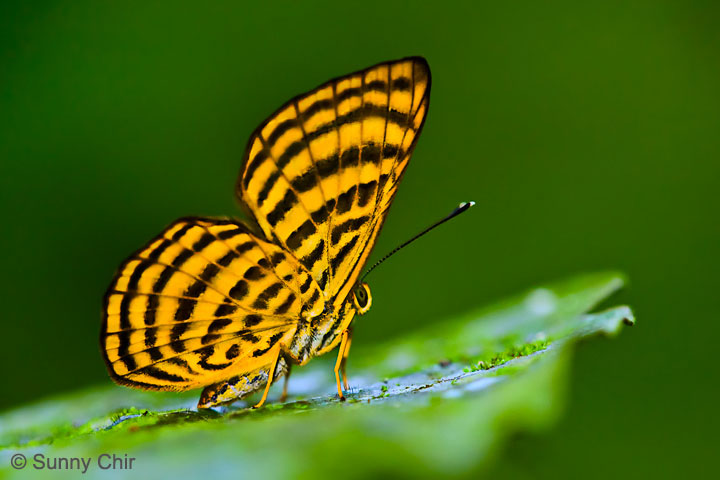
17 July 2010

Life History of the Anderson's Grass Yellow

Life History of the Anderson's Grass Yellow (Eurema andersonii andersonii)


Butterfly Biodata:
Genus: Eurema
Hübner, 1819
Species: andersonii Moore, 1886
Subspecies: andersonii Moore, 1886
Wingspan of Adult Butterfly: 40mm
Caterpillar Local Host Plant:
One plant found in the Central Catchment Area (species ID to be determined). [21 July 2012: Plant identified as Ventilago maingayi; another host plant Ventilago malaccensis also recently recorded.]


An Anderson's Grass Yellow perching on a fern frond.

Physical Description of Adult Butterfly:
Above, the wings are lemon-yellow with the hindwing having a thin black border and the forewing having a thick black border which is deeply excavated between veins 2 and 4, but not more deeply excavated in space 2 than in space 3. The inner edge of the black border in spaces 1a and 1b inclined slightly towards the tornus. Underneath, the wings are yellow with several rusty brown spots. There is no spot at the base of space 7 on the hindwing, but a single spot is present in the forewing cell. Usually, a rather broad dark subapical stripe can be seen in the forewing. Males have an elongate patch (the brand) lying along the cubital vein on the forewing.

An Anderson's Grass Yellow having its mineral intake on a damp patch.


An Anderson's Grass Yellow perching on a grass blade.

Field Observations of Butterfly Behaviour: Anderson's Grass Yellow is not as commonly seen as its close cousin, Common Grass Yellow, (Eurema hecabe contubernalis) as it is mainly a forest denizen with sightings restricted to the Central Catchment Area (CCA). Where its host plant thrives within CCA, Anderson's Grass Yellow can be sighted with relative ease. Typically on a sunny day, adults can be seen fluttering along forest trials, visiting flowers, puddling on wet grounds and making oviposition visits to its host plant.


An Anderson's Grass Yellow taking nectar from flowers of mile-a-minute weed.


Another puddiling Anderson's Grass Yellow deep in the nature reserve.

Early Stages:
The host plant grows in relative abundance in certain areas within CCA. It appears to be a liana which has young leaves in dark to reddish brown, but turning green when they mature. The early stages of the Anderson's Grass Yellow feed on relatively young leaves of this host plant. Noteworthy is that the same plant is also utilized by early stages of the Tree Yellow (Gandaca harina distanti).


The host plant of Anderson's Grass Yellow with young leaves shown.

The eggs of the Anderson's Grass Yellow are laid singly on the surface of a young leaf of the host plant. The long spindle shaped egg is laid standing at one end with a length of about 1.1-1.2mm. It is creamy white in color and has many fine vertical ridges and numerous indistinct and intermittent horizontal ridge lines. The micropylar sits at the tip of the standing egg.

An egg of the Anderson's Grass Yellow sighted on a young leaf within the nature reserve.


A close-up view of an egg of the Anderson's Grass Yellow.
The egg takes about 2-3 days to hatch with the newly hatched eating away part of the egg shell to emerge. Measuring about 1.8-1.9mm in lenght, the newly hatched sports a creamy white head capsule and a cylindrical and pale whitish body covered with rows of tubercles running lengthwise. Each tubercle has a setae emerging from the middle of it. The two rows of tubercles flanking the dorsal line are much larger but with shorter setae than the rest. A miniscule droplet of fluid can be found at the tip of some of the setae.


A newly hatched caterpillar of the Anderson's Grass Yellow, length: 1.9mm.


The newly hatched has the rest of the empty egg shell as its first meal before moving on to eat the lamina of the young leaf. The body and the head become more yellowish as the caterpillar feeds and grows. The body also assumes a strong green undertone as the caterpillar grows to a length of about 4mm in about 2-2.5 days for this instar.


Two view of a 1st instar caterpillar, length 2.7mm.

The 2nd instar caterpillar have numerous setae-bearing tubercles on its body with the length of the setae proportionately shorter than in the first instar. The head capsule is yellowish green and sporting a few rather fine setae. This instar lasts about 2-3 days with the body length reaching 8mm.


Two view of a 2nd instar caterpillar, early in this stage, length: 3.5mm


Two late 2nd Instar caterpillars, moments before their respective moult to the next instar.

The 3rd instar caterpillar has a yellowish green body with a similarly-coloured head capsule. Its numerous setae are proportionately shorter compared to the previous instar. A closer scrutiny reveals that the body is essentially yellow in base colour, and each body segment has up to 6 rings of small tubercles which are green to dark green in colour. Typically each tubercle has one short and fine setae protruding from it, and the end of each setae has one tiny fluid droplet. A white lateral band is seen on either side of the body, rather faint at this stage. This instar takes about 1.5-2.0 days to complete with body length reaching about 11-12mm.


Two views of 3rd instar caterpillar, early in this stage, length: 7.5mm


A very late 3rd instar caterpillar, soon to moult to the 4th instar.

The appearance of the 4th instar caterpillar is little changed from the 3rd instar. The lateral whitish bands are broader and thus more prominent. This instar lasts 1.5-2.0 days with body length reaching about 18mm.


Two views of a 4th instar caterpillar resting on the midrib of a young leaf, early in this stage, length: 9.5mm.


A 4th instar caterpillar, late in thie stage, length: 18mm

The 5th and final instar caterpillar resembles the 4th instar caterpillar closely. The one visible change is in the lateral white bands which have become prominent and well defined in their outlines. The 5th instar lasts for 3-4 days, and the body length reaches up to 29mm.


Two views of a 5th instar caterpillar, length: 25mm.

A 5th instar caterpillar, length: 27mm.
On the last day of the 5th instar, the body of the caterpillar shortens and changes to a dull shade of pale green. It ceases feeding and comes to rest on the underside of a stem/stalk on the host plant. Here the caterpillar spins a silk pad and a silk girdle, with which the caterpillar soon become immobile in its pre-pupatory pose.


A pre-pupatory larva of the Anderson's Grass Yellow on a stem of the host plant.


Pupation takes place about 0.5 day later. The pupa secures itself with the same silk girdle as in the pre-pupal stage, but with cremaster replacing claspers in attaching the posterior end to the silk pad on the stem, The yellowish green pupa has a pointed head, a slight dorsal protrusion, and a large wing case tapering into a keel. A pale brown dorsal band, rather broad in width, runs from the anterior to the posterior end. A pale brown line also runs laterally on each side from the thorax to the posterior end. Length of pupae: 17mm.


Two views of a pupa of the Anderson's Grass Yellow.


Close-up on the cremastral attachment to the silk pad on the substrate.
The attachment is achieved through brown hooks on the cremaster catching the mesh of silk threads.


Two views of a mature pupa of the Anderson's Grass Yellow.
The now transparent wing pad show s the yellow forewing upperside with its black border
.

After about days 5.5-6.0 days of development, the pupal skin turns translucent as the development within the pupal case comes to an end. The yellow coloration and back borders on the forewing upperside are now discernible. The following day, the adult butterfly emerges from the pupa.


A newly eclosed Anderson's Grass Yellow drying its wings near its pupal case.

References:
  • The Butterflies of The Malay Peninsula, A.S. Corbet and H.M. Pendlebury, 4th Edition, Malayan Nature Society.
  • Butterflies of Thailand, Pisuth Ek-Amnuay, 1st Edition, 2006
Text by Horace Tan, Photos by Simon Sng, Federick Ho, Khew SK and Horace Tan

10 July 2010

Butterfly Bunkers

Butterfly Bunkers
An Outing to Bunker Trail, Panti Forest Reserve, Johor


Just as there are swanky restaurants of shooting sites for the upper-crust photographer connoisseur, complete with Peruvian adventures, difficult terrains and stories to tell the grandchildren, there are also the quick fast food getaways into the nearest rainforest just 90 minutes away from the bustling concrete city to get that much needed Nature’s quick fix.


A quick pit-stop at the famous Johor "bah kut teh" roadside stall for breakfast, four hungry Singapoeans tuck in to a delectable concoction of pork ribs stewed in a secret herbal recipe.


Bunker Trail, located on the eastern boundary of Panti Forest, is no macro photographer’s best kept secret. The site is famous to bird watchers and bird photographers. The forest reserve is regarded by many ornithologists and bird enthusiasts as one of Malaysia’s important bird habitats.

The area around Bunker Trail suffered significant habitat damage in the last few decades to make way for oil palm plantations, sand quarrying, logging and other nature-unfriendly activities, leaving only limited patches of the original forested areas, that, surprisingly is still rich with biodiversity.


Coming off the main road to Mersing, at milestone #167, there are remnants of two WWII bunkers, presumably used by the military as armoured outposts during the Japanese occupation. The much-delayed opening of the Bunker Trail by the Johor administration is still outstanding, even as the visitor centre and ranger stations have been completed.


Upon reaching "base camp" at around the 8 km mark from the main road, where there is a shaded forest clearing often used by the Malaysian Armed Forces during training exercises, four impatient ButterflyCircle members jumped out of the car fully armed with their latest in digital photography technology.


Stepping off excitedly into the forested trails, it was hard to ignore the huge numbers of Jamides and Arhopalas. Both these genera of butterflies are equally difficult to distinguish and accurately identify. The combination of their numbers, erratic flight and characteristically flighty behaviour resulted in a nasty game of needing to be fast and stealthy enough to snipe a shot at one Arhopala before a Jamides haphazarded into it, sending both off into a drunken uncoordinated dance further into the foliage.


Thanks to the good concentration of birds and their droppings, this Sky Blue (Jamides caeruleus caeruleus) was fascinated enough to stay put for its mug shot.

Photographing butterflies at Bunker Trial on this particular day in June turned out to be nothing short of an adult version of child’s play, complete with the luxury of a harmonious orchestra of bird singing in the background and no leeches.


The concentration of such a large number of species of butterflies and insects in such a small place resulted in every bush yielding a different subject at every interval of the chase. It was literally the butterfly Paris fashion show in suburban middle class Cologne with none of the budget cuts on show, variety and Lepidotera equivalent of big names in the fashion industry.


Shortly after the elusive the Wanderer (Pareronia valeria lutescens) landed and graced a few shots, the rare Yellow Bodied Clubtail (Atrophaneura neptunus neptunus) appeared, looking for a host plant.


Seemingly absorbed in finding a choice home to lay her precious eggs, the Clubtail ignored the frantic shuttering and flashing of 3 photographers as it circled the bush a few times, lilting up and down with unflustered indecision.

Lunch time in the forest, and the butterflies get a reprieve!

The turnover on each “catwalk” was so intense, the fashion photographers had to eat in the field next to their subjects. I survived on nothing but redbull as I had no appetite for salty noodles in the forest.


There were a good number of Royal Assyrians hopping around all over the place and dodging under leaves.


There were even a couple of Plushes chasing a Witch that was hiding in the bushes.


We shot from 9:30a.m. to 4p.m. and to top off the already great day, Cher Hern spotted a pair of mating Green Imperials (Manto hypoleuca terana) which stayed long enough for all of us to get our fill of shots.


Bunker Trail truly is choice beef hugged in healthy wheat burger buns slapped into a fast food wrap. You get everything you could shoot in 2 days in just 1 day and you don’t even need to stay the night.

Ellen contemplating if that hole in the ground is big enough for her needs

Just be prepared to dig a hole if you need to do the “big one” and bathe naked with melted ice water from the cooler box under a tree in full view of the laughing monkeys because Bunker Trail has only one toilet facility… and it’s all locked up.

Text by Ellen Tan : Photos by Sunny Chir, Koh Cher Hern, Nelson Ong and Ellen Tan

03 July 2010

Life History of the Chocolate Sailor

Life History of the Chocolate Sailor (Neptis harita harita)


Butterfly Biodata:
Genus: Neptis Fabricius, 1807
Species: harita Moore, 1875
Subspecies:
harita Moore, 1875
Wingspan of Adult Butterfly: 55mm
Caterpillar Host Plants: Poikilospermum suaveolens (Urticaceae).


A Chocolate Sailor sunbathing on a perch in a wasteland.


A Chocolate Sailor resting on a perch.

Physical Description of Adult Butterfly:
On both wings the cells are open, and vein 8 on the hindwing ends on the costa. In the male, veins 6 and 7 on the hindwing are parallel for only one third their length. N harita, in contrast to the other two black-and-white Neptis species (N. hylas and N. leucoporos) in Singapore, has the usual markings pale, narrow and suffused with brown. Above, the post-discal spot in space 2 of the forewing is crescentic or oblique. On the hindwing, the male has a speculum so large that it obliterates the discal band in spaces 6 and 7. Underneath, the discal band on the hindwing is almost white, with its inner edge directed to costa between ends of veins 7 and 8. Dark fascia lying beyond the post-discal band are narrow and almost catenulate.


A male Chocolate Sailor flapping its wings, exposing its broad whitish speculum on the hindwings.


A Chocolate Sailor on a flowering branch of Bridelia tomentosa.


A Chocolate Sailor puddling on damp ground.

Field Observations of Butterfly Behaviour:
This species is uncommon in Singapore, and its occurrence is restricted to several sites in the catchment reserves and northern wastelands. As with other Sailors, the adults are sun-loving and fly in a slow "sailing" fashion. They also visit flowers and ripening fruits for energy intakes.


A Chocolate Sailor enjoying a quiet moment on a perch in the nature reserve.


A sunbathing Chocolate Sailor in the nature reserve.

Early Stages:
Thus far, only one local host plant, namely Poikilospermum suaveolens, has been identified. Special credits are due to two avid ButterflyCircle members, Ellen Tan and Nelson Ong, who chanced upon a female Chocolate Sailor ovipositing on this plant. Their discovery of the host plant and subsequent sharing of their find are crucial to this life history documentation. The host plant is rare in Singapore, and this likely accounts for the infrequent sightings of Chocolate Sailors locally.


A female Chocolate Sailor ovipositing an egg at the leaf tip of its host plant.

Caterpillars of the Chocolate Sailor feed on mature leaves of the host plant. As with other Neptis spp., the early instars of the Chocolate Sailor eat the lamina of each leaf from the tip, or from a damaged and protruding edge, with the midrib typically left uneaten and used as a resting site. Rather than feeding in the open on the leaf surface
with no defensive decoy (as in N. leucoporos) or by cutting and hanging leaf fragments for concealment (as in N. hylas), the earlier instars of the Chocolate Sailor construct frass chain (as a possible concealment tool) from the tip of the midrib or a damaged edge, very much like Athyma spp., the Commander and the Colonel. However unlike these other species, no frass barrier is observed to be utilized by the Chocolate Sailor.


Host plant: Poikilospermum suaveolens.

The eggs of the Chocolate Sailor are laid singly at the tip of a leaf on the host plant, or on the leaf underside of a mature leaf of the host plant. The ovipositing female adopts the same common ovipositing routine for most Nymphalidae species: After landing on a selected leaf , the female reverses along the leaf surface until its abdomen tip reaches a suitable spot where it then deposits an egg.


Two views of an egg laid at a leaf tip. Diameter: 1.1mm.

Each egg is somewhat globular in shape, with the surface marked with hexagonal pits and and thin spines at pit corners. The micropylar sits atop. Freshly laid eggs are green in colour, but turning pale green and then yellowish when maturing. Each egg has a diameter of about 1.1mm.


Two views of a mature egg.

The egg takes about 3-4 days to hatch. The young caterpillar emerges by eating away part of the egg shell. After emergence, the newly hatched will consume more of the egg shell as its first meal. Strangely, unlike most Nymphalid spp., where the new born completely consumes the egg shell, the newly hatched of the Chocolate Sailor does not seem to be keen on doing likewise (based on field observations of three leaves with 1st instar caterpillars, and one hatched in a breeding setup). Its cylindrical dark green body is covered with many small tubercles and short setae. The head capsule is deep dark brown with a paler brown fringe.


A newly hatched caterpillar, length: 2.3mm.

Six pairs of subdorsal tubercles are somewhat larger than the rest, and they are found on the 2nd and 3rd thoracic segments, 2nd, 4th, 7th and the 8th abdominal segments. These will go on to become more prominent branched spines in later instars. The 1st instar caterpillar goes about the task of constructing its first frass chain as soon as it has its first `leafy' meal. Noteworthy is that it adopts the same `rear-loading' method of frass chain construction as depicted in the video clip for the Colonel. After reaching about 4.5mm in 3 days, the caterpillar moults to the 2nd instar.


Two views of a 1st instar caterpillar resting on its frass chain, length: 3.2mm.


1st instar caterpillar doing maintenance work on its frass chain. Late in this stage, length: 4mm.

The body color of the 2nd instar caterpillar is dark brown with many tiny yellowish brown tubercles covering its body surface. Branched spines, still short in length and yellowish brown in colour, replaces the six pairs of subdorsal tubercles seen in the 1st instar. The outline of a dorsal saddle stretching from the thorax and slanting up the sides of the 6th-8th abdominal segments are vaguely visible. The head capsule is dark brown and dotted with a number of yellowish brown conical tubercles amongst which is a longer and more pointed pair near the apex. This instar lasts about 3 days with the body length reaching about 7.5-8.5mm.


2nd instar caterpillar, newly moulted, length: 4mm


Two views of a 2nd instar caterpillar, late in this stage, length: 7.5mm

In the 3rd instar, the six pairs of subdorsal spines are much longer and larger, with the pair on the 3rd thoracic segment longest, and the pairs on the 2nd thoracic and the 8th abdominal segments second longest. Each thoracic pair of subdorsal spines are joined through a transverse series of yellowish brown tubercles. Its dark head capsule is proportionately longer vertically, and the pair of apical spines now longer, more pointed and yellow-brown tipped.


Two views of a 3rd instar caterpillar, early in this stage, length: 8mm

The dorsal saddle is now more distinctly outlined at the posterior segments, with the pale to yellowish brown saddle contrasting strongly with lower dark brown body surface. This instar takes about 3 days to complete with body length reaching about 12-13mm. The caterpillar maintains the habit of constructing frass chain up to this instar. If moved to a new leaf at this stage, the caterpillar will proceed to construct a new frass chain soonest.


Two views of 3rd instar caterpillar, later in this stage, length: 11mm.

The 4th instar caterpillar resembles the 3rd instar caterpillar closely. Laterally oblique dark streaks are seen in the dorsal saddle. The subdorsal spines becomes longer and more prominent. A few lateral patches, small and narrow, white to pale green in colour, appear on the 7th and 8th abdominal segment. Dark patches appear on the dorsum between the 3rd thoracic spines and between the 2nd abdominal segment. This instar lasts 3 days with body length reaching about 16-18mm.


Two views of a newly moulted 4th instar caterpillar, length: 11mm.


Two views of 4th instar caterpillar, late in this stage, length: 16mm

The 5th instar caterpillar has much larger subdorsal spines on the 2nd and 3rd thoracic segments, and both pairs are forward pointing, in contrast to the remaining 4 pairs which are rear-pointing. The dorsal saddle is pale brown to greyish brown in colour. Lateral patches on the 7th and 8th abdominal segments are now larger and more prominent. Initially whitish, they turn lime green gradually in one to two days.


A 5th instar caterpilla, early in this stage, length: 20mm.


Two views of a 5th instar caterpillar, lengths: 26mm.

Between feeds, the caterpillar rests on the leaf upperside with its thorax raised and head pointed downward. It has a strong tendency of leaning one side of the anterior on the substrate, giving the impression of a `sleeping' caterpillar.


A 5th instar caterpillar found on a leaf in the field.


Two views of a 5th instar caterpillar, late in this stage, length: 30mm.

The 5th instar lasts for about 5-6 days, and the body length reaches up to about 30mm. On the last day, the color of the body and the spines changes to reddish brown. The caterpillar ceases feeding and wanders around. Eventually it comes to a halt on the underside of a leaf where the caterpillar spins a silk mound on a chosen spot from which it soon hangs vertically to take on the pre-pupatory pose.


A pre-pupa of the Chocolate Sailor.

Pupation takes place a day later. The pupa suspends itself via a cremastral attachment to the silk mound with no supporting silk girdle. It is almost entirely pale brown to pinkish brown in color. The abdominal segments are slender. The thoracic portion being larger with wing cases dilated laterally. The dorsum of the thorax is angular. The head is bluntly cleft at its front edge with small pointed lateral vertices. A pair of silver oval-shaped patches occurs on the dorsum of the metathorax, and a much smaller pair on the 1st abdominal segment. The pupa has the ability to flex laterally when disturbed. Length of pupae: 17-18mm.


Three views of a pupa of the Chocolate Sailor.

After about 5 days of development, the pupal turns dark as the development within the pupal case comes to an end. The next morning, the adult butterfly emerges from the pupal case.


Three views of a mature pupa.


A newly eclosed Chocolate Sailor drying its wings on the empty pupal case.


A newly eclosed Chocolate Sailor.

References:
  • The Butterflies of The Malay Peninsula, A.S. Corbet and H.M. Pendlebury, 4th Edition, The Malayan Nature Society.
  • Butterflies of Thailand, Pisuth Ek-Amnuay, 1st Edition, 2006
Text by Horace Tan, Photos by Nelson Ong, Ellen Tan, Benedict Tay and Horace Tan