
Butterfly Biodata:
Genus: Phaedyma C. Felder, 1861
Species: columella Cramer, 1780
Subspecies: singa Fruhstorfer, 1899
Wingspan of Adult Butterfly: 65mm
Caterpillar Host Plants: Cratoxylum cochinchinense (Hypericaceae), Pterocarpus indicus ( Leguminosae, Papilionoideae), Talipariti tiliaceum (Malvaceae), Ceiba speciosa (Malvaceae), Erythroxylum cuneatum (Erythroxylaceae, common names: Inai Inai, Wild Cocaine).

A Short Banded Sailor visiting Ixora flowers.
Physical Description of Adult Butterfly:
Above, this species resembles various Neptis species in having similar white markings against dark brown to black background. On the forewing, the white cell streak is narrow and short, and the spot in space 1a elongated. On the hindwing, the broad discal band does not reach the costa. In the male, vein 8 of the hindwing ends on the termen just below the apex (in contrast, this vein ends on the costa for Neptis species). The speculum on the hindwing upperside is prominent. Underneath, the white markings are set against yellowish brown background.

A Short Banded Sailor taking nectar from Ixora flowers.

A Short Banded Sailor resting on a leaf perch with closed wings.
Field Observations of Butterfly Behaviour: This species is not uncommon in Singapore and can be found in both urban parks and nature reserves. The sun-loving adults are often observed gracefully gliding in weak sailing flights, often settling on sun-lit spots with wings fully open. The adults visit flowers and ripening fruits for energy intakes, and the males also puddle for mineral intakes on damp patches. This species bears a close resemblance to the Common Sailor (Neptis hylas papaja), and two can only be distinguished with a closer scrutiny of the white markings on the wings. Generally, the Short Banded Sailor is larger than a typical Common Sailor.

Host plant : Cratoxylum cochinchinense Leaves (left) and flowers (right).
Early Stages:
The local host plants, Cratoxylum cochinchinense (Yellow Cow Wood), Pterocarpus indicus (Angsana) and Talipariti tiliaceum (Sea Hibiscus) can be readily found across the island in varied habitats. This probably accounts for the rather wide local distribution of this species. Caterpillars of Short Banded Sailor feed on both middle-aged and older leaves of these hosts.

A mating pair of the Short Banded Sailor.
The eggs of the Short Banded Sailor are laid singly at the tip of a leaf/leaflet on the host plant. During a typical oviposition stopover, the mother butterfly first lands on a chosen leaf/leaflet of the host plant and slowly reverses along the leaf surface towards the leaf tip where an egg is then deposited.

Two views of an egg laid at a leaf tip. Diameter: 1.1mm.
The eggs are somewhat globular in shape. Each has its surface marked with hexagonal pits and bearing spines at pit corners. The micropylar sits atop. Freshly laid eggs are green in colour, but turning pale green and then yellowish green when maturing. Each egg has a diameter of about 1.1mm.

Two views of a mature egg.
The egg takes about 3-4 days to hatch. The young caterpillar emerges by eating away part of the egg shell. The rest of the egg shell becomes the first meal for the newly hatched, which has a cylindrical pale green body covered with many small tubercles and short setae. Four pairs of subdorsal tubercles, on the 2nd and 3rd thoracic segments and the 2nd and 8th abdominal segments, are much larger and prominent. The head capsule is brown in color.

Two views of a newly hatched caterpillar eating the egg shell, length: 2.5mm.

1st instar caterpillar, after a new nibbles of leaf lamina adjacent to the oviposition site, length: 2.6mm.
After consuming the egg shell, the caterpillar proceeds to feed on the leaf lamina from the leaf tip. Typically the midrib is left intact as lamina on both sides is eaten. A small strip of lamina at the tip is also left intact as the caterpillar uses the site as a base for rests between feeds. Another interesting habit displayed by the caterpillar is the systematic cutting of leaf fragments and suspension of these fragments with silk threads, prior to eating them.

A 1st instar caterpillar resting at its base near its masterpiece of dangling leaf fragments.
As the caterpillar grows in this instar, the body turns increasingly green in base colour and tubercles on the body turn yellowish green in contrast. After reaching 5.0-5.5mm in 4 days, the caterpillar moults to the 2nd instar.

Two views of a 1st instar caterpillar, later in this stage, length: 4.2mm.
The body of the 2nd instar caterpillar features a faint outline of a dorsal saddle from the 3rd thoracic segment to the 8th abdominal segment, with the saddle being in light yellowish brown and the rest of the body in brown. Besides tiny tubercles covering most of its body surface, the 2nd instar caterpillar also features longer spines on the 2nd and 3rd thoracic segment as well as on the 2nd and 8th abdominal segment. The head capsule is light brown with darker lateral shadings. Its surface is dotted with a number of paler conical tubercles. The elongated face is wide at the base and narrow towards the apex. A pair of longer and more pointed tubercles sit at the top. The caterpillars of Short Banded Sailor in all instars have the habit of adopting a head-down posture with the dorsum of the thorax forward facing. This instar lasts about 3-5 days with the body length reaching about 8mm.

2nd instar caterpillar, newly moulted, length: 5mm

Two views of a 2nd instar caterpillar, late in this stage, length: 7.5mm
The 3rd instar caterpillar has similar body markings as the 2nd instar with the following changes: The subdorsal spines are much longer, more pointed and featuring prominent branches, with the pair on the 3rd thoracic segment much longer than the other three pairs. The long dorsal saddle is now more prominent. Faint oblique and dark stripes also appear on the middle portion of the saddle. Its head capsule is longer vertically, featuring dark lateral and median stripes with the earlier apical spines now longer, more pointed and yellowed tipped. This instar takes about 3-4 days to complete with body length reaching about 10mm. Towards the end of the instar, one or two small white lateral patches appear on the 7th abdominal segment.

Two views of a 3rd instar caterpillar, early in this stage, length: 7.5mm
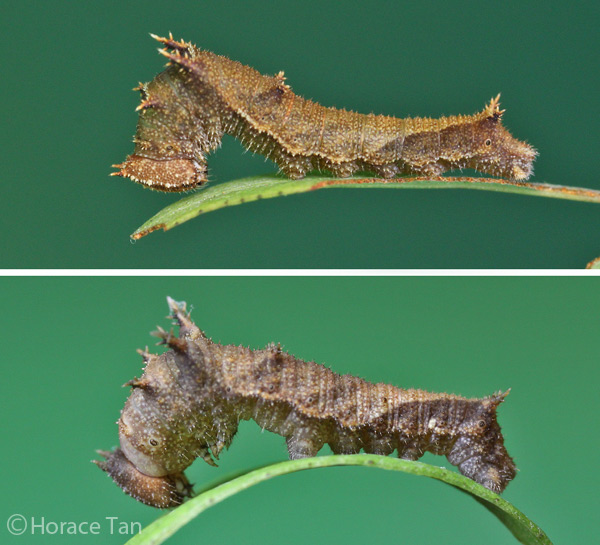
Two views of 3rd instar caterpillar, late in this stage. Lengths: 8mm (top); 9.5mm (bottom).
The 4th instar caterpillar resembles the 3rd instar caterpillar closely. The dorsal saddle is now more distinct with it being a much light shade of olive brown than the lower part of the body. The subdorsal pair of spines on the 3rd thoracic segment has become proportionally much longer than the remaining three pairs, with the pair on the 2nd abdominal segment shortest. and hardly noticeable The head capsule is almost white to light pink in base colour and tiny circular dark pits dot its frontal surface. The two apical spines (horns) are orange-tipped. This instar lasts 5-7 days with body length reaching about 16mm.

Two views of a newly moulted 4th instar caterpillar.

Two views of a 4th instar caterpillar, length: 14.5mm.
The 5th instar caterpillar is little changed from the 4th instar in most body markings and features. The subdorsal pair of branch spines on the 3rd thoracic segment, in darker brown, is again proportionately longer, and the pair on the 2nd abdominal segment degenerates further to near negligible size. Most 5th instar caterpillars also feature two small lime-green lateral patches on the 7th abdominal segment. The 5th instar caterpillar does not keep the earlier habit of cutting and hanging leaf fragments. Typically the caterpillar rests on the leaf upperside near the base of the leaf and feeds on the leaf lamina at the distal end.

Two views of a 5th instar caterpillar, early in this tage, length: 14mm.
One noticeable change from the 4th to the 5th instar is in spines and horns on the head capsule which are now proportionally shorter.

Frontal view of head capsules of Short Banded Sailor caterpillars. Left: 4th instar. Right: 5th instar.

Two views of a 5th instar caterpillar, length: 24mm.
The 5th instar lasts for about 7-9 days, and the body length reaches up to 25-26mm. On the last day, the color of the body decolorizes to pale/pinkish brown. The caterpillar ceases feeding and wanders around for a pupation site which typically is a small branch or stem. Here the caterpillar spins a silk mound to which it attaches its posterior end, and hangs vertically to take on the pre-pupatory pose.

A 5th instar caterpillar found on a Cratoxylum leaf of in Sourthern Ridges.

Two views of a pre-pupa of the Short Banded Sailor.
Pupation takes place a day later. The pupa suspends itself via a cremastral attachment to the silk mound with no supporting silk girdle. It is almost entirely pale brown in color. The abdominal segments are slender. The thoracic portion being larger with wing cases dilated laterally. The dorsum of the thorax is angular. The head is bluntly cleft at its front edge with small pointed lateral vertices. A pair of silver oval-shaped patches occurs on the dorsum of the metathorax, and a much smaller pair on the 1st abdominal segment. The pupa has the ability to flex laterally when disturbed. Length of pupae: 16-18mm.
Pupation Event of a Short Banded Sailor caterpillar

Three views of a pupa of the Short Banded Sailor.
After about 6 days of development, the pupal turns dark as the development within the pupal case comes to an end. The spots and streak on the forewing upperside also become discernible. The following day, the adult butterfly emerges from the pupal case.
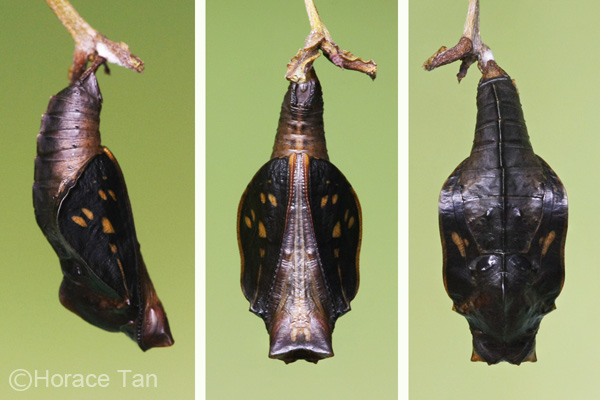
Three views of a mature pupa. Markings on the forewings are now visible.

A newly eclosed Short Banded Sailor expanding its wings on its pupal case.

A newly eclosed Short Banded Sailor expanding its wings on its pupal case.
References:
- The Butterflies of The Malay Peninsula, A.S. Corbet and H.M. Pendlebury, 4th Edition, The Malayan Nature Society.
- Butterflies of Thailand, Pisuth Ek-Amnuay, 1st Edition, 2006
- The Butterflies of Hong Kong, Bascombe et al, Academic Press, 1999.


