24 December 2009

'Tis the Season to be Jolly!

ButterflyCircle Wishes One and All a Merry Christmas and a Happy 2010!


Christmas is upon us, and the weather here in Singapore seems to be dreary and all our favourite butterflies are probably taking a hiatus from their usual fluttering in this cold wet weather, and settled miserably under shelter.

But 'tis the season to be jolly (for us humans anyway), and to celebrate life and hope. Let's look forward to a new decade with optimism that more countries will do more to alleviate climate change & global warming.

Looking forward to 2010, which has been designated as the International Year of Biodiversity (IYB), we are certain that ButterflyCircle can contribute even more to enhancing butterfly biodiversity in Singapore as well as continue to learn more about butterflies. There are several projects that will be incorporating butterfly-friendly environments and trails coming onstream in Singapore - Gardens by the Bay, Sg Buloh Redevelopment Phase 2, Hort Park Butterfly Garden Phase 2 and so on to look forward to.

ButterflyCircle takes this opportunity to wish all our members and readers of the BC Blog a Merry Christmas and a Happy 2010!!! Three Cheers to our Beloved Flying Jewels!


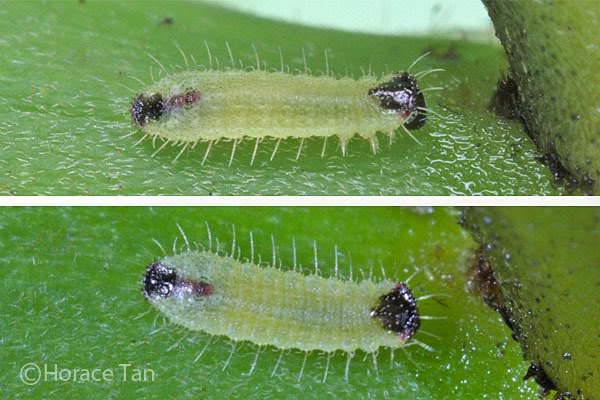
Note on Photo : Featured is the 5th instar caterpillar (that has just moulted from its old skin) of the Archduke (Lexias pardalis dirteana), one of my favourite 'cats'. I've always likened it to a Chrismas tree, and the intricate spines and hairs make it appear like a complex snowflake too.

19 December 2009

Life History of the Plain Plushblue

Life History of the Plain Plushblue (Flos apidanus saturatus)


Butterfly Biodata:
Genus: Flos Doherty, 1889
Species: apidanus Cramer, 1777
Subspecies: saturatus Snellen, 1890
Wingspan of Adult Butterfly: 34mm
Caterpillar Host Plants:
Terminalia catappa (Combretaceae, Common name: Sea Almond), Syzygium glaucum (Myrtaceae), S. grande (Myrtaceae) and other Syzygium species (yet to be identified).


A Plain Plushblue perching on a leaf in the nature reserve.

Physical Description of Adult Butterfly:
Above, the male is deep bluish violet, with a narrow forewing border (about 1.0mm); the female is bluer and more shining, with rather regular black borders on the costal and distal margins of both wings. Below, the wings are pale yellowish to darker brown with whitish markings featuring a purple tinge. The discal and post-discal bands are evenly curved on the forewings, and there is a pale yellowish end-cell bar on the forewing. Hindwings have irregular discal whitish bands from mid-costa to mid-dorsum. There is a small ochrous brown patch at the base of the costa on both wings. The hindwing is tailed at vein 2 and toothed at veins 1b and 3. The compound eyes are dark yellow brown (see the cover picture of this earlier blog article).


A close-up view of the front portion of a Plain Plushblue.
Note that the ochrous brown patches at behind the head.
Field Observations of Butterfly Behaviour:
Worldwide, Flos apidanus is the most widely distributed member of the Flos genus. This is also true locally in Singapore as it can be found in multiple locations, in and out of the nature reserves, and it is the most commonly sighted of the four Flos species residing here. The fast flying adults are usually spotted near flowering shrubs and their host plants. Typically they perch with their wings closed, but they can also be seen to open their wings fully to sunbathe in warm weather.


A female Plain Plushblue perching on a leaf in the Southern Ridges.

Early Stages:

It is mentioned in C&P4 that the Plain Plushblue utilizes a number of Syzygium species as larval hosts. So far we have established that Syzygium glaucum and S. grande serve this role in Singapore. In addition, Terminalia catappa (Sea Almond) has been recorded as another host. This latter plant can grow to be a rather large tree with a pagoda shape. Its leaves are obovate, 20-30cm long, often spirally crowded at ends of branches, and turning orange or red before they fall. The 4-5cm long fruits are flattened ovoid and keeled all round. The seeds are edible. Sea Almond is common in Singapore, either growing wild or cultivated as roadside trees.


Host plant: Sea Almond. Leaves and fruits are featured here.


Host plant: a Syzygium species yet to be fully identified.


A female Plain Plushblue laying eggs at the petiole of a Syzygium species.
Eggs are laid in small groups of 2-5 on the petiole or the underside of a relatively young leaf of the host plant. Each egg is about 0.9mm in diameter, white with a light yellowish green tinge. It is shaped like a pressed bun with a slightly depressed micropylar area atop. The surface has a coarsely reticulated pattern of intersecting ridges.
Groups of eggs of the Plain Plushblue on young shoots of the Sea Almond.


Closer looks at groups of eggs of the Plain Plushblue.

It takes 2-3 days for the egg to hatch. The newly hatched is pale yellowish in body color and has a length of about 1.5mm. It has a rather flattened woodlouse appearance with a large semicircular prothorax, a yellowish brown head and
long dorso-lateral and lateral setae. There are also a fair number of very short setae on the body surface.
Two views of a newly hatched caterpillar, length: 1.5mm.

The 1st instar caterpillar feeds by skimming the surface of a young leaf, but later instars are able to consume the lamina in whole.
Larval stages of the Plain Plushblue are gregarious and a few caterpillars have been observed in the field sharing a feeding site with no animosity towards each other. As the 1st instar caterpillar grows, its body color becomes more yellowish green. Pinky red patches also appear on the front portion of the prothorax and the posterior abdominal segments. After 2-3 days of growth, and reaching a length of about 2.5mm, the caterpillar moults to the next instar.
Two views of a 1st instar caterpillar, length: 2mm.

The 2nd instar caterpillar features long lateral hairs and a black head. Long dorso-lateral setae are no longer present, but many short setae with blobbed endings appear on the entire body surface. A pair of faint dorso-lateral line runs along the length of the body. The prothorax is marked by a large black patch with a leading edge in pinky red. The dorsal nectary organ (DNO) is already visible on the 7th abdominal segment and highlighted with a small dark reddish patch stretching to the 8th segment. A large anal plate, black in color, dominates the remaining posterior segments.


Two views of a 2nd instar caterpillar, early in this stage, length: 2.5mm.

2nd instar caterpillar, late in this stage, length: 3.5mm.
The 2nd instar caterpillar has a functional DNO as ants living in its proximity are observed to actively attend to the young caterpillars, having been attracted to the nectary fluid excreted via the DNO. The ant-caterpillar association continues for all remaining larval stages of the Plain Plushblue.
A 2nd instar caterpillar being tailed by an ant which is eyeing the nectary fluid excreted by the caterpillar.

A sequence of three pictures showing an ant receiving its pay packet of a nectary droplet from the 2nd instar caterpillar.

The 2nd instar caterpillar reaches a length of about 4mm, and after about 3 days in this stage, it moults again. The 3rd instar caterpillar resembles the 2nd instar caterpillar closely. New to this instar is a dorsal band in darker green against the yellowish green base colour. The DNO is now rather prominent with an dark brown oval ring marking its outer boundary. The 3rd instar takes about 3-4 days to complete with the body length reaching about 7mm.
Two views of a 3rd instar caterpillar, length: 5.5mm.

A small group of two 3rd instar caterpillars attended by ants.

The 4th instar caterpillar has similar markings as the 3rd instar. One notable change is in the prothoracic dark patch which now has two small white patches embedded at its posterior. Another change is in the dark red patch stretching from the DNO to the anal plate as it now has two side-branches reaching the tentacular organs (TOs) on the 8th abdominal segment. The 4th instar takes about 4-6 days to complete with the body length reaching 11mm.

4th instar caterpillar, length: 11mm.

Two views of a 4th instar caterpillar being attended to by three ants.
The 5th instar caterpillar has similar but more striking markings. Visible changes are 1) a white intermittent line running down the middle of the dark patch on the prothorax; 2) both the dark patch on the prothorax and the anal plate are now flanked by white borders which are moderate in thickness.

5th intar caterpillars, legnths: 15.5mm (top) and 19mm (bottom).


A group of three 5th intar caterpillars sharing one leaf.


The DNO and the TOs at the posterior segments of a 5th intar caterpillar.
The right picture shows the wet DNO after a recent excretion.


Dorsal views showing the newly excreted droplet atop the DNO.
Lateral views of the same nectary droplets at the DNO.

After 7-8 days of feeding and reaching a length of about 20mm, the caterpillar slows down and stops food intake for about 1 day. During this time, its body length gradually shortened. Soon it becomes an immobile pre-pupa in its leaf shelter.

Two views of a pre-pupa of the Plain Plushblue.

The pre-pupa caterpillar prepares for pupation by spinning a silk girdle and a silk pad to which it attaches via claspers at its posterior segments. After 1 day as a pre-pupa, pupation takes place. The pupa, with a length of 12-14mm, has a shape typical of any Lycaenid species, but with a somewhat produced anal segment. It is yellowish green in coloration.
A time-lapse sequence of the pupation event for a Plain Plusblue caterpillar.


Two views of a pupa of the Plain Plushblue, length:12mm.

Nine days later, the pupa matures enough to show the markings on the forewing upperside. The next day, the pupal stage comes to an end with the emergence of the adult butterfly.

Mature pupae: female (top) and male (bottom).


A newly eclosed Plain Plushblue resting on a leaf.

Unlike most of the Lycaenidae species, the caterpillars of the Plain Plushblue have the habit of constructing leaf shelters in which they rest and seek safety between feeds on the lamina of nearby leaves and part of the shelter. Pupation also takes place within a leaf shelter.


Leaf shelters used by Plain Plushblue caterpllars on Syzygium gauclum.


A leaf shelter formed by joining two adjacent leaves.
Can you spot the caterpillar?


References:
  • The Butterflies of The Malay Peninsula, A.S. Corbet and H.M. Pendlebury, 4th Edition, The Malayan Nature Society.
  • Butterflies of Thailand, Pisuth Ek-Amnuay, 1st Edition, 2006

Text by Horace Tan, Photos by Federick Ho, Khew SK and Horace Tan.

12 December 2009

Aposematism in Butterflies

Aposematism in Butterflies
The Theory of Warning Colouration in Butterflies


In an earlier article on Butterfly Predators, we saw how a butterfly's life is fraught with danger all around them, particularly from carnivorous predators. These range from birds and lizards, to spiders and dragonflies.


In 1866, Alfred Russel Wallace, in response to Charles Darwin, was the first to suggest that conspicuous colour schemes of some insects may have evolved through natural selection as a warning to predators. Following that meeting of the Entomological Society of London, John Jenner Weir conducted experiments with caterpillars and birds in his aviary for two years. The results he reported subsequently in 1869 provided the first experimental evidence for warning colouration in animals.


Aposematism is a secondary defence mechanism that warns potential predators of the existence of another primary defensive mechanism. In the butterfly world, the primary means of defence is usually because of the unpalatability of the butterfly.


The species that exhibit this primary defensive trait are usually those whose caterpillars have evolved mechanisms to sequester plant toxins and use them for their own defense. The butterfly species that have been able to synthesize these toxins at their caterpillar stages will present themselves as an unattractive prey to predators like birds and lizards, which may suffer diarrhoea or nausea after eating the butterfly.


Predators will quickly learn to avoid these species of butterflies, and very often, these are the species that exhibit warning colouration or possess easily recognisable and distinctive patterns on their wings. Once a predator 'learns' from experience that these conspicuous butterflies are distasteful, they will henceforth continue to avoid any similar looking (patterned or coloured) butterfles in future.


Amongst butterflies, the typical warning colours are black, yellow, red and orange. However there are others that are greys or whites, and not necessarily brightly coloured, but with patterns that are distinctive and prominent such that they become easily recognisable. These species tend to call attention to themselves, and are those that we human beings are also able to spot easily due to their "advertising" their presence in the field.


It is the colours, the combination of colours and the patterns that these butterfly species evolve, that make them recognisable to their predators. Aposematic colouration as a function of clarity - increased chromatic contrast, luminance contrast, and sharpness make a pattern easier to recognise.


Amongst the butterfly families, the species that display aposematic colouration are usually from the Papilionidae (typically feeders of Aristolochia spp), Pieridae (from the genus Delias), sub-family Danainae (almost all the species that feed on lactiferous vines such as Asclepias) and sub-family Heliconiinae (whose caterpillars feed on Passifloraceae).


However, it would be untrue to say that all brightly colourful butterflies are unpalatable. Other than those which mimic the unpalatable model, which will be the subject of a forthcoming blog article, there are other species that are as equally colourful and bright, but without possessing any primary defense characteristics and are hence fair prey for a predator.


So the next time you see a colourful and recognisable butterfly fluttering amongst the flowers in your garden, consider the fact that it may be intentionally attracting attention to itself as an advertisement of its unprofitability as a prey item to potential predators. To us humans however, we look in awe and admiration at its beauty and colours as one of Mother Nature's Flying Jewels.


Text by Khew SK : Photos by Henry Koh, Khew SK & Anthony Wong

09 December 2009

I Spy, With My Little Eye

I Spy, With My Little Eye...
A Closer Look At The Eye of a Butterfly


In my childhood days, I used to play this game, "I Spy, With My Little Eye... something starting with the letter ..." on long car journeys that my family used to take down peninsula Malaysia, starting from my hometown in Penang, and reaching Johor Bahru and Singapore. It's just a little game of observation and quizzes to pass the time on the long trip down south.
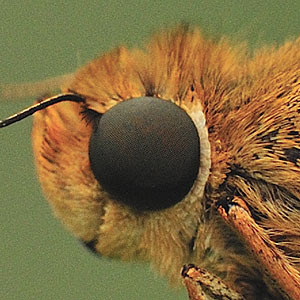


The eye is a powerful organ in the animal world. It allows us to see and understand, recognise and react to the world around us. It is no different amongst invertebrates like butterflies. Unlike vertebrates, which are equipped with the single-lens eye, most invertebrates - crustaceans and insects - have compound eyes.


A compound eye is made up of many separate units called ommatidia (singular: ommatidium). Each unit has its own surface area, lens, and optic nerve fiber. It receives light from a small part of the animals field of view. The animal's brain integrates these views into a single image. Compound eyes are made up of many divisions, giving the eye a net or mesh like appearance. It is this multitude of divisions that gives it the name: Compound Eye.
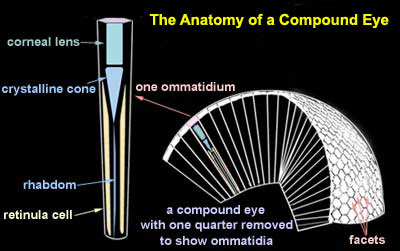

Image courtesy of BioMEDIA ASSOCIATES

An insect's compound eyes usually bulge out and have a wide field of view. The lenses in compound eyes can't change focus, so insects can't see things that are far away. However, most things that concern an insect are up close and personal. The compound eye is very good at seeing things nearby and detecting motion.
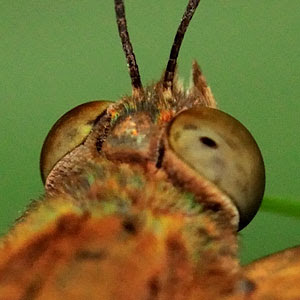


Butterflies rely on colour to find food from flowers, and they have colour vision that is more enhanced than our own. A butterfly's vision is quite sharp at close quarters, but because acuity depends on the number of facets aimed at the object, butterflies are very near-sighted. Their colour vision has been experimentally proven, and in addition to all the wavelengths that we humans can see, butterflies can see far into the ultraviolet (UV) as well as infrared (IR).They use ultraviolet (UV) light to perceive patterns on nectar-laden flowers that are invisible to us, and they perceive the colours of flowers differently from human beings.


Recent research also suggests that colour sensitivity varies across different groups and species, and eventually this may offer some explanation for the behavioural differences observed between species.


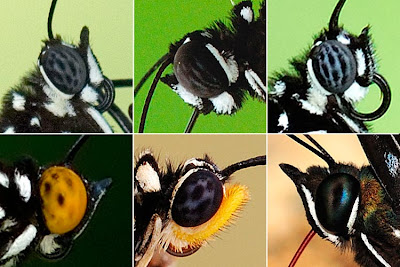
Over many years of photographing butterflies, I have observed that the eyes of butterflies across different families and genera are rather distinctive. The shots below are a collation of the butterflies of different families.

Firstly for the Papilionidae, most, if not all, of the species have opaque jet-black eyes. The eyes are large and are totally black and featureless.


The next family, Pieridae, tend to have eyes that are more typical of compound eyes, with checker-board patterns in the eyes. The colour of the eyes is usually similar to the colour of the butterflies' general colour - typically whites or yellows.


The next family, Nymphalidae, is rather varied, having a total of nine sub-families of rather distinctive characteristics within the sub-families. The group shown below shows a combination of Satyrinae and Morphinae. The Satyrinae have striped compound eye structure, giving their predominantly grey eyes a banded appearance. The Morphinae are more varied, but one genus, Faunis, has a nice deep jade-green eyes.


The next subfamilies, Danainae, Heliconiinae and Apaturinae, shown below, have striped and chequered appearance. but some with rather vivid colours of yellows and greens.


The remaining Nymphalidae, featuring the families of Nymphalinae, Cyrestinae, Charaxinae, Limetidinidae, also show a variety of chequer-board and spotted appearances, and in many cases, where a larger distinct spot is displayed in some species. The Neptis also have a bluish-green sheen in their compound eyes.
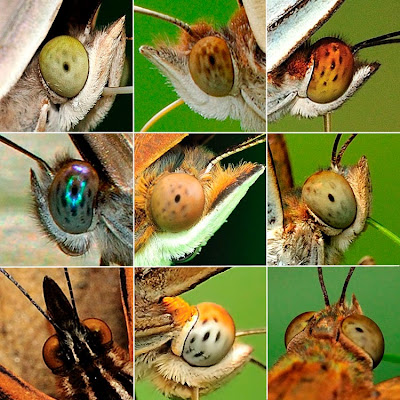


Several species of the family Riodinidae feature emerald green eyes, whilst others have reddish brown eyes. Also, the sub-family Miletinae, which also sport striped compound eyes, have yellow-green eyes which appear almost iridescent in the field.


The Lycaenidae, which form one of the largest families of butterflies feature a whole spectrum of compound eye types, ranging from large hairy jet-black eyes, to spotted green and yellow eyes to metallic dark green eyes. My favourite is the deep green of the Arhopalas that make the eyes look like metallic jewels


The final family, the Hesperiidae, or Skippers feature extra large eyes, probably needed due to the butterflies' crepuscular (or flying in the early hours of dawn and the late hours during dusk) habits. Probably needing more light when flying at tremendous speeds during hours of low light, the Hesperiidae have, by far, the largest eyes amongst all the butterfly families. Several species feature scarlet or dark red eyes, with a darker centre within the compound eye. But most Skippers have dark brown and cleanly spherical eyes set in a rather large head of the majority of the Hesperiiidae.
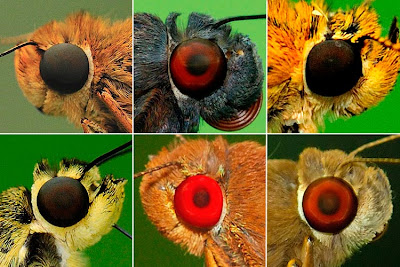


So there you have it - even the eyes of our flying jewels are so varied and beautiful when we view them up close and personal to admire Mother Nature's works of art.

Text by Khew SK ; Photos by Khew SK & Horace Tan


References and Acknowledgments :
  • The Butterflies of the Malay Peninsula, A.S. Corbet & H.M. Pendlebury, 4th Edition, The Malayan Nature Society
  • Handbook for Butterfly Watchers, Robert Michael Pyle, 1984, Houghton Mifflin Co, Boston/New York
  • Butterflies, Dick Vane-Wright, 2003, Natural History Museum, London