05 December 2009

Life History of the Common Awl

Life History of the Common Awl (Hasora badra badra)


Butterfly Biodata:
Genus: Hasora Moore, 1881
Species: badra Moore, 1858
Subspecies: badra Moore, 1858
Wingspan of Adult Butterfly: 47mm
Caterpillar Host Plants: Derris trifoliata (Leguminosae, Papilionoideae),
D. elliptica and two others (suspected to be Derris species).


A female Common Awl on the leaf surface of the Coconut Palm.

Physical Description of Adult Butterfly:
Adults are rather large in size with pointed forewing apex and markedly lobate hindwings. Above, the wings are dark brown. In the male, the wings are typically unmarked or with faint subapical spots. In contrast, the female has three pale yellowish subapical spots, large pale yellow hyaline spots in the cells and in spaces 2 and 3 on the forewing Wings bases of the female are ochreous. Below, both sexes are brown and often washed with purple, more so in pristine specimens. The forewing is pale yellowish to whitish at dorsum entering middle of space 2. On the hindwing, there is a small white roundish spot in the cell and an elongated white spot in the subtornal area. The spots on the forewing upperside correspond to those on the underside.


A female Common Awl with partially opened wings, showing us the various spots on its forewings

Field Observations of Butterfly Behaviour:
Adults are rarely seen in Singapore, likely due to its crepuscular nature. In contrast, the larval stages are rather readily found on various Derris species at multiple locations in Singapore. The adults are usually sighted in the vicinity of its larval food plants, typically ovipositing females. The usual perching site is on the underside of a leaf or other plant parts, resulting in photographs of "upside-down" adults being the most common takes of this species.


A male Common Awl on the underside of a leaf.


A male Common Awl pertching on the underside of a leaf.

Early Stages:

The 1st local host plant, Derris trifoliata, is a scandent shrub with 3-5 leaflets in a pinna, pink flowers, thin and flat pods. This plant is commonly found on coastal areas such as the Sungei Buloh Wetland Reserve and Kranji Nature Reserve.


Host plants : Derris trifoliata.

The 2nd host plant, Derris elliptica, is also a scandent shrub but with 9-15 obovate-oblong leaflets in a pinna and has brown pubescent branches. Extracts from both Derris species have been used as insecticides and by locals as "poison" for catching fish/shrimps.


Host plant : Derris elliptica.

Two other host plants, found in the nature reserves and in the Southern Ridges, are also woody climbers with 5-foliate and 7-foliate leaves. It is likely that they are Derris species too. The variegated early stages of the Common Awl feed on the young and still tender leaves of the host plants. The newly hatched and the 1st and 2nd instars typically feed on the youngest and still yellow/brown leaflets. Common Awl caterpillars of all instars also construct leaf shelters by joining leaf blades with silk threads.


Local host plants : unknown sp. #1 (left); unknown sp. #2 (right).


A mother Common Awl ovipositing on young shoots of Derris elliptica.

The eggs are laid singly on young shoots of the host plants. Each egg is white with a biege tinge. It is shaped like a pressed bun with a large flattened base (diameter: 0.9mm) and prominent ridges running from the pole to the base. The micropylar sits atop at the pole.


Two views of an egg of the Common Awl.


Mature egg (left), empty egg shell (right)

It takes 2-3 days for the collected egg to hatch. The young caterpillar eats just enough of the shell to emerge, and has a length of about 2mm. It has the typical cylindrical shape for skipper caterpillars, and the pale yellowish brown body has a number of moderately long setae. The large head is black, slightly bi-lobed and lightly hairy.


1st instar caterpillars. Top: early in this stage, length: 1.9mm.
Bottom: later in this stage, length :2.5mm.


The young caterpillar constructs its first leaf shelter by bringing two halves of a small young leaf together with silk threads. It rests within the flap and ventures out to eat on nearby leaf surface. In later instars, the Common Awl caterpillars also construct leaf shelters in a similar fashion but do so with larger and older leaves.


Leaf shelters and eggs found on young shoots and leaflets of unknown host #1.

After 2 days in 1st instar and reaching a length of about 4mm, the caterpillar moults to the next instar. The 2nd instar caterpillar has four faint yellowish dorsal bands, and a large number of faint yellowish rings on the body segments. Black dorso-lateral patches are found on the 3rd thoracic segment, 2nd, 4th, 6th and 8th abdominal segments.These patches increase in size as the caterpillar grows in this instar. All three thoracic segments are much smaller (narrower) compared to the abdominal segments, with the prothoracic segment being dark brown to black. The body and the head capsule are also covered in short fine setae.


2nd instar caterpillars. Top: early in this stage, length: 4mm.
Bottom: late in this stage,length: 8.5mm.


The 2nd instar caterpillar reaches a length of about 9mm, and after 2 days in this stage, it moults again. The 3rd instar caterpillar resembles the 2nd instar caterpillar but with more striking yellow coloration on the segmental rings and dorsal bands. This instar lasts another 2 days with the length reaching 14-15mm.


3rd instar caterpillars. Top: early in this stage, length: 9mm.
Bottom: late in this stage,length: 13.5mm.


The 4th instar caterpillar resembles the 3rd instar caterpillar closely. One noticeable change is the appearance of a pair of narrow black dorso-lateral patches on the 2nd thoracic segment. This stage takes about 6-9 days to complete with the body length reaching 25-29mm.


4th instar caterpillars. Top: early in this stage, length: 14mm.
Bottom: late in this stage, length: 25mm.


The final and 5th instar caterpillar has similar body markings and coloration as the 4th instar caterpillar. One unmistaken change is in the head capsule which has now become dark cherry red with three medium-sized black spots. The prothoracic segment is colored as per the head capsule and has a pair of black dorso-lateral stripes. Dense white setae cover the whole body. This stage takes about 6-9 days to complete with body length reaching about 41mm.


5th (final) instar caterpillars of the Common Awl. Lengths: 33mm (top); 36mm (bottom).


A close-up view of the head capsule of the final instar larva of the Common Awl.

Towards the end of 5th instar, the body of the caterpillar gradually shrinks in length. It ceases feeding and stations itself in its leaf shelter and enters the preparatory pupa phase. During the early part of this stage, the caterpillar spins large quantity of silk threads to seal the pupation shelter, and in particular, constructs a silk girdle at its 2nd/3rd abdominal segment and a short transverse silk band near its posterior end. Both the dorsal point of the girdle and the transverse band are also secured by vertical/oblique threads to the inner wall of the shelter.


Two views of a pre-pupa of the Common Awl.

After about 1 day of the pre-pupal phase, pupation takes place within the pupation shelter. The pupa secures itself with its cremaster attached to the transverse band. The pupa has a short thorax, a rather long abdomen and a black and pointed rostrum. Fresh after the pupation event, the body is pale yellow with large and cherry red spots (corresponding to the black patches on the larval body), but these fade 0.5 to 1 day later, and the body surface becomes mostly covered in a white substance. Length of pupae: 24-26mm.


Two views of a newly formed pupa. Note the red spots which will fade away within a day.


Two views of a pupa of the Common Awl with a coating of whitish powdery substance.


Sequence of three shots of the silk girdle from the pre-pupal to the pupal stage.
Note the girdle is suspended vertically with another silk thread to the shelter wall (or ceiling).


Three views of the posterior end from the pre-pupal to the pupal stage.
Note the transverse silk band and cremastral attachment to it during the pupal stage.


Two views of the cremastral attachment to the bundle of transverse silk strands.
Note the cluster of brown to dark brown hooks protruding from the cremaster to engage the silk threads.


After 6-7 days, the pupa becomes darkened in color signaling the imminent emergence of the adult. The next day the adult butterfly emerges from the mature pupa.


Two views of a mature pupa of the Common Awl


A newly eclosed Common Awl drying its wings near its pupal case.


A newly eclosed female Common Awl.

References:

  • The Butterflies of The Malay Peninsula, A.S. Corbet and H.M. Pendlebury, 4th Edition, The Malayan Nature Society.
  • Butterflies of Thailand, Pisuth Ek-Amnuay, 1st Edition, 2006
  • The Butterflies of Hong Kong, M. Bascombe, G. Johnston, F. Bascombe, Princeton University Pres 1999

Text by Horace Tan, Photos by Khew SK and Horace Tan.

02 December 2009

Butterfly of the Month - December 2009

Butterfly of the Month - December 2009
The Yamfly (Loxura atymnus fuconius)


It's now exactly two years since the Butterflies of Singapore Blog started this series that features a butterfly species for each month. The Blog has chugged along steadily, providing and sharing information about butterflies in Singapore and the neighbouring region around our little island in the sun, and featuring the high quality photography of members of ButterflyCircle.


At a regular rate of at least one article weekly, sometimes more, the stories and documentation of butterflies are only made possible with the help of the active members of ButterflyCircle who have unselfishly contributed their photos to make this Blog special. Particular mention must be made of Horace Tan, our early stages expert, for his excellent and painstakingly detailed documentation of the life histories of many butterfly species - some of which have not been recorded before.


So, twenty four months have passed since we featured the Malay Lacewing as our first Butterfly of the Month back in December 2007, and now for this month of December 2009, we feature the small, but conspicuous and brightly-coloured Yamfly. A relatively common species which is as often seen in urban parks and gardens as well as the nature reserves, the butterfly usually stays in the vicinity of its caterpillar host plant, Smilax sp., (probably S.bracteata).


The Yamfly is a rich orange on the upperside, with a broad black apical border on the forewings above. The underside is a lighter orange-yellow, with obscure darker orange markings on both wings. The hindwing has a prominent tornal lobe, with orange/black/white markings, and a broad tail extending from vein 2 of the hindwing, terminating in a blackened end with white tip.


It is quite interesting that many Yamflys have been observed with their tails and parts of the tornal area torn off. Is it just wear and tear? Or that the decoy of the head-like appearance is working well to fool predators into attacking the 'wrong' end of the butterfly?


The butterfly is rather skittish most of the time, preferring to flit from perch to perch in the low shrubbery. They generally perch with their wings folded upright, although some individuals have been observed to sunbathe with their wings partially opened during certain times of the day.


A female Yamfly ovipositing on the young shoots of the host plant, Smilax sp.

They are often observed singly, and encountered as often at urban parks as well as in the nature reserves. Where it is observed, its caterpillar host plant, Smilax sp. is probably not too far away. The host plant is apparently a non-native invasive species that is notorious for strangling other plants and even trees, and is the bane of forest maintenance personnel in Singapore. It is likely that the Yamfly, and its associated species, the Branded Imperial, has host-shifted to this non-native Smilax, from their original host plants in Singapore.


The caterpillar of the Yamfly feeds on the young shoots of the host plant, where the caterpillar mainly stays for its entire feeding lifespan. Read more about the early stages of the Yamfly here.

A Yamfly feeding on the sugary secretions of a young wild orchid bud together with some 'friendly' ants which don't seem to bother it

There have also been instances where the Yamfly is seen feeding off the sugary young shoots and buds of plants, like in this wild orchid shown here, where it shares the nectar source with ants swarming around it. However, the ants do not appear to threaten the Yamfly, and it feeds rather nonchalantly amongst them, without fear of being attacked. Perhaps by instinct, the butterfly knows which ants are predators and which ants are not?


And so, with this bright orange diminutive butterfly, we end the final month of the first decade of the 21st century and look forward to 2010 and more discoveries and new things to learn about our winged friends and Mother Nature's Flying Jewels.


Have a Merry Christmas and a Happy New Year to all our readers and members of ButterflyCircle!


Text by Khew SK ; Photos by Sunny Chir, James Foong, Federick Ho, Khew SK, Henry Koh & Horace Tan

27 November 2009

When the Melastoma Blooms...

When the Melastoma Blooms...
The Singapore Rhododendron and Butterflies


The Singapore Rhododendron (Melastoma malabathricum) is a rather amazing plant. Despite being mistakenly named so, it is neither a Rhododendron, not is it confined to Singapore only. From the plant family Melastomaceae, the Singapore (or sometimes also called Straits) Rhododendron is a common plant that springs up almost anywhere where land is cleared, or along open forest paths. The seeds of this plant are dispersed mainly by birds and mammals that feed on its rather sweet fruits, and the plant appears as commonly in the nature reserves as well as urban parks and gardens.


Though an under-appreciated plant by horticulturists, the Singapore Rhododendron is a favourite with bird watchers and butterfly enthusiasts. This is because the flowers and fruits are targeted by birds, butterflies and small mammals. In particular, the Scarlet Backed Flowerpecker is a regular visitor to fruiting Melastoma bushes.


The Singapore Rhododendron usually grows as a "weed" in untended areas, normally up to a metre high, and if left to grow, can reach heights of up to 3 metres. It is a small shrub, that has tiny scales on its branches and petioles. The leaves are narrow and lanceolate, about 5-10 cm long, usually with 3 prominent veins running from the base.


The flowers are light pink-purple, with elbowed anthers surrounding the style, and are borne in clustered inflorescences. The fruit is interesting, a sort of pod, usually about 1.5 cm long, which is covered in small bumps and topped with a persistent calyx.


The greenish pod splits open halfway and flips over to reveal a fleshy deep purple structure studded with numerous (about a thousand) tiny seeds, and is usually 5-sectioned. The fruits are berry-like and break open irregularly. The seeds stain the mouth when eaten, and is sweet and slightly astringent.


A Purple Duke extends its proboscis deep into the fruit of the Singapore Rhododendron. Note the white seeds covering the fruit


The Singapore Rhododendron and Butterflies


Whilst butterflies are occasionally observed to feed on the nectar of the purple-pink flowers, the primary pollinators appear to be bees and wasps.

A small bee approaching the flower of the Singapore Rhododendron for nectar

It is the ripening fruits that are irrestible to butterflies, and when a bush has many such ripened fruits, there will often be swarming with butterflies of the Nymphalidae and Lycaenidae families.


The Colonel (Pandita sinope sinope), a Tawny Palmfly (Elymnias panthera panthera) and a Grey Pansy (Junonia atlites atlites) feed on the Singapore Rhododendron fruits

From many such encounters, ButterflyCircle members have observed that many butterflies that feed on the sweet ripened fruits can sometimes be so intoxicated as to be able to be picked off the fruits with our fingers! They can stay still and continue feeding for long periods of time, allowing the photographer to shoot many shots of a species that is usually skittish and difficult to approach.


A Commander (Moduza procris milonia), a Common Palmfly (Elymnias hypermnestra agina) and a Grey Sailor (Neptis leucoporos cresina) feeding on the fruits of the Singapore Rhododendron

Interestingly, butterflies of the Papilionidae, Pieridae, Riodinidae and Hesperiidae families seem to have less preference for the fruits of the Singapore Rhododendron.

A female Malay Baron (Euthalia monina monina) perched on the fruits of the Singapore Rhododendron

For the butterflies that feed on the ripened fruits, they often have to share the sweet bounty with ants, bees and wasps. The latter two feeders tend to also scare the butterflies away as they barge in onto the fruits.

A Yellow-vented hornet (Vespa analis) helps itself to the fruits of the Singapore Rhododendron

After having their fill of the fruit juices, many of the Nymphalidae, particularly from the genera Tanaecia and Euthalia, will rest in nearby shady spots or sunbathe with their wings opened on sunlit leaves. This gives further opportunities to observe and photograph the butterflies when they are slightly more lethargic than usual.


An Acacia Blue (Surendra vivarna amisena) feeds on the ripened fruit of the Singapore Rhododendron

The ripened fruits tend to be viable to attract butterflies for quite some time - often up to a week or more, as the sugary substance that the butterflies like to feed on appear to regenerate itself during the humidity of the night or after a short shower. During the daytime, the sun dries up the fruits, where it becomes less attractive to the butterflies. We've observed butterflies probing their proboscis deep into the edges of the fruit shell, where the sugars are probably still liquid enough to be imbibed by the butterflies.


A female Purple Duke (Eulaceura osteria kumana) feeds on the ripened fruit of the Singapore Rhododendron next to a goblet-shaped fruit that has yet to ripen

Besides providing a food source for the adult butterflies, the Singapore Rhododendron is also the known host plant to the Horsfield's Baron (Tanaecia iapis puseda) and two Lycaenids - the Long Banded Silverline (Spindasis lohita senama) and Semanga superba deliciosa. The caterpillars of all three species feed on the leaves and shoots of the plant.


A female Horsfield's Baron (Tanaecia iapis puseda) oviposits on the leaf tip of the Singapore Rhododendron, and the 5th instar caterpillar of the Horsfield's Baron


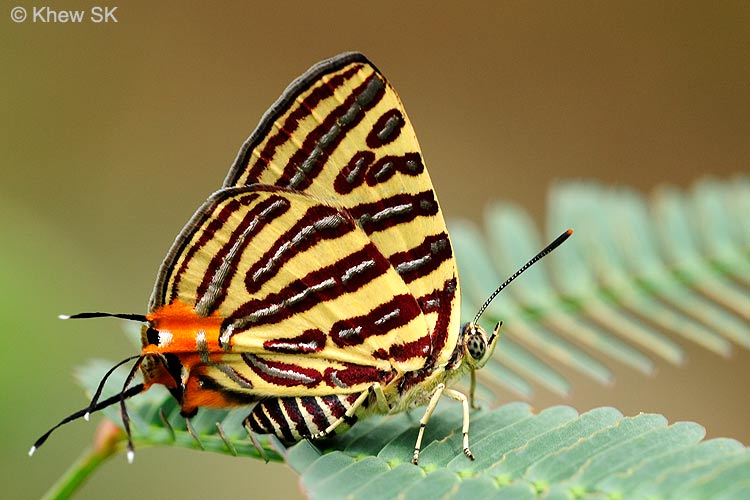
Two pretty Lycaenids - The Long Banded Silverline (Spindasis lohita senama) and Semanga superba deliciosa whose caterpillars depend on the Singapore Rhododendron as one of their caterpillar host plants

And so the humble "weed", the Singapore Rhododendron is a very versatile plant, critical to the survival of many butterfly species in Singapore and South-East Asia, by providing nectar, sugars from the fruits and leaves for the caterpillars.


Text by Khew SK : Photos by Khew SK