13 July 2008

Butterfly of the Month - July 2008

BUTTERFLY OF THE MONTH - JULY 2008
The Branded Imperial (Eooxylides tharis distanti)


This pretty forest butterfly is always present to greet visitors to the nature reserves of Singapore, never failing to delight nature enthusiasts with its bright orange colouration and long white tails. It is often seen fluttering in the shady understorey and thick vegetation, and rarely moving out to bright sunny areas. The Branded Imperial is local in distribution, but is not uncommon. Frequently, a few individuals are observed, frolicking and chasing each other in shady vegetation.

The wings are blackish brown above, with a white tornal patch on the hindwing. The underside is a reddish orange, with an unmarked forewing, with the hindwings featuring large black submarginal spots on the white tornal area which is fringed by an irregular black line, separating the white tornal patch from the orange area of the hindwing.


The eyes are an opaque jet black, as are the antennae, whilst the butterfly has black-and-white banded legs. There are three pairs of tails on the hindwings, of which the one at vein 2 is the longest, often measuring about 1cm in length.


The Branded Imperial has a short skipping flight, as it flits from perch to perch at usually no more than a metre above the ground. As with many Lycaenidae, the tails and 'eyespots' on the hindwings are believed to function as illusionary decoy to fool predators into attacking the tails rather than the vital part of the butterfly. Indeed, if one is to observe the Branded Imperial at rest, individual sometimes move their hindwings up and down and their tails twirl and move in the light forest breeze, giving it an appearance that the combination of the hindwing eyespots and the tails are the head and antennae of the butterfly.

Occasionally, several individuals can be observed feeding on the sap of young shoots of various species of forest plants, where the butterflies are so busy feeding on the sugary-sweet sap that they even allow observers to touch them!


The Branded Imperial's early stages have been recorded on its preferred host plant, Smilax bracteata, a forest climber which is considered a "pest" and a threat to the trees and large bushes onto which the vine climbs and slowly suffocates.


Text by Khew SK ; Photos by Khew SK, Mark Wong and James Chia

05 July 2008

Life History of the Hieroglyphic Flat

Life History of the Hieroglyphic Flat (Odina hieroglyphica ortina)


Butterfly Biodata:
Genus: Odina Mabille, 1891
Species: hieroglyphica Butler, 1780
Sub species: ortina Evans, 1941
Wingspan of Adult Butterfly: 32mm
Caterpillar Host Plants:
Erycibe tomentosa (Convolvulaceae)

Physical Description of Adult Butterfly:
Male is yellow-orange, with yellow-orange markings framed by thick black lines on both wings. Female is paler yellow.
The underside markings are similar in pattern but paler. The abdomen of the butterfly is stripped in orange and black. The Hieroglyphic Flat is a very distinctive-looking skipper, with the cryptic patterns reminiscent of the camouflage paint of a German Messerschmitt fighter plane in World War II.

Field Observations of Butterfly Behaviour:
This species is rarely encountered in Singapore. Over the last few years, it has been sighted in a dozen times in various areas in the Central Catchment Area, Southern Ridges and in an abandoned farm land in the west. It is a fast-flyer and can only be observed when the adults stop to feed on flowers and bird dropping, or when the females are carrying out oviposition routines of leaf hopping. When resting, as with other "flat" skippers, the adults have the habit of perching on leaf undersides.


The Hieroglyphic Flat feeding on bird dropping on a board walk (left),
and taking nectar in an open wasteland (right).


Early Stages: The host plant, Erycibe tomentosa, is a woody climber, and locally can be found on hedges, edges of forests and sides of forest trails, in areas such as the Central Catchment Area and Southern Ridges. On one occasion, Sunny Chir, an active Buttercircle member, chanced upon a female laying eggs on the host plant at the edge of the nature reserve, close to a row of private houses.


Host plant : Erycibe tomentosa

The eggs are laid singly at the leaf tip of a young leaf or mid-age leaf. Each egg is white and almost spherical with vertical ridges, and has a diameter of 0.8mm. As with other "flat" (such as the Chestnut Angle) skippers, the mother rubs the tip of her abdomen over the freshly laid egg, resulting in the egg being concealed in a mess of fine brown hairs.


Two views of the hairy eggs of the Hieroglyphic Flat.


Empty egg shell of the Hieroglyphic Flat.

It takes 3 days for the egg to hatch. The young caterpillar eats just enough of the shell to emerge, and has a length of about 2mm. It has the typical cylindrical shape for skipper caterpillars. It body is yellowish orange with a transverse black line right behind a black bilobed head.
After leaving the egg shell, the 1st instar caterpillar makes its way to the leaf edge to construct its first leaf shelter. It rests within the shelter and ventures out to eat the leaf surface nearby. The intake of this diet gives the caterpillar a greenish undertone.


1st instar caterpillar, length: 2mm

A view of the leaves of the host plant, showing the location of an
empty egg shell, and small leaf shelter for the 1st instar caterpillar.


As with some other skipper species, the Hieroglyphic Flat caterpillars have been observed to ballistically eject their somewhat sticky faecal pellets (frass) at speed. In a home breeding environment, this also results in a splatter of frass on the inner side of the container wall next to the leaf shelter.
After 3 days in 1st instar and reaching a length of about 4mm, the caterpillar moults to the next instar within the shelter. It still has the same light yellowish body with a green undertone, but now numerous tiny whitish speckles become apparent. It reaches a length of about 6mm after 5 days of growth in this instar.

2nd instar caterpillar, 4mm


2nd Instar caterpillar, 6mm.


A 2nd Instar caterpillar almost done with the cut of the leaf blade in the construction of its leaf shelter.

The 3rd instar caterpillar has a similar appearance as in the previous instar. The 3rd instar lasts about 3-4 days with the body length reaches 10-11mm. The leaf shelters for the larger caterpillars in 3rd and later instars are made from bringing two edges of the leaf together with sinuous cuts and silk threads, resulting in a ``curry puff'' appearance.

3rd instar caterpillar, early in this stage, length: 7mm


3rd instar caterpillar, late in this stage, length: 10mm
The 4th instar caterpillar looks similar to the earlier instars with the only visible difference being the much more distinctive speckle pattern on its body, and two rows of small black spots dorsally on the first seven abdominal segments, with two spots to each body segment. The 4th instar takes about 4 to 6 days to complete with the body length reaching 17-18mm.


4th instar caterpillar, early in this stage, length: 10mm


4th instar caterpillar, ready to moult to the next stage, length: 15mm.

The head capsule of the final and 5th instar caterpillar has a brown or dark brown base color with pale brown to orange patches. The surface of the head capsule is covered with a layer of short fine hairs. Growth in this stage is rather slow and it takes about 14-15 days to complete with the body length reaching about 24mm.
5th instar caterpillar, newly moulted to this stage, 15mm


5th instar caterpillar, late in this stage, length: 24mm

At the end of 5th instar, the body of the caterpillar gradually shrinks in length. Soon it becomes dormant in its leaf shelter and enters the prepupatory phase which lasts for one day.

Two views of a pre-pupatory larva of the Hieroglyphic Flat.

Pupation takes place within the leaf shelter. The pupa secures itself with its cremaster attached to a short transverse band on the leaf surface, and has a silk girdle. The pupa is mostly green in base colour. It has a short thorax, a rather long abdomen and a pointed rostrum. Length of pupae: 16-18mm.


Two views of a fresh pupa of the Hieroglyphic Flat.

After 9 days, the pupa becomes mostly black in color with the cryptic patterns on the forewing somewhat distinguishable through the now transparent pupal skin. Eclosion takes place the next day.


Two views of a mature pupa of Hieroglyphic Flat.


A newly eclosed Hieroglyphic Flat.

References:
  • The Butterflies of The Malay Peninsula, A.S. Corbet and H.M. Pendlebury, 4th Edition, Malayan Nature Society.
  • The Butterflies of Hong Kong, M. Bascombe, G. Johnston, F. Bascombe, Princeton University Pres 1999
Text and Photos by Horace Tan

29 June 2008

The Butterfly Proboscis

A Butterfly's Proboscis - Its Lifeline to Survival


Butterflies are well-known for their beauty and grace and are one of the most admired and adored creatures of the insect world. Most people are aware that butterflies do not have chewing or biting mouthparts, nor have any sort of defensive mechanisms which scratch, sting, bite or poke, unlike most other insects. How then do these pretty and harmless insects derive their sustenance for survival?
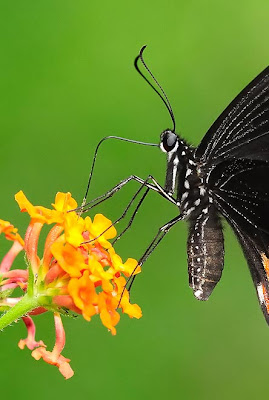


They feed on a liquid diet through their adult life, imbibing dissolved sugar, salts and other minerals from a variety of sources ranging from flowers, rotting fruit, tree sap, carrion, urine, faeces and so on. Some species are also partial to human sweat and will stop to feed on sweaty forearms, faces and hands of humans who are in the vicinity of these hungry butterflies!


A Malayan Eggfly uses its proboscis to suck up human sweat!

Butterflies feed through a paired tube located at their heads. This paired tube is called the proboscis. The Greek origin of proboscis comes from "pro" (before) and "boskein" (to feed). The word proboscis is pronounced in two different ways, both of which are acceptable - (pro-BOSS-iss or pro-BOSS-kiss). Click on the links to hear the pronunciation of the word proboscis.


Through the amazing process of metamorphosis, the caterpillar's biting/chewing mouthparts - for eating their host plants, transforms into the paired "drinking straw" proboscis. When the butterfly ecloses, besides pumping fluids into its limp wings to expand them, it also has to get its proboscis in working order. As it ecloses from its pupal case, the butterfly's proboscis is in two separate pieces that are joined together by tiny hooks and fringes. The eclosing butterfly has to twist and curl the two halves of the proboscis to create one drinking tube. If, in the event this preparatory function is interrupted, the butterfly can no longer feed, even though it is able to fly, hence condemning it to a short life of hunger and starvation.


Situated between the butterfly's eyes, but below them, is the proboscis. This paired structure, comprising two halves, are hooked together after eclosion, forming a central canal. The proboscis is usually coiled up like a watchspring right against the butterfly's face, to protect it. When in use, it is extended with muscles to probe the nectaries of flowers or other substances. When outstretched in this manner, the proboscis behaves like a drinking straw through which the butterfly draws fluids up and into its body. Commonly 1 to 2 cm long in butterflies, the proboscis can be as long as 30cm(!) in certain Hawkmoths. Indeed, the proboscis of certain species of Hesperiidae (Skippers) are typically longer than the body of the butterfly, sometimes twice as long.


The proboscis of this Hoary Palmer is more than twice as long as its body!

The proboscis appears to be protected by the butterfly's labial palp. The two palpi line up along the butterfly's face, between which the proboscis lie. In certain species' case, the palpi are so hairy as to give the butterfly an appearance of an unshaven face.

When a butterfly finds a potential food source, it unfurls its proboscis and uses its forked tip to investigate the fluids. The proboscis is therefore a very useful tool and particularly well-adapted for the butterfly to reaching deep into flowers for nectar. In the process of feeding on the flowers' nectar, butterflies also transport the pollen from the stamens of a flower to other flowers as the butterfly moves around to feed, thereby helping in the process of pollination. Indeed, butterflies are also one of the agents of pollination and contribute to the propagation of many of the plant species on which the butterflies feed on the flowers.


The proboscis of the Plain Tiger is covered with pollen from the flower, all ready to be transferred to the next flower for pollination, as it goes about feeding on nectar.

The proboscis is also used when the butterflies puddle (the act of feeding on damp footpaths or river banks) where they imbibe dissolved salts and other minerals from the fluids on the ground. The proboscis is similarly used when the butterfly feeds on tree sap, rotting fruit, bird droppings and a whole spectrum of dissolved minerals from these sources that the butterfly requires for sustenance, fertility and energy to go about its daily activities.


The proboscis is very much sized according to the size of the butterfly, with larger butterflies having longer and thicker proboscis whilst the smaller butterflies have thinner and finer proboscis. An interesting observation is that the proboscis of butterflies also come in various colours - ranging from jet black to orange and greens.


A display of multi-coloured proboscis as these butterflies feed on rotting fig fruits on the forest floor.

Text & Photos by Khew SK

Special Acknowledgments to :

  • Merriam-Webster Online for the Audio pronounciation clips

References :

  • Handbook for Butterfly Watchers : Robert Michael Pyle, Houghton Mifflin Company, Boston/New York, 1992

25 June 2008

The Life History of the Great Helen

Life History of the Great Helen (Papilio iswara iswara)


Butterfly Biodata:
Genus: Papilio Linnaeus, 1758
Species: iswara White, 1842
Subspecies: iswara White, 1842
Wingspan of Adult Butterfly: 140mm
Caterpillar Host Plants: Maclurodendron porteri (Rutaceae)


A male Great Helen visiting a flower.


A male Great Helen visiting a flower, giving a view of its upperside


Physical Description of Adult Butterfly:
Great Helen is a large butterfly with a wing span of up to 14cm. The forewing is black above and, on both surfaces, the hindwing has a large white discal patch of four spots in spaces 4 to 7. There is a spatulate tail at each hindwing at vein 4. On the hindwing underside, there are blue post-discal lunules distal to the white spots in 2, 3 and 4. The female has a large black ocellus ringed with red in each of spaces 1a and 2 on the hindwing upperside (see the top picture in this article).

Field Observations of Butterfly Behaviour:
Locally the occurrence of this species is restricted to the Central Catchment Nature Reserves where its host plant, Maclurodendron porteri (old name: Acronychia porteri), is rather common, especially along MacRitchie Nature Trail and Nee Soon Pipeline. The adults usually fly rapidly at tree-top height, except when they come down to feed at flowering bushes or to look for oviposition sites. Like many of the Papilio species, when an adult stops to feed at flowers, it flutters its forewings while its hindwings are kept relatively still. When resting at a perch, the forewings droop backwards to almost or completely conceal the white discal patch on the hindwings.

Early Stages:
The host plant, Maclurodendron porteri, is a tree with simple, opposite and ovate leaves which are 10-18cm long. The leaves have a pleasant aromatic smell when crushed or when broken at stalks. Cancer researchers have found this plant to contain various flavonols with cancer-fighting attributes.


Host plant : Maclurodendron porteri


A female Great Helen attempting to oviposit on a leaf of the host plant

The eggs of the Great Helen are laid singly on undersides of young leaves of the host plant. Typically only one egg or one caterpillar is found on a single plant. The egg is pale creamy yellow with a finely roughened surface. It is nearly spherical with a diameter of about 1.8mm.


A fresh egg of Great Helen, diameter: 1.8mm


A mature egg, giving a faint front view of the head of the caterillar.

The egg found in the field took about 4 days to mature. The young caterpillar eats its way out of the mature egg, and then proceeds to finish up the rest of the egg shell. The newly hatched has a rather spiky appearance, and an initial body length of about 4mm. It is greyish white dorsally and dark brown laterally,


Newly hatched 1st instar caterpillar, length: 4mm


1st instar caterpillar, length: 6mm

In the first 4 instars, the Great Helen caterpillars look like bird droppings as they rest on the leaves. The resemblance in the 3rd and 4th instars are stronger with the body also assuming a slimy appearance. As in the case of all Swallowtail butterflies, the Great Helen caterpillars in all instars possess a fleshy organ called osmeterium in the prothoracic segment. Usually hidden, the osmeterium can be everted to emit a foul-smelling secretion when the caterpillar is threatened

As the 1st instar caterpillar grows to a maximum length of about 8mm, the dorsal whitish patches changes to orangy brown. There is a faint whitish saddle on the mid-abdominal segments, and white markings on the posterior abdominal segments. After about 3 days in 1st instar, the caterpillar moults to the next instar.


1st instar caterpillar, day 3 in this stage, ready to moult; length: 8mm

The 2nd instar caterpillar has a similar appearance to the late 1st instar caterpillar except for the more distinctly white saddle mark and posterior abdominal segments.
This instar lasts 3 days with the body length reaching about 16mm before the next moult.


2nd instar caterpillar, length: 10.5mm

In the 3rd instar, again there is no drastic change in physical appearance except for more dark brown to black patches appearing on the mottled body, and the more distinct white saddle mark. This instar takes 3 days to complete with body length reaching 25mm.


3rd instar caterpillar, length: 25mm

The 4th instar caterpillar looks almost the same as in the 3rd instar but with a more slimy appearance. This instar lasts 4 days with body length reaching about 38mm.


4th instar caterpillar, length: 36mm

The next moult brings the caterpillar to its 5th and final instar. Now there is a drastic change in appearance. There are two eye spots on the third thoracic segment, a transverse band at abdominal segments 1 and 2 , and oblique bars at mid-abdominal segments. After the moult to 5th instar, the body ground color is initially mottled green, but this changes gradually to the characteristic smooth green color after 1 day.


5th instar caterpillar, first day after the moult, length: 39mm

Now the shield-like thorax is very prominent. The eye spots on the 3rd thoracic segment are connected by a transverse green dorsal band with sinuous markings. A similar band, but in orangy brown, occurs between abdominal segments 1 and 2, and features pale purplish gaps between the sinuous markings. The first oblique bars, one on each side, run from the base of abdominal segment 3 to the top of segment 4. The second oblique bars occur at the two sides of abdominal segment 5, wide at the base and tapering to the dorsum. Both sets of oblique bars are mainly greenish brown dotted with tiny pale purple spots.


5th instar caterpillar, late in this stage, length: 65mm

The 5th instar lasts for 8 days, and the body length reaches up to 65mm. Toward the end of this instar, the body gradually shortens in length. Eventually the caterpillar comes to rest on the lower surface of a stem and becomes a pre-pupatory larva.


A pre-pupatory larva of Great Helen

Pupation takes place a day later. The pupa suspends itself with a silk girdle from the stem. It is mottled in shades of brown, green and white. The pupa has cephalic horns and a dorsal thoracic hump, and is angled in side view. Length of pupae: 36-37mm.


Pupa of Great Helen; fresh on left and mature on right

After 13-15 days of development, the pupa turns black as the development within the pupal case comes to an end. The next day the adult butterfly emerges from the pupal case. The beautiful undersides of its wings are fully displayed as it dries its wings for the first few hours after eclosion.


A newly eclosed female Great Helen drying its wings near the empty pupal case


A newly eclosed male Great Helen

Acknowledgments:

I would like to express my gratitude to Samsuri Ahmad of NParks for generous assistance in the identification of the host plant.


References:

  • The Butterflies of The Malay Peninsula, A.S. Corbet and H.M. Pendlebury, 4th Edition, Malayan Nature Society.
  • The Butterflies of Hong Kong, M. Bascombe, G. Johnston, F. Bascombe, Princeton University Press 1999
  • Plants that Fight Cancer, S.E. Kintzios, M.G. Barberaki, CRC Press 2004
Text and Photos by Horace Tan