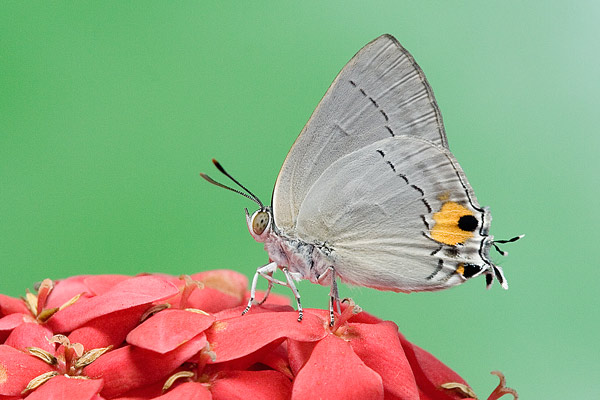
09 March 2008

Life History of the Chestnut Angle

Life History of the Chestnut Angle (Odontoptilum angulatum angulatum)


Butterfly Biodata:
Genus: Odontoptilum de Niceville, 1890
Species: angulatum C. Felder, 1862
Subspecies: angulatum C.Felder, 1862
Wingspan of Adult Butterfly: 40mm
Caterpillar Host Plants: Commersonia bartramia, Talipariti tiliaceum (Sea Hibiscus)

Physical Description of Adult Butterfly:
The forewing termen is sinuous, and the hindwing prominently stepped at vein 7. The upperside is chestnut-brown with a complex, cryptic pattern, and has a crescentic hyaline spot in space 2, and a smaller spot above it near the base of space 3. Hindwing has elongated tornal cilia. The male possesses a tuft of white hairs on the fore coxae, and the female has a thick anal tuft on the abdomen.


Field Observations of Butterfly Behaviour: This species is rather rare in Singapore. The adults are usually found near its larval food plants, or when feeding along a muddy track or on bird droppings. In Singapore, it may be found in an urban bushland where Commersonia bartramia grows, or about trees of Hibiscus tiliacus in coastal wetland. They frequently fly rapidly in bright sunshine in open spaces within forests or bushland, and visit flowers for nectar. Other sighting locations include various parts of the Central Catchment Area. Early Stages:

Host plant : Commersonia bartramia

The eggs are laid singly on the leaf upperside. Each egg is white and almost spherical with a flattened base and vertical ridges. The diameter is about 0.9mm. After an egg is laid, the mother butterfly rubs the tip of her abdomen over it. In so doing, pale brown abdominal hairs are glued to the chorion, effectively concealing the egg.


Egg covered in hairs (left), with hairs lost (right)


Mature egg (left), empty egg shell (right)
It takes 7 days for the collected egg to hatch. The young caterpillar eats just enough of the shell to emerge, and has a length of about 2mm. It has the typical cylindrical shape for skipper caterpillars, and there are short setae arising from regular rows of tubercles. The head is bilobed and hairy. The length of these fine "facial" hairs increases with instars.

1st instar caterpillar, length: 2.5mm

Soon after, the young caterpillar constructs its first leaf shelter by making short, curved cuts at the edge of the leaf and turns a small flap. It rests within the flap and ventures out to eat on nearby leaf surface.


The 1st leaf shelter for the 1st instar caterpillar
In later instars, the Chestnut Angle caterpillars make sinuous cuts which avoid the main veins so that the leaf flap remains green. They eat through the leaf at various points between leaf veins on this flap and this results in numerous holes appearing on the leaf shelter. It is interesting to note that Chestnut Angle caterpillars ballistically eject their individual faecal pellets (frass) at great speeds.

2nd instar caterpillar, early in this stage, length: 4mm

After 4 days in 1st instar and reaching a length of about 3.5mm, the caterpillar moults to the next instar. The 2nd instar (and in later instar) caterpillar has its body covered with short hairs arising from numerous low tubercles.


2nd instar caterpillar, late in this stage, length: 5mm

The 2nd instar caterpillar reaches a length of about 5.5mm, and after 6 days in this stage, it moults again. The 3rd instar takes 10 days to complete with the length reaching 12-13mm. During this period, the body color is initially yellow with a green undertone, but as the caterpillar develops, the color changes gradually to creamy white.


3rd instar caterpillar, early in this stage, length: 6mm

3rd instar caterpillar, late in this stage, length: 10mm

The 4th instar takes about 7 days to complete with body length reaching 19-20mm. The facial hairs are now visibly long and prominent.


4th instar caterpillar, early in this stage, length: 14mm


A leaf shelter for a 4th instar caterpillar in the field
The final and 5th instar cat has rather long and dense hairs on its head, giving it a very bushy appearance. This stage takes about 10 days to complete with body length reaching 30mm.

5th instar caterpillar, late in this stage, length: 27mm

At the end of 5th instar, the body of the caterpillar shrinks in length. Soon it becomes dormant in its leaf shelter and enters the preparatory pupa phase which lasts for one day.

Preparatory pupa of Chestnut Angle

Pupation takes place within the leaf shelter. The pupa secures itself with its cremaster attached to a short transverse band, and with vertcal and oblique threads connecting the transverse band and dorsal point of the girdle to the shelter wall. The pupa has a short thorax, a rather long abdomen, a short rostrum and low projections behind the prothoracic spiracles. There is also a pair of small but distinct orange projections on the anterior part of the mesothorax. Its body appearance is mostly white with a light green undertone, and against this background there are black spots arranged in neat symmetrical layout. Length of pupae: 17-19mm.

Fresh pupa of Chestnut Angle

After 7 days, the pupa becomes darkened in color signaling the imminent emergence of the adult. The next day the adult butterfly emerges from the mature pupa.


Mature pupa of Chestnut Angle


A newly eclosed Chestnut Angle


A newly eclosed Chestnut Angle resting on the inner side of a plastic container, showing its underside


References:
  • The Butterflies of the Malay Peninsula, A.S. Corbet and H.M. Pendlebury, 4th Edition, Malayan Nature Society.
  • The Butterflies of Hong Kong, M. Bascombe, G. Johnston, F. Bascombe, Princeton University Press 1999
Text and Photos by Horace Tan

06 March 2008

Voyage of the Tawny Coster

The Voyage of the Tawny Coster (Acraea terpsicore)


Some time back in 2006, a member of ButterflyCircle, Rey Aguila, photographed a mating pair of orange coloured butterflies which he thought were moths. Upon seeing the posted shot, we immediately knew that the Tawny Coster had finally completed its long voyage to Singapore, which started in India and Sri Lanka - a journey which probably took over three decades to complete.

ButterflyCircle members went to the open patch of wasteland to investigate where the pair was first sighted, and found to our pleasant surprise, a colony of the Tawny Costers at the site. Fluttering effortlessly in the breezy area were a good number of males and females of this new addition to the Singapore checklist. They had finally arrived in Singapore!


The Tawny Coster is known to be common in India and Sri Lanka, where it can be found both in forest clearings and open country. Though mainly seen at low elevations, it has been recorded at heights of up to 7,000 ft in South India and sometimes in the north.

Tracing the route of this new species for the region, we found documentary evidence of the appearance of this species in Thailand in the early 80's. How long it had taken to move over land from India and Sri Lanka past Bangladesh, Myanmar and finally to Thailand, is anybody's guess. But it was already a resident species in Thailand by the early 80's.

Sporadic sightings were recorded in South Thailand and the northern part of West Malaysia, and a confirmed record specimen was collected by Arshad at the edge of the Batu Pahat forest reserve in Perlis in 1992. Another sighting was made by Wong Tet Seng in early 1993 near Tanjung Rhu on Pulau Langkawi and subsequently on open land in Bukit Mertajam in the northern state of Penang in April 1993.

It was also recorded on Penang island in that year. Sightings of the species in the remaining years of the 90's were scattered and undocumented. It appeared in 2002 in Petaling Jaya, and was photographed by a butterfly enthusiast. A further sighting was recorded in 2003 in Negri Sembilan.


No further documented records of the sighting of the butterfly were found until 2006 when it appeared at an open wasteland in the north-eastern part of Singapore island. It spread across the island and has become a rather common species all over Singapore, including the offshore island of Pulau Ubin.

A further bonus sighting of the butterfly by veteran nature guide, Subaraj Rajathurai, was made on the Indonesian island of Batam, immediately after it was observed in Singapore.

The Tawny Coster (Acraea terpsicore)

The Tawny Coster belongs to the family Nymphalidae ; Subfamily Heliconiinae. The butterflies of this subfamily are characterised by a perfectly flat hindwing and by having the cells of both wings closed by tubular veins. Their behaviour is sluggish, and, like the Danainae, they have a leathery body and are tenacious of life. They frequently exhibit Mullerian mimicry and serve as models for Batesian mimics from other families. The subfamily is strongly represented in the Ethiopian region, less so in the Neotropical Region, and is weakly represented in the Oriental and Australiasian Regions.


The egg resembles that of Danaini being much higher than wide and bearing rather ill-defined vertical ribs. The eggs are laid in clusters and the gregarious larvae are cylindrical and bear branched spines, termed scoli, on each segment. The host plants are commonly species of Passifloraceae.

The female Tawny Coster typically oviposits a large clutch of eggs numbering anywhere from 20 to 50 eggs in one sitting. The eggs are carefully arranged on the undersides of a leaf of the host plant. In Singapore, the species has adapted itself to the host plant Passiflora foetida. This host plant, a common "weed" growing in wasteland and cleared open areas, is a fast-growing vine.

The relatively plentiful availability of the host plant could be one of the reasons for the rapid spread of the Tawny Coster across Singapore. Furthermore, as each clutch of eggs hatch, the large numbers of caterpillars would make the species more likely to succeed in colonising areas where the host plants are abundant. As the Tawny Coster is distasteful to predators like birds, this also gives it a better chance of survival.


The upperside of the Tawny Coster is a deep orange in the male and a lighter orange-yellow in the female. There is a transverse black spot in cell, and another irregular, oblique and broader at the disco-cellulars. The upper four spots of the discal series inclined obliquely outwards, the lower two obliquely inwards The hindwing possesses a basal series of four or five black spots with a similar spot beyond in middle of cell and a subcostal black spot above it, followed by a discal series of obscure blackish spots.


The underside ground-colour is ochraceous yellow or a paler tawny yellow. The forewing paling to whitish on the apex, with the black markings as on the upper side but somewhat blurred and diffuse. The hindwing has a series of white spots traversing the black terminal margin. Antennae black, head and thorax black spotted with ochraceous and white.

The Tawny Coster has a wingspan of 53-64 mm.


The caterpillars are cylindrical, slender, with six longitudinal rows of fine branched spines; colour reddish brown with an oily gloss, much paler on the head, second and last segment. The pupa is perpendicularly hung, long, slender, smooth; two lateral angles on the thorax; head quadrate; colour creamy white, with broad longitudinal bars of purplish-black spotted with orange.


The Journey South is Complete
How this tenacious butterfly is able to slowly but surely make its voyage down all the way to Singapore from its origins in India and Sri Lanka is one of the wonders of the natural world. Using its ability to feed on a variety of host plants in the families Passifloraceae and Loganiaceae and probably a number of others, it has leapfrogged over land and survived predators and other dangers to cover a distance of many thousand kilometres to end up in Singapore.

Having now also been seen in Batam, it will surely try to continue its journey to Bintan in the Riau Archipelago, and who knows whether it will appear in the main Indonesian islands one day in the not too distant future?

But for now, Singapore has a new resident species - and a pretty and colourful butterfly at that, and this new "foreign talent" is likely to stay with us and be a part of the diverse flora and fauna of our little island in the sun.


Text and Photos by Khew SK

References :

  1. Wikipedia : Acraea terpsicore
  2. Malayan Naturalist (Magazine of the Malaysian Nature Society) Vol 49 No 3 : 1996
  3. The Malayan Nature Journal Vol 59 Part 1 October 2006
Post Note : Various lepidopterists in India are still debating on the actual scientific name of the Tawny Coster, preferring the precedent name of Acraea terpsicore to the more recent name Acraea violae. The jury is still out on the final name. For the time being, we have kept to the more commonly used scientific name of Acraea violae based on the more popular global references of Lepidoptera.

Update 2015 : The scientific name of this species has been adopted as Acraea terpsicore by several authors henceforth, and updated accordingly.


01 March 2008

Life History of the White Royal

Life History of the White Royal (Pratapa deva relata)


Butterfly Biodata:
Genus : Pratapa Moore, 1881
Species : deva Moore, 1858
Subspecies : relata Distant, 1884
Wingspan of Adult Butterfly : 38mm
Caterpillar Host Plant : Scurrula ferruginea

Physical Description of Adult Butterfly:
The upperside is deep lustrous blue for the male and paler blue for the female, and both sexes have black borders on both wings with the one on the forewings being very broad at the apex. The underside for both sexes is greyish white with a post-discal series of narrow black streaks. The hindwing underside has a orange-crowned black tornal lobe and a black marginal spot in space 2 broadly crowned in orange. There are two pairs of white-tipped tails at the end of veins 1b and 2.

Field Observations of Butterfly Behaviour:
The adults are rarely observed in the field. In the few field sightings in Pulau Ubin and an urban bushland, the adults were mostly found near its host plant either as newly eclosed specimens or females on ovipositing visits. They fly with swift but short flights. Some adults have also been observed to be flying at tree-top level in sunny weather.

Scurrula ferruginea, a wide-angle view (left), close-up on young leaves (right)

The adult female lays eggs on the underside of a mature leaf. Freshly laid eggs are white with a light green tinge but this disappears within hours. Each egg is about 0.7mm in diameter, and has a reticulated pattern of ridges and pits on its surface. After three days of development within the egg shell, the caterpillar emerges by eating the top portion of the egg shell, and exits through the resultant hole.

Freshly laid egg (top), mature egg (bottom)

The newly hatched caterpillar is about 1mm long, light brown in color and has rather long dorsolateral hairs. Both young and old leaves of the host plant are covered with a tawny tomentum, and the newly hatched caterpillar has to push aside these fine and vertillate hairs before skimming the lamina from one side of the leaf. The feeding is observed to take place on both young and old leaves. On mature leaves, the caterpillar has a preference for the underside where the light brown surface offers a better camouflage. Up to the third instar, the feeding caterpillar resembles a ploughing machine in action, with a winding furrow in its wake, and piles of fine hairs pushed to the sides and ahead of it.

A newly hatched caterpillar leaving the site of its first meal.
One-day old 1st instar caterpillar

As it grows, a number of small and short reddish brown markings appears on its body. After four days of feeding and growing to a length of about 2mm, the caterpillar comes to rest for a period of about one day for the moult to the 2nd instar. In the new instar, the caterpillar assumes a more woodlouse shape with shorter dorsolateral hairs in proportion to its body size. There is a diamond-shaped prothoracic shield on the first thoracic segment and the dorsal nectary organ on the 7th segment. The neatly arranged reddish brown markings on its body has become very prominent.

2nd instar caterpillar of White Royal

After another four days of feeding in the same ploughing manner, the caterpillar reaches a length of 4.5mm, and it goes on to stay dormant for about one day for the moult to 3rd instar. The 3rd instar caterpillar loses most of the reddish brown markings from its body which now has a a light green undertone. The tentacular organs on the 8th body segment are also observable as they are everted from time to time. Feeding is still done by skimming the leaf surface, but on rare occasions, some 3rd instar caterpillars were also observed to eat from the edge of the leaf.
3rd instar caterpillar of White Royal
Feeding activity in 3rd instar lasts four days, with body length reaches 8.5mm-9mm. Another day is spent for moulting to the 4th and final instar. The final instar caterpillar has become more stout with a raised dorsal ridge marked with a whitish undertone. It exclusively eats from the edge of the leaf. As it feeds, the caterpillar wraps its sub-spiracular part of its first few body segments around the leaf edge.
A newly moulted 4th instar caterpillar eating its excuviae
A 4th instar caterpillar eating at the leaf edge
The 4th instar caterpillar spends five days feeding, reaching a length of 12-13mm before entering the prep-pupal stage. The caterpillar moves to a branch of the host plant, and comes to rest in a head-up position. After about half a day in its position, the prep-pupa turns around to assume a head-down position. Pupation finally takes places after another half-day. Total number of days of larval growth inclusive of pre-pupuation is 21.
Pre-pupation stage in left and middle panels showing the reversal of head position. The resultant pupa is shown in the right panel.
The pupa is held firmly by the tail in a head down position. It has a white base color with bold dark band on its upper half and dark yellowish diffuse patches along the dorsal line. When disturbed, the pupa could jerk up and down at a fast pace.
Two views of a fresh pupa
After 7 days, the pupa case becomes transparent and features such as the forewing upperside, eyes and antennae of the adult are visible. The next day, eclosion takes place in the mid-morning from 7am to 10am. The emerged adult stays on the split pupal case to expand and dry its wings before moving on to begin another cycle of this species. From egg to eclosion, the cycle length recorded is about 32 days.
A mature pupa with the forewing upperside visible.
Part 1 of 2 of an eclosion sequence (left to right order).
Part 2 of 2 of an eclosion sequence (left to right order).
A newly emerged White Royal.
Another newly emerged White Royal.
Text and Photos by Horace Tan

24 February 2008

Life History of the Baron

Life History of The Baron (Euthalia aconthea gurda)

A male Baron basks in the early morning sunshine

A female Baron foraging on damp ground on rotting fruit

Butterfly Biodata :
Genus : Euthalia Hubner, 1819
Species : aconthea Fruhstorfer, 1906
Subspecies : gurda Fruhstorfer, 1906
Wingspan of Adult Butterfly : 70mm
Caterpillar Host Plant : Mangifera indica

Physical Description of Adult Butterfly : The wings are dark brown above with a broad but obscure post-discal band on both wings. A few small white spots define the inner edge of this band. The spots are larger and most distinct in the female than the male. The underside is a paler brown than the upperside. The proboscis of this species is a bright yellow-green.

Field Observations of Butterfly Behaviour : The Baron is relatively common and is often seen in urban parks and gardens. The species is also observed in residential estates where its preferred host plant, the Mango, is cultivated. As the Mango tree is a favourite fruit tree found in many gardens, the Baron is often attracted to these urban areas. It is a flighty butterfly, and a strong flyer, alert and difficult to photograph. Both males and females can sometimes be found feeding on overripe fruits.


Host plant of the Baron - Mangifera indica

Early Stages : The eggs are laid singly, usually on the undersides of the broad leaves of the host plant. The appearance of the egg is very similar to its related species in the genera of Tanaecia and Lexias, being dome-like in shape, about 2mm in diameter, and covered with hexagonal segments from which whitish hair-like protuberances emerge.


"Spiky" green egg of the Baron

After about 3-4 days, the 1st instar caterpillar emerges, eating the eggshell as its first meal. The caterpillar is yellow in colour, and sports white-edged black spines from its body. It grows to about 4mm long, before moulting into its 2nd instar.


1st instar caterpillar of the Baron

The 2nd instar caterpillar has complex branched spines and is predominantly green, with a light yellow dorsal stripe, edged with purple-brown spots, corresponding with the base of the spines.


2nd instar caterpillar of the Baron with its branched spines

The 3rd instar caterpillar is similar in appearance to the 2nd instar, but the spines have grown much longer. It feeds on the younger leaves of its host plant, and reaches about 16mm before moulting again.


3rd instar caterpillar

The 4th instar caterpillar reaches a length of about 22mm and its branched spines make it appear to be much larger than it actually is. When resting on the mid-rib of its host plant, the branched spines give the caterpillar some measure of camouflage from predators.


4th instar caterpillar reaching a length of 22 mm

The 5th instar caterpillar is medium green, and the yellowish-white dorsal stripe loses the earlier purple-brown spots along the edge of the stripe. The branched spines appear almost like a bird's feather, with the secondary spines arranged neatly perpendicular to the main spine. It reaches a mature length of about 45mm before shortening and adopting its pre-pupation pose.


Final instar caterpillar with its prominent yellowish-white dorsal stripe

Pupation takes place on the underside of a leaf of the host plant, with the cremaster firmly attached to the mid-rib of the leaf. The light green pupa has a series of brownish spots arranged symmetrically. The pupa of the Baron appears very similar to the related species in the genus, and also the related Tanaecia and Lexias species.


Two views of the Baron's pupa

The adult butterfly ecloses in the early morning hours and stays for about an hour as it dries its wings, before taking off to feed, find a mate and continue the circle of life and propagation of the next generation.

Newly eclosed female Baron showing the undersides of its wings

Newly eclosed female Baron showing the uppersides of its wings

Text by Khew SK ; Photos by Goh LC and Khew SK