
Butterfly Biodata:
Genus : Rapala Moore, 1881
Species : suffusa Moore, 1879
Subspecies : barthema Distant, 1885
Wingspan of Adult Butterfly: 15-19 mm
Caterpillar Local Host Plant: Bridelia tomentosa (Phyllanthaceae, common name: Pop-gun Seed, 土蜜树).


Physical Description of Adult Butterfly:
On the upperside, the female is entirely brown whereas the male is orange-red with broad dark brownish borders which are purple-shot in a side light on the forewing, while the hindwing is largely unmarked. As with other Rapala spp., the male has an oval-shaped brand in space 7 on the hindwing. On the underside, both sexes are ochreous to pale buff brown. The markings are typical for Rapala spp, with cell-end bars on both wings, and brown postdiscal lines edged with white on the side nearer to the termen. The hindwing carries a white-tipped tail at the end of vein 2 with a tornal lobe between veins 1a and 1b. In addition, there is a black tornal spot, a bluish green patch in space 1b, a round black sub-marginal spot in space 2, and black post-discal striae in spaces 1b and 2.
 A comparison of the hindwing underside of Scarlet Flash, Suffused Flash and Malay Red Flash.
Of the four members of the R. suffusa group, three species, namely, R. dieneces (Scarlet Flash), R. suffusa (Suffused Flash) and R. damona (Malay Red Flash), are often challenging to differentiate due to their similar colorations and markings. One way to tell them apart is to examine the underside hindwing for the following two features (as provided by Dr Seow TL).
In space 1b (marked in pink oval in the picture above)
In space 2 (marked in blue oval in the picture above)
 A female Suffused Flash.
 A male Suffused Flash.
Field Observations:
The Suffused Flash is moderately rare in Singapore. Sightings of this species have mostly been confined to a few locations within the catchment nature reserve and the landward edge of mangrove swamps. The fast-flying adults have been sighted taking nectar at flowering plants and perching on leaves to sunbathe occasionally.
 A female Suffused Flash.
 Another female Suffused Flash.
Early Stages:
In Singapore, thus far only one larval host plant has been identified. This local larval host is Bridelia tomentosa, a plant typically found along forest edges and popular as a larval host plant and nectary plant for a number of butterfly species. On this plant, caterpillars of the Suffused Flash feed mainly on flower buds and flowers, as well as developing young fruits.
 Local host plant: Bridelia tomentosa.
Eggs are laid singly on a part of a flower or flower bud of the host plant. Each egg is about 0.6mm in diameter, greenish in colour when freshly laid. It is bun-shaped with a depressed micropylar at the pole and a surface reticulated with very fine ridges.
 Two views of a fresh egg of the Suffused Flash.
 Two views of a two-day old egg of the Suffused Flash.
 Two views of a fully developed egg of the Suffused Flash with the caterpillar ready to emerge.
It takes about 3 days for the egg to hatch. The young caterpillar consumes just enough of the egg shell to emerge. It is pale yellowish brown in base colour, and has a length of about 1mm. Long setae (hairs) run along the length of the body dorsally as well as sub-spiracularly. A dark brown prothoracic shield is present, and the dorsum of the metathorax and the posterior segments from the 6th are brown to dark brown in colour. Pairs of dorsal tubercles are featured from the thorax to the 5th abdominal segments, and they turn whitish as growth progresses. The 1st instar lasts about 2-2.5 days with the body length increased to about 2.1mm.
 A newly hatched caterpillar of the Suffused Flash next to its empty egg shell, length: 1mm.
 Two views of a newly hatched caterpillar of the Suffused Flash, length: 1mm.
 A 1st instar caterpillar of the Suffused Flash feeding on flower parts of Bridelia tomentosa.
 Two views of a 1st instar caterpillar, late in this instar, length: 2mm.
In the 2nd instar caterpillar, the dorsal tubercles are larger and the long dorsal setae seen in the 1st instar are now absent. Instead, proportionately shorter dark setae occur in greater numbers on the body surface. Similar tubercles also appear subspiracularly on body segments from mesothorax to the 8th abdominal segment. The caterpillar still features a dark brown prothoracic shield and a dark brown head capsule. The metathorax is reddish brown and the posterior abdominal segments from the 6th are dark brown. The 2nd instar lasts about 2-2.5 days, with the body length reaching up to 5mm.
 Two views of an early 2nd instar caterpillar of the Suffused Flash, length: 2.8mm.
 Two views of 2nd instar caterpillar of the Suffused Flash, late in this stage, length:5mm.
 Two views of a 2nd instar caterpillar of the Suffused Flash, dormant prior to its moult.
In the 3rd instar, the caterpillar bears strong resemblance to the 2nd instar caterpillar but with body base colour turning more greenish, and the dorsal and subspiracular tubercles more yellowish. The dorsal nectary organ on the 7th abdominal segment and the tentacular organs on the 8th abdominal segment are now easily discernible. The 3rd instar lasts about 3 days, with the body length reaching up to 10mm.
 Two views of a newly moulted 3rd instar caterpillar of the Suffused Flash, eating its old skin.
 Two views of an early 3rd instar caterpillar of the Suffused Flash, feeding on flower buds of Bridelia tomentosa, length: 6mm.
 Two views of a 3rd instar caterpillar of the Suffused Flash eating flower buds of Bridelia tomentosa, length: 9mm.
 Two views of a 3rd instar caterpillar of the Suffused Flash, length: 10mm.
 Two views of a late 3rd instar caterpillar of Suffused Flash, dormant prior to its moult to the final instar.
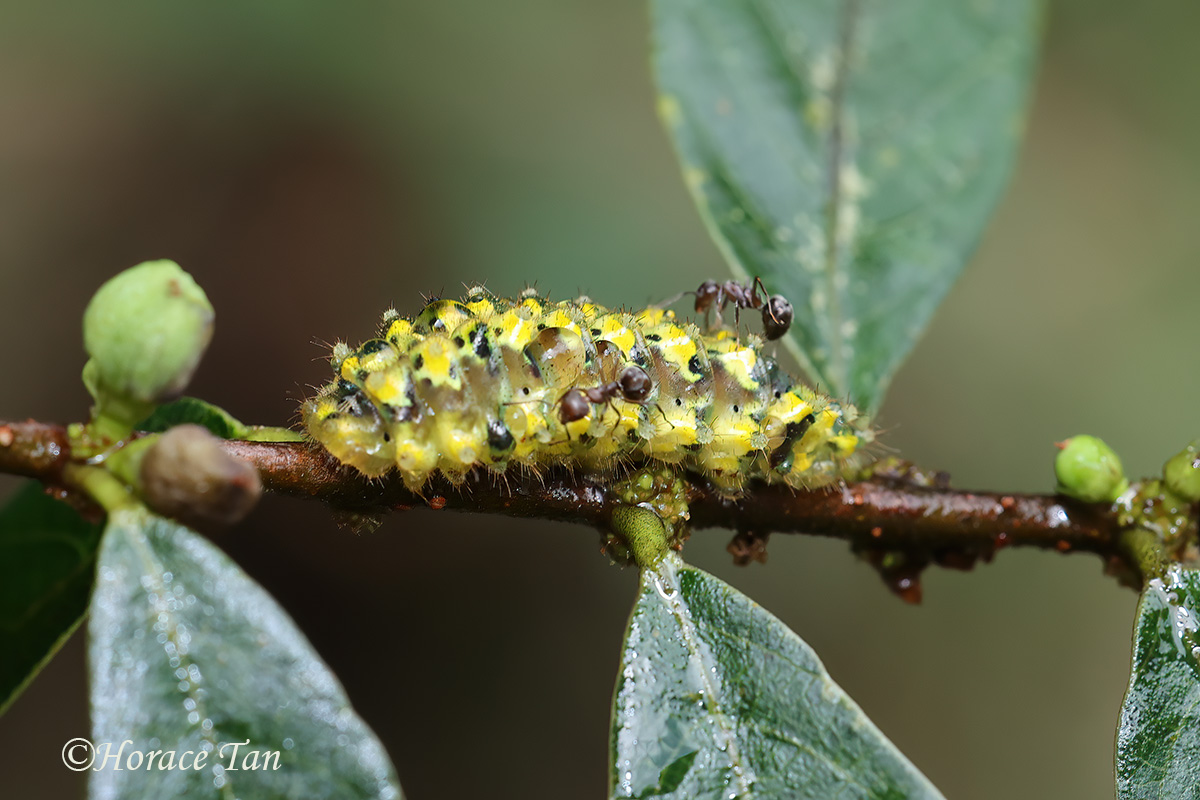
The 4th instar caterpillar resembles the 3rd instar caterpillar in most body features/markings but with several changes. The body base colour now varies from dull green to brownish green and the dorsal/subspiracular tubercles varies from pale yellow to lemon yellow. Small dark spots appear in the dorsal/subspiracular tubercles. In addition, spiracles are now prominently black in colour, and the prothoracic shield is whitish with dark brown fringes. The 4th (and final) instar lasts about 4 days with the body length reaching up to 21-22mm.
 Two views of a newly moulted 4th instar caterpillar of the Suffused Flash, eating its old skin.
 Frontal view of a 4th instar caterpillar of the Suffused Flash, showing the prothoracic shield and black spiracles.
 Two views of a 4th instar caterpillar of the Suffused Flash, length: 11.5mm.
 A final instar caterpillar of the Suffused Flash with ants in attendance.
 Two views of a 4th instar caterpillar of the Suffused Flash, length: 17mm.
 A 4th instar caterpillar of the Suffused Flash feeding on a young fruit of Bridelia tomentosa.
 Two views of a 4th instar caterpillar of the Suffused Flash, length: 20mm.
As it enters the pre-pupatory phase of its life cycle, the caterpillar ceases its feeding activity. Its body gradually shrinks in length and the base colour turns dark brownish. The pre-pupatory caterpillar wanders around for a suitable pupation site. Typically it settles for a spot on a surface which is partially concealed. At the chosen pupation site, it stays dormant for about 0.5 day or so before spinning a silk girdle and a silk pad to which it attaches itself via claspers at the posterior end.
 Two views of a late 4th instar caterpillar of the Suffused Flash.
 Two views of a pre-pupa of the Suffused Flash.
About 1 day after the pre-pupatory caterpillar secures itself to the pupation spot, pupation takes place. The pupa is held firmly to the pupation spot with the silk girdle and cremastral attachment to the silk pad. It is 11.5 to 12.5mm in length, with the typical shape for a lycaenid pupa. It is yellowish brown with dark brown speckles and patches dotting the pupal surface.
 Two views of a pupa of the Suffused Flash.
 Two views of a mature pupa of the Suffused Flash.
Seven days later, the pupa becomes darkened in color signaling the imminent emergence of the adult. The next day the adult butterfly emerges from the mature pupa.
On the upperside, the female is entirely brown whereas the male is orange-red with broad dark brownish borders which are purple-shot in a side light on the forewing, while the hindwing is largely unmarked. As with other Rapala spp., the male has an oval-shaped brand in space 7 on the hindwing. On the underside, both sexes are ochreous to pale buff brown. The markings are typical for Rapala spp, with cell-end bars on both wings, and brown postdiscal lines edged with white on the side nearer to the termen. The hindwing carries a white-tipped tail at the end of vein 2 with a tornal lobe between veins 1a and 1b. In addition, there is a black tornal spot, a bluish green patch in space 1b, a round black sub-marginal spot in space 2, and black post-discal striae in spaces 1b and 2.

Of the four members of the R. suffusa group, three species, namely, R. dieneces (Scarlet Flash), R. suffusa (Suffused Flash) and R. damona (Malay Red Flash), are often challenging to differentiate due to their similar colorations and markings. One way to tell them apart is to examine the underside hindwing for the following two features (as provided by Dr Seow TL).
In space 1b (marked in pink oval in the picture above)
- R. dieneces (Scarlet Flash), speckled patch occupies about 50% to 60% of space.
- R. suffusa (Suffused Flash), speckled patch occupies about 50% or less of space.
- R. damona (Malay Red Flash), speckled patch occupies about 80% to 100% of space.
In space 2 (marked in blue oval in the picture above)
- R. dieneces (Scarlet Flash), black spot has an orange crown.
- R. suffusa (Suffused Flash), black spot does not have an orange crown or yellow and merged with ground colour.
- R. damona (Malay Red Flash), black spot has a crown which is orange or yellow and obscure.


Field Observations:
The Suffused Flash is moderately rare in Singapore. Sightings of this species have mostly been confined to a few locations within the catchment nature reserve and the landward edge of mangrove swamps. The fast-flying adults have been sighted taking nectar at flowering plants and perching on leaves to sunbathe occasionally.


Early Stages:
In Singapore, thus far only one larval host plant has been identified. This local larval host is Bridelia tomentosa, a plant typically found along forest edges and popular as a larval host plant and nectary plant for a number of butterfly species. On this plant, caterpillars of the Suffused Flash feed mainly on flower buds and flowers, as well as developing young fruits.

Eggs are laid singly on a part of a flower or flower bud of the host plant. Each egg is about 0.6mm in diameter, greenish in colour when freshly laid. It is bun-shaped with a depressed micropylar at the pole and a surface reticulated with very fine ridges.


It takes about 3 days for the egg to hatch. The young caterpillar consumes just enough of the egg shell to emerge. It is pale yellowish brown in base colour, and has a length of about 1mm. Long setae (hairs) run along the length of the body dorsally as well as sub-spiracularly. A dark brown prothoracic shield is present, and the dorsum of the metathorax and the posterior segments from the 6th are brown to dark brown in colour. Pairs of dorsal tubercles are featured from the thorax to the 5th abdominal segments, and they turn whitish as growth progresses. The 1st instar lasts about 2-2.5 days with the body length increased to about 2.1mm.


In the 2nd instar caterpillar, the dorsal tubercles are larger and the long dorsal setae seen in the 1st instar are now absent. Instead, proportionately shorter dark setae occur in greater numbers on the body surface. Similar tubercles also appear subspiracularly on body segments from mesothorax to the 8th abdominal segment. The caterpillar still features a dark brown prothoracic shield and a dark brown head capsule. The metathorax is reddish brown and the posterior abdominal segments from the 6th are dark brown. The 2nd instar lasts about 2-2.5 days, with the body length reaching up to 5mm.


In the 3rd instar, the caterpillar bears strong resemblance to the 2nd instar caterpillar but with body base colour turning more greenish, and the dorsal and subspiracular tubercles more yellowish. The dorsal nectary organ on the 7th abdominal segment and the tentacular organs on the 8th abdominal segment are now easily discernible. The 3rd instar lasts about 3 days, with the body length reaching up to 10mm.


The 4th instar caterpillar resembles the 3rd instar caterpillar in most body features/markings but with several changes. The body base colour now varies from dull green to brownish green and the dorsal/subspiracular tubercles varies from pale yellow to lemon yellow. Small dark spots appear in the dorsal/subspiracular tubercles. In addition, spiracles are now prominently black in colour, and the prothoracic shield is whitish with dark brown fringes. The 4th (and final) instar lasts about 4 days with the body length reaching up to 21-22mm.




As it enters the pre-pupatory phase of its life cycle, the caterpillar ceases its feeding activity. Its body gradually shrinks in length and the base colour turns dark brownish. The pre-pupatory caterpillar wanders around for a suitable pupation site. Typically it settles for a spot on a surface which is partially concealed. At the chosen pupation site, it stays dormant for about 0.5 day or so before spinning a silk girdle and a silk pad to which it attaches itself via claspers at the posterior end.


About 1 day after the pre-pupatory caterpillar secures itself to the pupation spot, pupation takes place. The pupa is held firmly to the pupation spot with the silk girdle and cremastral attachment to the silk pad. It is 11.5 to 12.5mm in length, with the typical shape for a lycaenid pupa. It is yellowish brown with dark brown speckles and patches dotting the pupal surface.


Seven days later, the pupa becomes darkened in color signaling the imminent emergence of the adult. The next day the adult butterfly emerges from the mature pupa.

References:
- [C&P5] The Butterflies of The Malay Peninsula, A.S. Corbet and H.M. Pendlebury, G. and N. van der Poorten (Eds.), 5th Edition, Malayan Nature Society, 2020.
- Butterflies of Thailand, Pisuth Ek-Amnuay, 2nd Edition, 2012.
- A Field Guide to the Butterflies of Singapore, Khew S.K., Ink On Paper Communications, 2nd Edition, 2015.
I would like to express my gratitude to Mr Foo Jit-Leang for sharing information on early stages of the Suffused Flash.
Text by Horace Tan, Photos by Koh Cher Hern, Khew SK, Jonathan Soong, Ellen Tan and Horace Tan.


